

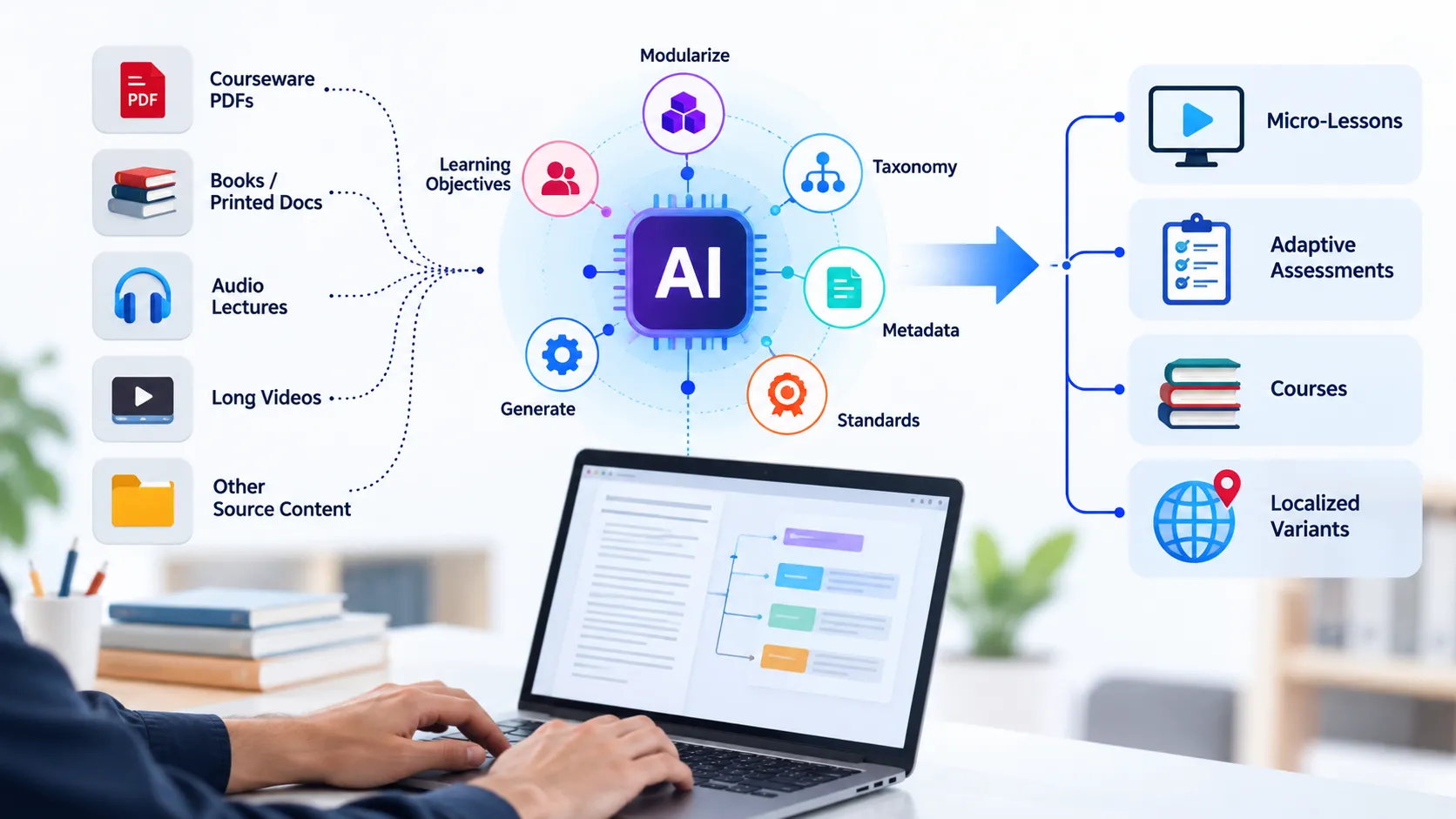
Educational publishers often have years of valuable material stored across textbooks, lesson plans, PDFs, presentations, assessments, videos, and digital files. The challenge is no longer simply preserving this material. It is finding practical ways to make it usable across multiple learning experiences. Content Transformation can help publishers restructure existing learning libraries into flexible, reusable assets that can support new formats, audiences, and digital products without requiring every resource to be created from scratch.
Why Learning Libraries Need to Become More Flexible
A large content library can represent a significant investment in subject matter expertise, instructional design, research, and editorial development. However, content created for a specific format may become difficult to reuse when learner expectations, curriculum requirements, or delivery platforms change.
Publishers may encounter challenges such as:
- Content locked in static formats: Valuable information may exist primarily in textbooks, PDFs, presentations, or fixed courseware.
- Limited content reuse: A lesson designed for one product may not easily transfer to another learning experience.
- Inconsistent structures: Different content collections may use different templates, taxonomies, metadata, and organizational methods.
- Manual adaptation: Editors and instructional teams may spend significant time recreating existing material for new formats.
- Difficulty managing large libraries: As content collections grow, identifying, updating, and repurposing individual assets becomes increasingly complex.
- Changing delivery requirements: The same educational material may need to support web, mobile, interactive, assessment, or personalized learning environments.
The underlying problem is not a lack of content. In many cases, publishers already have substantial intellectual property. The challenge is making that content easier to discover, adapt, combine, and deliver.
Moving From Content Collections to Reusable Assets
A reusable content strategy starts by looking at learning materials as a collection of smaller, connected components rather than as individual finished documents.
For example, a chapter may contain several concepts, explanations, examples, activities, images, definitions, and assessment opportunities. Instead of treating the chapter as one fixed unit, publishers can organize these elements into structured assets that can be reused in different contexts.
This approach can make it possible to:
- Break large resources into smaller learning components.
- Associate content with topics, subjects, levels, and learning objectives.
- Reuse explanations and examples across different products.
- Connect assessment items with relevant concepts.
- Update individual components without rebuilding an entire resource.
- Assemble different combinations of assets for specific audiences.
The result is a content library that behaves more like a flexible system than a collection of disconnected files.
How Structured Content Improves Reusability
Structure plays an important role in making educational content reusable. When learning assets have clearly defined relationships and metadata, teams can more easily understand what each asset contains and where it can be used.
For example, a structured learning component could include information about its subject, grade level, learning objective, content type, difficulty, prerequisites, and related assessment items.
This information can help publishers identify suitable assets for new courses or learning experiences.
It can also reduce unnecessary duplication. Instead of creating a new explanation every time a topic appears in a different product, teams can identify an existing component and adapt it where appropriate.
Using Technology to Scale Content Reuse
Manually restructuring thousands of learning assets can be difficult. Technology can support publishers by accelerating repetitive activities such as classification, tagging, extraction, formatting, and content organization.
AI can be particularly useful when combined with editorial review and defined quality standards. It can assist with identifying concepts within large content collections, suggesting metadata, organizing related material, and creating initial versions of derivative learning assets.
However, automation should not replace educational expertise. Subject matter experts, editors, and instructional designers still play an important role in checking accuracy, context, pedagogy, and quality.
A scalable workflow therefore combines automation with human oversight rather than treating AI as a completely independent content-production system.
Connecting Reusable Assets to Digital Experiences
Once learning content is structured and reusable, publishers can use it as the foundation for broader digital experiences. A Digital Learning Solution can connect content with assessments, interactive activities, learner pathways, analytics, and other digital components.
For example, a publisher could use the same underlying learning assets to create a lesson for an online course, assessment questions for a testing environment, supplementary resources for instructors, or shorter learning components for mobile delivery.
This approach allows the underlying content to remain consistent while the presentation and experience can change based on the product or learner requirement.
Supporting Personalization at Scale
Reusable content can also support more flexible learning pathways.
Different learners may require different explanations, levels of difficulty, practice activities, or supporting resources. When content is organized into identifiable components, learning platforms can potentially select and combine appropriate assets based on defined learning requirements.
For publishers, this creates opportunities to develop more adaptable products without maintaining entirely separate content collections for every learner group.
Instead, a common content foundation can support multiple experiences while allowing specific components to be selected, updated, or rearranged as needed.
Improving Content Governance
Reusability also creates a need for stronger governance.
When the same learning asset appears across multiple products, publishers need to know where that asset is being used and which version is current. Without proper governance, updating one component can become difficult because teams may not know which products depend on it.
A structured content environment can help organizations establish clearer processes for:
- Version management
- Content ownership
- Metadata standards
- Quality review
- Accessibility requirements
- Content approval
- Usage tracking
- Retirement of outdated assets
These practices become increasingly important as publishers expand their digital portfolios.
Building More Value From Existing Intellectual Property
Turning a learning library into reusable assets does not mean discarding existing content. In many cases, the objective is to extract more value from material that publishers have already developed.
A well-organized content library can provide a foundation for creating new products, updating existing resources, supporting different audiences, and responding to changes in curriculum or delivery technology.
This can also change how publishers approach content development. Instead of asking, "What new content do we need to create?" teams can first ask, "What useful assets already exist, and how can we reuse them?"
That shift can encourage greater efficiency while preserving the expertise and educational value contained within the original materials.
The Future of Reusable Learning Content
Educational publishing is moving toward content ecosystems where individual learning assets can support multiple products and experiences. Publishers that organize their libraries around reusable, structured components can create greater flexibility without continually rebuilding their content from the ground up.
The most effective approach combines structured content, intelligent technology, strong governance, instructional expertise, and human quality control. With the right framework, existing learning libraries can become adaptable foundations for new digital products, learning experiences, and delivery models.
As publishers continue investing in digital education, Custom Content Solutions can help organizations adapt their existing intellectual property to specific learning, technology, and business requirements while creating a more scalable foundation for future content development.























Sign in to leave a comment.