

Coloured capsicum has become an important ingredient for restaurants, hotels, cafés, catering companies, supermarkets, and food distributors. Its vibrant appearance, crisp texture, and versatility make it suitable for pizzas, salads, pasta, sandwiches, stir-fries, and many other dishes.
For commercial buyers, however, purchasing coloured capsicum involves more than finding vegetables at an attractive price. Businesses need to consider product quality, availability, order quantities, delivery arrangements, storage, and the consistency of future supplies.
A restaurant serving customers every day may need a regular supply of red, yellow, and green capsicum. A supermarket may prioritize attractive produce for retail displays, while a wholesaler may require larger volumes that meet specific grading requirements.
Choosing the right sourcing strategy can help businesses organize procurement, manage inventory, and maintain consistent product standards.
Nature Harvest Farms, based in Anand district, Gujarat, uses modern farming practices and Controlled Environment Agriculture (CEA) to produce vegetables for commercial markets. Its focus on quality-conscious cultivation and B2B supply makes it relevant for businesses looking for a coloured capsicum supplier in Gujarat.
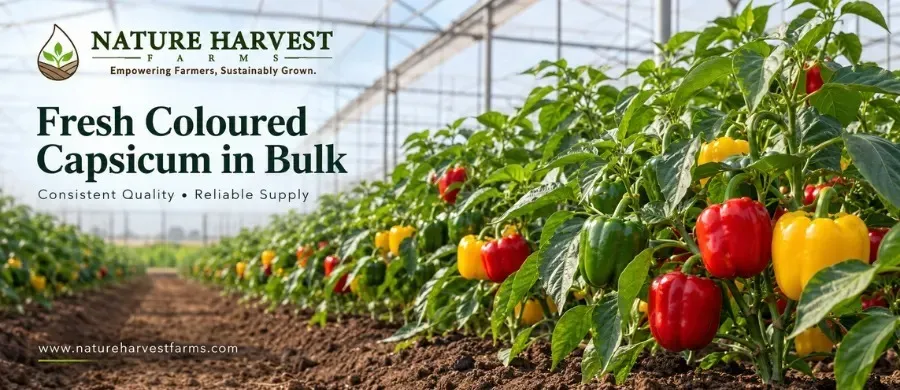
What Is the Best Way to Source Coloured Capsicum in Gujarat?
The best way to source coloured capsicum in Gujarat is to identify a suitable farm or commercial supplier, define your quality and quantity requirements, confirm current availability, and establish clear arrangements for delivery and repeat orders.
Commercial buyers should follow these steps:
- Identify the required capsicum colours and approximate quantity.
- Define the size, appearance, and quality specifications.
- Shortlist farms and suppliers that serve commercial customers.
- Confirm current harvest availability and expected supply frequency.
- Discuss packaging, transport, delivery location, and pricing.
- Evaluate the produce before committing to recurring orders.
- Review quality and delivery performance over time.
A structured procurement process helps restaurants, wholesalers, and retailers make informed purchasing decisions rather than relying entirely on last-minute availability.
1. Understand Which Type of Capsicum Your Business Needs
Before contacting a supplier, determine the type of capsicum required for your business. Different commercial applications may have different preferences for colour, size, shape, firmness, and appearance.
Red capsicum
Red capsicum is widely used in salads, grilled vegetable dishes, pizzas, pasta, sandwiches, and premium food presentations.
Its bright colour can help improve the visual appeal of prepared dishes and fresh-produce displays.
Yellow capsicum
Yellow capsicum offers a contrasting colour that works well in mixed salads, stir-fries, restaurant dishes, and retail displays.
Restaurants and caterers may purchase yellow capsicum alongside red and green varieties to create colourful presentations.
Green capsicum
Green capsicum is commonly used in Indian, Indo-Chinese, and international cuisines. It is a familiar ingredient in curries, vegetable preparations, pizzas, sandwiches, and many commercial kitchen recipes.
Mixed coloured capsicum
Businesses that prepare salads, continental dishes, pizzas, and mixed vegetable products may prefer a combination of red, yellow, and green capsicum.
Before placing an order, specify whether you need individual colours or a mixed assortment. Also confirm which colours are available from the supplier's current crop and harvest schedule.
2. Match Your Capsicum Requirements to Your Business Type
Every commercial buyer has different procurement priorities. Understanding these differences helps businesses request suitable products and avoid unnecessary purchases.
Restaurants and cafés
Restaurants generally need ingredients that support consistent preparation and presentation. Capsicum may be used in pizzas, pasta, salads, sandwiches, wraps, grilled dishes, and stir-fries.
Important considerations include freshness, firmness, usable quantity, and consistency between deliveries.
For restaurants with standardized recipes, purchasing capsicum with relatively consistent specifications can make preparation easier.
Hotels and resorts
Hotels may require capsicum for restaurant kitchens, buffet service, banquets, events, and room-service menus.
Their requirements can change depending on occupancy, reservations, events, and seasonal demand.
A planned purchasing arrangement helps the procurement team communicate upcoming requirements to its supplier.
Catering companies
Caterers often purchase vegetables according to the number of guests and the planned menu.
For weddings, corporate functions, and other large events, confirming quantities and delivery arrangements in advance can help reduce last-minute sourcing problems.
Supermarkets and vegetable retailers
Retailers generally need produce with an attractive appearance, good firmness, and suitable shelf performance.
Colour consistency and careful handling are particularly important because customers often evaluate fresh vegetables visually before purchasing them.
Wholesalers and distributors
Vegetable wholesalers need to consider the quantity they can distribute, the specifications requested by their customers, and the condition of produce during onward transportation.
They may also need to coordinate orders for multiple buyers with different preferences.
Food processors and institutional kitchens
Food processors may require capsicum for prepared meals, sauces, vegetable mixes, and other products. Institutional kitchens may need predictable quantities for recurring meal preparation.
For these businesses, supply planning and clearly defined product specifications can be especially useful.
Nature Harvest Farms works with B2B customer categories that include HoReCa businesses, wholesalers, institutional kitchens, and food processors. Actual capsicum availability and order fulfilment should be confirmed directly with the farm.
3. Plan Your Purchase Quantity Before Placing an Order
Buying too little can lead to repeated purchasing and additional transport coordination. Buying too much can create excess inventory, deterioration, and avoidable waste.
Commercial buyers should estimate their requirements before requesting a quote.
A simple method is to calculate expected daily or weekly usage and adjust it according to the business's actual purchasing cycle.
For example, a restaurant could estimate how much capsicum it uses in each recipe, review the number of portions typically prepared, and calculate its expected weekly requirement.
A wholesaler may instead calculate demand from customer orders and recent sales.
Questions to consider when estimating quantities
- How much capsicum does the business use each day?
- Which colours are required?
- Are demand levels different on weekends?
- Are upcoming events likely to increase consumption?
- How frequently can the supplier deliver?
- How much produce can be stored appropriately?
- What quantity is practical to purchase at one time?
These calculations help establish a realistic order size.
Avoid assuming that a supplier can always provide the same quantity on demand. Agricultural production depends on crop stage, harvest volumes, existing commitments, and the required product specifications.
4. Create a Reliable Procurement Schedule
Businesses that use capsicum regularly can benefit from a planned purchasing schedule.
Instead of contacting suppliers only when inventory is nearly depleted, procurement teams can estimate demand and communicate their requirements in advance.
A practical schedule should account for:
- Expected weekly consumption.
- Current inventory.
- Upcoming events and large orders.
- Supplier availability.
- Delivery frequency.
- Storage capacity.
- Potential changes in demand.
For example, a café may use a recurring weekly order, while a catering company may need to increase its order before a major event.
The schedule should remain flexible enough to accommodate changes in demand and agricultural availability.
When discussing recurring orders with Nature Harvest Farms, buyers can share their expected weekly or monthly volume, preferred colours, and delivery location. This information helps the supplier assess whether the requirements can be supported by available harvest volumes.
5. Evaluate Freshness and Quality Before Regular Purchasing
A successful procurement strategy needs clear quality expectations.
Capsicum intended for commercial use should be evaluated for characteristics relevant to its final application.
Fresh appearance
Look for produce with a clean, fresh appearance and appropriate colour development.
Firm texture
Firm capsicum is generally easier to handle and prepare than soft or deteriorating fruit.
Physical condition
Inspect the produce for cuts, bruising, excessive shrivelling, and other visible damage.
Size and shape
The required size depends on the application. Restaurants may prefer consistency for slicing, while retailers may focus on appearance and wholesalers may prioritize specifications requested by their customers.
Colour
Confirm that the supplied colours match the order. Businesses requiring red and yellow capsicum should communicate this clearly rather than assuming a mixed shipment will contain the desired proportions.
Batch consistency
Evaluate quality across multiple deliveries, not just one sample. Consistent specifications can help businesses maintain their own product standards.
A written quality checklist can make communication easier between the buyer and supplier.
6. Understand How Modern Farming Supports Commercial Supply
Capsicum production requires appropriate management of temperature, irrigation, nutrition, humidity, and plant health. These factors can influence fruit development, firmness, colour, and marketable quality.
Controlled Environment Agriculture helps growers manage important growing conditions more closely than conventional open-field cultivation.
Nature Harvest Farms uses a CEA approach that can include hydroponic systems and controlled soil-based cultivation, depending on the crop and production requirements.
For commercial buyers, the important questions are how the crop is grown, what quality standards are followed, and whether the supplier can provide the required product specifications.
Potential benefits of controlled cultivation
Closer environmental management: Growing conditions can be monitored and managed more carefully.
Crop-quality management: Appropriate crop management can help support more consistent fruit development.
Resource efficiency: Controlled cultivation can support more efficient management of water and other growing resources.
Production planning: Monitoring crop development helps growers plan expected harvests and communicate availability.
However, controlled farming does not eliminate all agricultural risks or guarantee that every batch will be identical. Buyers should still confirm actual product quality and current availability before placing commercial orders.
7. Consider Packaging and Transportation
Good-quality produce needs appropriate handling after harvesting. Packaging and transportation can affect the condition in which capsicum reaches a commercial buyer.
Before confirming an order, discuss how the produce will be packed and transported.
Consider the following factors:
- Packaging that helps reduce crushing and bruising.
- Containers appropriate for the order quantity.
- Protection from excessive handling.
- Transport arrangements suitable for fresh produce.
- Expected delivery timing.
- Procedures for reporting damaged or unsuitable produce.
Delivery requirements can differ between nearby restaurants, supermarkets, and wholesalers receiving larger shipments.
Businesses should also clarify who is responsible for transport, whether delivery charges apply, and how delivery schedules are confirmed.
For buyers sourcing capsicum within Gujarat, a supplier operating within the state may offer practical opportunities for closer coordination. The suitability of the arrangement depends on the buyer's location, order size, and the supplier's delivery coverage.
8. Manage Capsicum Inventory to Reduce Waste
Fresh vegetables have a limited usable life, so inventory management is an important part of commercial procurement.
Purchasing large quantities without considering actual demand can increase the risk of waste. Ordering too frequently without planning may also increase administrative work and transport coordination.
A practical inventory system should record:
- Quantity received.
- Date of receipt.
- Product condition.
- Quantity used.
- Remaining stock.
- Expected next delivery.
- Any quality issues.
Use a first-in, first-out approach where appropriate, ensuring older suitable stock is used before newer stock.
Store capsicum under appropriate produce-storage conditions, following relevant food-safety guidance and the recommendations of your supplier. Avoid excessive handling and inspect inventory regularly.
Restaurants can also compare purchasing records with menu demand to improve future estimates.
For example, if a restaurant repeatedly discards unused capsicum at the end of the week, it may need to adjust its order quantity or improve menu-based demand planning.
9. Compare Suppliers Based on Overall Value
Price is an important consideration, but the lowest quoted rate may not represent the best overall value.
Commercial buyers should compare suppliers based on the full purchasing arrangement.
| Factor | What to Evaluate |
| Price | Quoted rate and applicable charges |
| Freshness | Condition and suitability of produce |
| Quality | Colour, firmness, size, and appearance |
| Quantity | Ability to meet the required order volume |
| Availability | Current crop and expected harvest |
| Packaging | Protection during handling and transport |
| Delivery | Timing, location, and coordination |
| Communication | Clarity about specifications and availability |
| Consistency | Quality across repeat orders |
| Flexibility | Ability to discuss changing requirements |
It can also be useful to compare the amount of usable produce received rather than looking only at the price per kilogram.
For instance, a lower-priced order may not be as economical if it contains substantial damaged or unsuitable produce. Actual results depend on the supplier, the condition of our produce, and how the buyer uses the capsicum.
A consistent evaluation process helps businesses make better-informed purchasing decisions.
10. Why Local Sourcing Matters for Businesses in Gujarat
Businesses across Gujarat may need coloured capsicum for restaurants, hotels, catering operations, retail outlets, wholesale distribution, and food processing.
Local sourcing can make it easier to coordinate purchasing requirements, discuss harvest availability, and organize transport. However, the actual benefits depend on delivery distance, order size, supply capacity, and logistics.
Nature Harvest Farms operates in Ghora, near Umreth, in Anand district, Gujarat.
Commercial buyers in Anand, Ahmedabad, Vadodara, Nadiad, Kheda, and other areas of Gujarat can contact the farm to discuss their requirements and confirm whether their location can be served.
Do not assume that every location or order quantity is automatically covered. Delivery availability, pricing, and supply volumes should be confirmed before finalizing a purchasing arrangement.
For businesses searching for a coloured capsicum supplier in Gujarat, working with a supplier that understands commercial requirements can help establish a clearer procurement process.
Why Choose Nature Harvest Farms for Commercial Capsicum Requirements?
Nature Harvest Farms is a technology-driven agribusiness focused on premium vegetables, Controlled Environment Agriculture, and B2B fresh-produce supply.
Its farming approach emphasizes crop management, resource efficiency, and quality-focused cultivation.
The business serves commercial customer categories that include hotels, restaurants, caterers, wholesalers, institutional kitchens, food processors, retailers, and distributors.
A modern cultivation approach
Nature Harvest Farms uses CEA-based growing systems, including hydroponic and controlled soil-based cultivation where appropriate to the crop and production requirements.
Focus on commercial needs
The business recognizes that commercial buyers need clear communication about product specifications, order volumes, and supply availability.
Planning for recurring requirements
Sharing expected weekly or monthly quantities helps the farm understand a buyer's needs and evaluate whether the requested supply arrangement is feasible.
Gujarat-based operations
The farm's location in Anand district makes it a relevant option for businesses investigating commercial vegetable sourcing within Gujarat.
If your business is looking for a fresh capsicum supplier in Gujarat, you can contact Nature Harvest Farms to discuss available colours, required quantities, delivery location, and purchasing frequency.

How to Request a Commercial Capsicum Quote
Preparing the right information before contacting a supplier can help make the enquiry more efficient.
Include the following details in your request:
- Business name and type: Restaurant, hotel, wholesaler, retailer, caterer, or food processor.
- Required product: Red, yellow, green, or mixed coloured capsicum.
- Quantity: Approximate kilograms required per order.
- Frequency: One-time purchase, weekly order, or monthly requirement.
- Quality specifications: Preferred size, appearance, and grading requirements.
- Delivery location: City, area, and relevant delivery details.
- Required date: When the first shipment is needed.
- Packaging requirements: Any specific commercial handling needs.
The supplier can then assess the enquiry against current availability, production requirements, and logistics.
Nature Harvest Farms provides a contact process for B2B buyers to share their business type, expected volume, product interest, and location.
FAQ
1. Where can restaurants buy coloured capsicum in bulk in Gujarat?
Restaurants can contact commercial farms, organized vegetable suppliers, and wholesalers operating in Gujarat. They should compare freshness, required colours, order quantities, delivery arrangements, and current availability. Nature Harvest Farms accepts commercial enquiries based on buyer requirements and available harvest volumes.
2. Who purchases coloured capsicum in commercial quantities?
Commercial buyers include restaurants, hotels, cafés, caterers, cloud kitchens, supermarkets, vegetable retailers, wholesalers, institutional kitchens, food processors, and fresh-produce distributors.
3. What should a business include in a bulk capsicum order?
A bulk order enquiry should specify the required colours, approximate quantity, size or grading preferences, delivery location, expected delivery date, packaging requirements, and purchasing frequency.
4. How can restaurants reduce coloured capsicum wastage?
Restaurants can estimate usage from recipes and sales, purchase quantities suited to demand, store produce appropriately, inspect inventory regularly, and use older suitable stock first. Reviewing waste records can help improve future order estimates.
5. Is controlled-environment capsicum suitable for commercial kitchens?
Controlled-environment cultivation can help growers manage crop conditions more closely. Commercial kitchens should still evaluate the actual freshness, condition, specifications, and availability of the supplied capsicum before purchasing.
6. Does Nature Harvest Farms supply coloured capsicum in bulk?
Nature Harvest Farms accepts commercial enquiries for capsicum supply. Buyers should confirm the currently available colours, order quantities, prices, and delivery arrangements directly with the farm.
7. Where is Nature Harvest Farms located?
Nature Harvest Farms is located in Ghora, near Umreth, in Anand district, Gujarat. Its published address is Survey No. 125/1/1, Thamna–Ghora Road, Village Ghora, Umreth, Anand, Gujarat 388220.
8. How often should a business order capsicum?
The ideal purchasing frequency depends on daily usage, storage capacity, delivery options, and current availability. Businesses should balance order size with expected demand and discuss a practical schedule with their supplier.
Final Thoughts
Sourcing coloured capsicum for a commercial business requires a balance of quality, quantity, freshness, price, and supply planning. Restaurants, hotels, caterers, retailers, and wholesalers can benefit from clearly defined purchasing requirements and a consistent process for evaluating suppliers.
Start by identifying the capsicum colours you need, estimating your regular consumption, defining your quality expectations, and confirming the supplier's current harvest and delivery capabilities.
Nature Harvest Farms combines modern cultivation practices with a B2B-focused approach to fresh-produce supply in Gujarat. Businesses looking for a coloured capsicum supplier in Anand or elsewhere in Gujarat can contact the farm to discuss their requirements and determine whether a suitable supply arrangement is available.
A well-planned sourcing process can help your business manage inventory more effectively, reduce avoidable waste, and make informed decisions about its fresh-vegetable supply chain.
Looking to Buy Coloured Capsicum in Bulk?
Connect with Nature Harvest Farms to discuss your required quantity, preferred capsicum type, delivery location, and recurring supply requirements.
Fresh Capsicum. Bulk Supply. Gujarat Grown.





















Sign in to leave a comment.