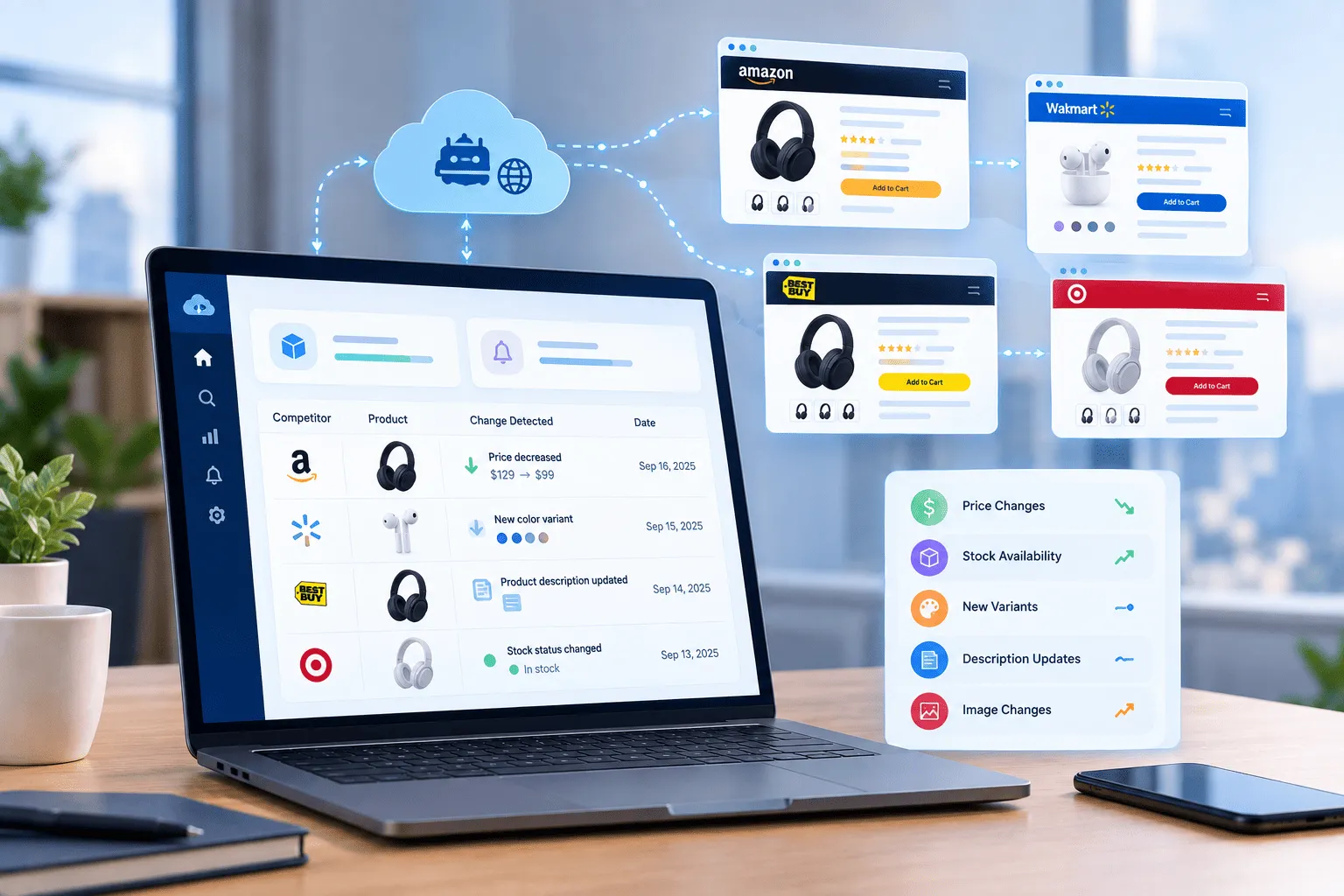


SaaS markets can change quickly. Competitors may launch new features, modify pricing plans, introduce new integrations, change product positioning, or update their website messaging without announcing every change publicly. For SaaS companies operating in competitive categories, keeping track of these updates can provide valuable context for product, marketing, sales, and strategy teams.
Manual competitor research can work for occasional checks, but it becomes difficult when businesses need to monitor dozens of competitors and thousands of pages. Automated competitor website scraping can help collect publicly available information at regular intervals and turn website changes into structured competitive intelligence.
What Is Competitor Website Scraping?
Competitor website scraping involves automatically collecting publicly available information from competitor websites. For SaaS companies, the information can include product pages, pricing pages, feature descriptions, integration pages, documentation, comparison pages, customer stories, and other publicly accessible content.
Rather than checking each website manually, companies can establish automated workflows that capture relevant information at predefined intervals. New data can then be compared with previous versions to identify meaningful changes.
This creates a historical record of how competitors' products and positioning evolve over time.
Tracking New Product Features
Product pages often contain valuable signals about a competitor's roadmap and product development. A new feature may appear on a product page, a new integration may be added, or an existing capability may receive a new description.
Automated data collection can capture these changes and allow teams to compare current and historical versions.
For example, a SaaS company could monitor competitor pages for changes involving:
- New product features
- Newly supported integrations
- Changes to feature descriptions
- New product modules
- Enterprise capabilities
- Security or compliance features
- AI-related functionality
Instead of relying on occasional competitor reviews, product teams can maintain a continuously updated view of publicly communicated capabilities.
Monitoring Competitor Pricing Changes
Pricing is another important area for SaaS competitive intelligence. Competitors may change subscription prices, add new plans, modify usage limits, or restructure their pricing models.
A scraping workflow can periodically collect publicly displayed pricing information and store each observation. Comparing historical snapshots can reveal when a competitor changed its pricing structure.
Teams can monitor elements such as:
- Plan names
- Monthly and annual prices
- Feature availability by plan
- Usage limits
- Free trials
- Enterprise pricing messaging
- Add-ons and paid extensions
This information can help pricing and commercial teams understand how competitors present their offers without requiring analysts to manually revisit every pricing page.
Detecting Changes in Product Positioning
Competitor changes are not limited to features and prices. Website messaging can reveal shifts in how a company wants its product to be perceived.
For example, a SaaS business that previously emphasized automation may begin highlighting artificial intelligence, enterprise security, or data analytics. Changes to headlines, value propositions, product descriptions, and industry-specific pages can provide signals of changing positioning.
Automated extraction allows marketing teams to compare these elements over time and identify recurring messaging patterns.
This can support competitive content research while keeping the analysis based on observable website information.
Tracking Competitor Integrations and Partnerships
Integrations are particularly important in SaaS ecosystems because they demonstrate how products connect with other platforms.
A competitor may add support for a CRM, payment provider, analytics platform, communication tool, or cloud service. Monitoring integration directories and product pages can help companies identify these additions.
Similarly, newly published partnership pages, marketplace listings, or ecosystem announcements can provide additional competitive signals.
A structured dataset makes it easier to categorize these developments and identify which technology categories competitors are prioritizing.
Creating Automated Change Detection
The real advantage of automated scraping comes from comparing data over time.
A company can establish a recurring collection process where selected competitor pages are captured daily, weekly, or at another appropriate frequency. Each version can be stored with its collection date and compared against the previous version.
A change detection workflow can then identify events such as:
Old version → New version → Detected change → Team notification
For example, if a competitor adds an AI-powered feature to its product page, the system can flag the page for review. Marketing or product teams can then determine whether the change requires a response.
Not every website change is strategically important, so automated monitoring works best when combined with rules that prioritize specific pages, keywords, sections, or types of changes.
How a Data Extraction Company Can Support SaaS Monitoring
Building an enterprise-scale scraping infrastructure internally can require ongoing technical resources. Websites change their structures, data formats vary between sources, and large-scale collection requires appropriate infrastructure and monitoring.
Working with a data extraction company can provide access to managed data collection capabilities without requiring SaaS teams to build every component themselves.
Depending on the project, an external provider can support data extraction, custom APIs, recurring collection, structured datasets, and workflows designed around specific sources and business requirements.
This approach can be particularly useful when a company needs to monitor a large competitor set or combine information from multiple websites.
Turning Website Changes Into Competitive Intelligence
Web scraping is most valuable when collected data becomes part of a broader competitive intelligence workflow. Raw website content alone does not explain why a competitor made a change, but it can provide a reliable record of what changed and when.
SaaS companies can combine scraped information with product research, pricing analysis, market research, and internal sales feedback to identify broader competitive patterns.
Over time, these historical datasets can answer questions such as when competitors introduced certain capabilities, how their pricing evolved, and which product categories or customer segments they increasingly emphasize.
Conclusion
Competitor websites contain a continuous stream of publicly visible product and market information. By using competitor website scraping, SaaS companies can systematically monitor changes to features, pricing, integrations, positioning, and other product-related information.
For organizations that need large-scale or continuously updated datasets, partnering with a data extraction company can help provide the infrastructure required to collect, structure, and maintain this information. The result is a more consistent competitive monitoring process that gives product, marketing, sales, and strategy teams historical data they can use for informed decision-making.
























Sign in to leave a comment.