How SAP Joule Capabilities Are Shaping the Future of Enterprise AI

Introduction
Enterprise AI is moving beyond chatbots that simply answer questions. Businesses increasingly want artificial intelligence that understands their operational context, helps employees make informed decisions, and supports work across connected applications. The real challenge is not generating a response; it is turning information into useful action while maintaining accuracy, security, and accountability.
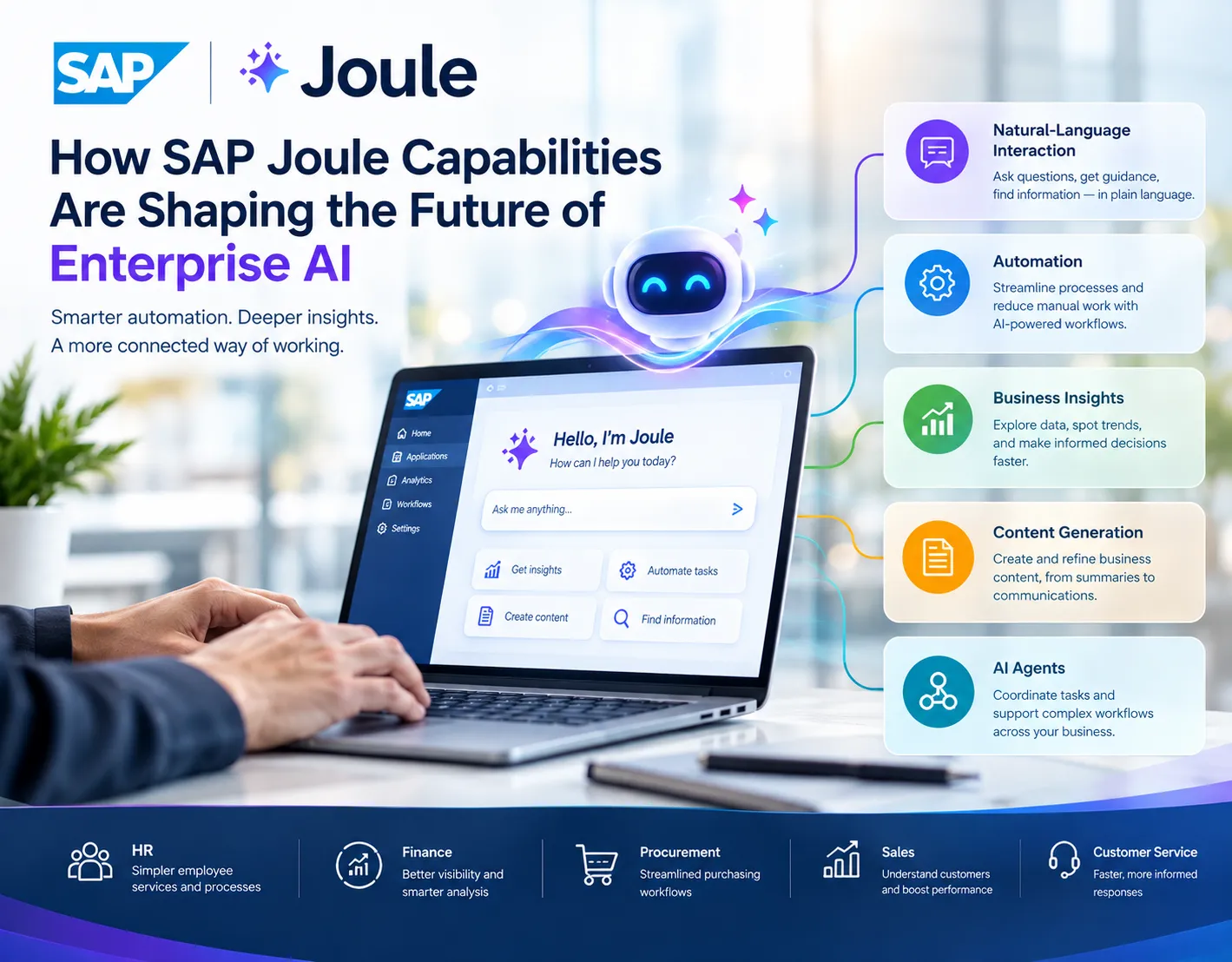
SAP Joule reflects this shift. As SAP’s AI copilot, it brings conversational assistance and AI-powered functionality into supported SAP business applications. Its growing ecosystem includes analytical assistance, content generation, developer support, and emerging agent-based capabilities designed to help coordinate business tasks. Exploring Sap joule capabilities offers businesses a useful starting point for understanding how enterprise AI may evolve from an optional productivity tool into a more integrated part of everyday operations.
From Conversational AI to Intelligent Enterprise Systems
Early business uses of generative AI often focused on writing emails, summarizing documents, and answering general questions. These applications remain valuable, but enterprise environments require more than fluent responses. Employees need information that reflects current business records, established processes, and their authorized access to company systems.
This is where enterprise-focused AI becomes particularly important. When an AI assistant operates within a connected business environment, it can potentially help users locate relevant information, navigate supported tasks, and work with data in context. The usefulness of that assistance depends on the quality of the underlying systems and the capabilities available in each application.
Joule is designed around this enterprise context. Rather than requiring employees to treat AI as an entirely separate destination, SAP integrates Joule into supported experiences across its business software portfolio. This creates opportunities to bring assistance closer to the point where work actually happens, while allowing organizations to build on their existing SAP environment.
AI Agents: The Next Step Beyond Simple Assistance
One of the most significant developments in enterprise AI is the rise of AI agents. A conventional conversational assistant generally responds to a prompt, while an agent can be designed to pursue a defined goal through multiple steps, using authorized tools and information along the way.
For example, a business process may require an employee to gather information, review a record, check a condition, and prepare the next action. An appropriately configured AI agent could support parts of that sequence instead of requiring the employee to initiate every step manually. More advanced arrangements may coordinate specialized agents to handle different parts of a larger workflow.
SAP is developing its Joule ecosystem in this direction through Joule Agents and Joule Assistants. These capabilities are intended to support specialized tasks and, in suitable scenarios, coordinate work across business functions. Their actual scope depends on the SAP solutions deployed, enabled features, integrations, and organizational permissions.
This evolution does not mean every business process will become autonomous. Complex decisions, exceptions, and actions with significant financial or operational consequences still require appropriate controls. The future of enterprise AI is more likely to involve a combination of automated execution and human supervision than unrestricted machine decision-making.
Business Process Automation That Understands Context
Traditional automation is effective when a process follows predictable rules. However, business operations frequently involve incomplete information, changing priorities, and exceptions that are difficult to handle with rigid workflows alone.
AI-enabled automation can help address some of these limitations by interpreting requests, working with relevant information, and supporting defined actions. Within compatible SAP applications, Joule can assist with supported business tasks, while agent-based capabilities offer further possibilities for coordinating multi-step work.
Consider a procurement team that needs to review purchasing information and prepare a task for the next stage of approval. An AI-enabled workflow could help gather relevant context or support available actions, reducing the amount of manual navigation involved. Employees would still need to verify important details and follow the organization’s purchasing rules.
The same principle can apply to HR administration, finance operations, supply chain coordination, and customer service. The greatest benefit may not come from automating an entire department, but from removing repeated, low-value steps that interrupt employees throughout the day.
Businesses should begin by identifying processes with clear objectives, reliable data, and measurable bottlenecks. This makes it easier to assess whether AI improves performance rather than simply adding another layer of technology.
Personalized Insights for Better Business Decisions
Enterprise systems hold information about customers, financial performance, employee activity, inventory, and operational results. Yet employees often struggle to extract the right insight quickly because information is distributed across reports and applications.
Joule can help users explore supported business information through conversational interactions and compatible analytical experiences. Depending on the SAP products in use, employees may be able to ask questions, investigate relevant measures, or receive information in a more accessible format. Certain analytical capabilities connect with SAP Analytics Cloud.
Imagine a manager reviewing a change in operating costs. Instead of starting with several separate reports, the manager may use supported conversational analytics to explore relevant measures and identify questions for further investigation. This can shorten the path from finding information to understanding what needs attention.
Over time, enterprise AI may become more adaptive to users’ roles, responsibilities, and workflows. A finance professional and a supply chain manager may need different information even when they are working with related business data. Context-aware assistance can help make those experiences more relevant, provided that personalization respects access permissions and organizational policies.
Personalized insights should still be treated as support for decision-making, not a replacement for it. Data quality, business definitions, and the reasoning behind recommendations all matter. Important conclusions must be checked against reliable evidence.
Content Generation and the Changing Employee Experience
Another important direction for enterprise AI is the integration of content generation into routine business work. Employees regularly create summaries, prepare communications, document processes, and explain complex information to different audiences. These tasks are necessary, but they can consume time that could otherwise be spent on analysis or customer relationships.
Joule’s supported generative AI experiences can help users create or refine relevant content within particular SAP workflows. In software development, Joule for Developers provides AI assistance for supported coding and development activities. These uses illustrate how AI can contribute to specialized work rather than remaining limited to general conversation.
The most effective approach is to use generated content as a starting point. Employees should review the output for factual accuracy, appropriate tone, confidentiality, and compliance with internal standards. This balance allows organizations to benefit from faster content preparation without surrendering professional judgment.
Building Trustworthy and Responsible Enterprise AI
As AI becomes more deeply connected to business processes, governance becomes just as important as functionality. An assistant that can access operational information or initiate supported actions must work within clear boundaries. Organizations need appropriate permissions, secure integrations, auditability, and procedures for reviewing high-impact decisions.
Implementation also requires attention to employee readiness. Teams need to understand which tasks AI can support, how to verify its output, and when a process requires human approval. Without this guidance, even a capable system may produce inconsistent results or fail to earn users’ trust.
A practical deployment strategy starts with a focused use case, establishes baseline performance, and measures outcomes such as time saved, process completion rates, error frequency, and user satisfaction. Regular evaluation helps businesses identify where the technology delivers value and where workflows or data need improvement.
Conclusion
The future of enterprise AI will be shaped by systems that connect intelligence with the work businesses already perform. SAP Joule represents this direction by bringing conversational assistance, business-context awareness, analytical support, content generation, and emerging agent-based capabilities into supported SAP environments.
For organizations, the opportunity lies in using these capabilities to simplify everyday work, coordinate defined processes, and make relevant information easier to understand. Success will depend on more than adopting new AI features. Reliable data, thoughtful integration, clear governance, and human oversight will remain essential as enterprises become more intelligent and connected.
By approaching AI strategically and measuring its practical impact, businesses can build a foundation for responsible automation while helping employees focus on decisions, relationships, and work that create lasting value.
#SAPJoule #EnterpriseAI #SAPBusinessAI #AIAgents #BusinessProcessAutomation #DigitalTransformation #IntelligentEnterprise




Sign in to leave a comment.