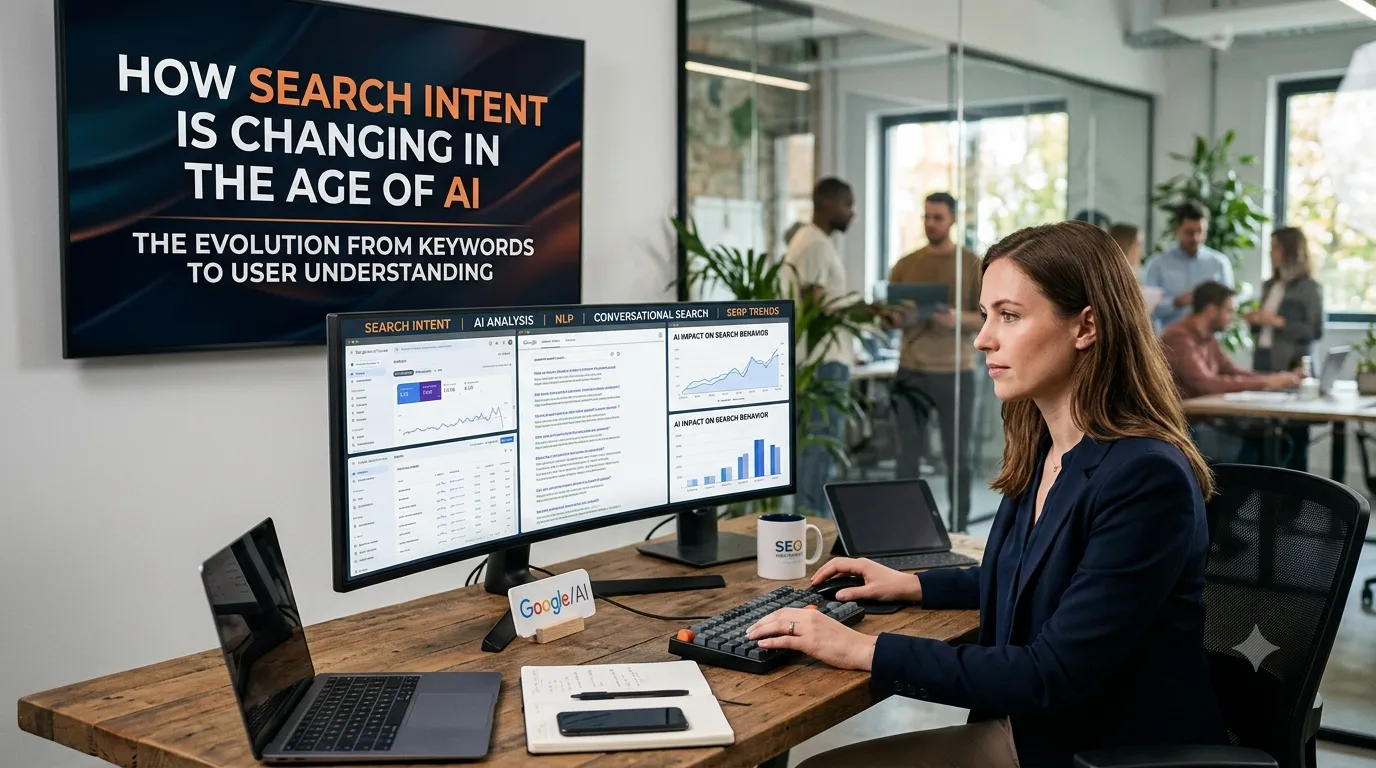

Search is no longer limited to short phrases such as “SEO company in Kolkata” or “best digital marketing agency near me.” People are increasingly asking longer, more specific questions and expecting search engines to understand the context behind them. Google reported that searches are becoming more complex, and in India and the US, AI Overviews have driven more than a 10% increase in usage for the types of queries where they appear.
For businesses, this changes an important question: are you creating content around keywords, or are you actually solving the problem behind those keywords?
A modern digital marketing Company needs to understand how intent develops across research, comparison and decision-making. In this guide, we’ll look at how AI is changing search intent, why traditional keyword targeting is no longer enough, and how businesses can build content that matches what potential customers genuinely want to know.
What Is Search Intent in the Age of AI?
Search intent is the underlying reason behind a search query—the information, solution, product or action a person is trying to find. AI-powered search makes intent more conversational and contextual because users can describe their situation instead of relying on short keyword phrases.
Traditional searches often looked like:
- “SEO services Kolkata”
- “best CRM software”
- “physiotherapy at home”
- “digital marketing company”
AI-assisted searches can be much more specific:
- “Which SEO approach is better for a small business competing locally in Kolkata?”
- “What should I check before hiring an SEO company in Kolkata?”
- “Why am I getting website traffic but very few enquiries?”
- “Which digital marketing services should a startup invest in first?”
The second group contains more information about the user's situation, expectations and decision stage.
Google says AI Overviews and AI Mode can handle longer, more complex questions and may use a “query fan-out” approach, where related searches are performed across different subtopics to build a broader response.
That means content needs to answer the main question as well as the related questions behind it.
How Is AI Changing Traditional Search Intent?
AI is making search more conversational, exploratory and context-driven. Instead of searching once, users can ask follow-up questions, compare alternatives and refine their requirements within the same search experience.
Google reported that early AI Mode testers were asking queries two to three times longer than traditional searches. Google has also reported that searches beginning with “How do I…” reached an all-time high in 2025, rising 25% year over year.
This creates several important changes.
From keywords to questions
A keyword such as “Google Ads agency” tells you very little about the user's exact need.
A question such as “How much should a small Kolkata business spend on Google Ads before deciding whether the campaign is working?” reveals much more.
The content opportunity is therefore not simply the keyword. It is the problem surrounding the keyword.
From one query to a search journey
A potential customer may move through several questions:
- What is causing my problem?
- What solutions are available?
- Which solution is suitable for my business?
- How much does it cost?
- Who should I hire?
- What results should I realistically expect?
A strong content strategy connects these questions instead of creating isolated pages for every keyword variation.
Why Keyword Matching Alone Is Becoming Less Effective
Exact-match keywords still matter, but they no longer provide the complete picture of search intent.
Google's current guidance says its generative search features continue to rely on core Search systems and recommends creating valuable, unique, people-first content rather than producing large volumes of pages designed around search variations.
For example, consider a business searching for an SEO company in Kolkata.
A weak page might repeatedly mention:
“SEO company in Kolkata”
“best SEO company in Kolkata”
“SEO services Kolkata”
A stronger page would answer the actual buying questions:
- What should an SEO company provide?
- How should businesses evaluate SEO proposals?
- What is included in technical, local and content SEO?
- How long can different SEO activities take?
- What reporting should a client expect?
- Which warning signs indicate poor SEO practices?
- What should a business ask before signing a contract?
The second approach gives search engines more context and gives the buyer more reasons to trust the business.
What Search Intent Signals Should Businesses Focus On?
When creating or updating content, look beyond the keyword and identify the signals that reveal what the user wants.
| Intent Signal | What It Often Means | Content Approach |
|---|---|---|
| “What is” | Learning or clarification | Definition + practical explanation |
| “How to” | Problem solving | Step-by-step guidance |
| “Best” | Evaluation | Comparison + decision criteria |
| “vs” | Alternative comparison | Pros, cons and suitability |
| “Cost” or “pricing” | Commercial evaluation | Pricing factors + expectations |
| “Near me” | Local decision | Local relevance + service information |
| “Reviews” | Trust evaluation | Evidence, experience and comparison |
| “For small business” | Specific use case | Business-size-specific guidance |
| “Agency/company” | Provider evaluation | Services, process and selection criteria |
These signals can help a digital marketing company in Kolkata create content that matches different stages of the buyer journey instead of treating every search as an identical opportunity.
How Should Content Be Created for AI-Driven Search?
The most effective approach is to build content around intent clusters, not isolated keywords.
An intent cluster groups related questions around one underlying problem.
For example, a business targeting local customers might build a content cluster around local digital visibility:
- How local search works
- Google Business Profile optimisation
- Local SEO ranking factors
- Google Maps visibility
- Local reviews and reputation
- Local landing pages
- Measuring calls and enquiries
- Choosing a local SEO provider
This creates topical depth while helping users move from research to action.
Google's guidance specifically recommends unique, non-commodity content that provides genuine value and a clear structure.
A practical content framework is:
Question → Direct answer → Explanation → Evidence → Example → Decision guidance → Next step
This structure works particularly well for AI-assisted search because important information is clearly stated rather than hidden inside long paragraphs.
What Should a Business Change in Its SEO Strategy?
Businesses do not need to abandon traditional SEO. Instead, they need to make their existing SEO more closely connected to user intent.
Google explicitly states that fundamental SEO practices remain relevant for AI Overviews and AI Mode. Pages still need to be crawlable, indexable and useful, while internal linking, textual content, page experience and accurate structured data remain important.
A practical strategy includes five steps:
1. Map keywords to real problems
Do not stop at search volume. Ask what the person is trying to accomplish.
2. Expand high-value queries into question clusters
Identify the comparisons, objections and follow-up questions surrounding important commercial searches.
3. Give direct answers early
Do not make readers search through 1,500 words to find the answer to a simple question.
4. Add decision-making information
Include suitability, limitations, costs or pricing factors, implementation considerations and questions buyers should ask.
5. Measure visibility beyond traditional rankings
Look at qualified organic traffic, engagement, enquiries, conversions and visibility across AI-powered search experiences.
Google announced dedicated Search Console reporting for visibility in generative AI features such as AI Overviews and AI Mode, with the rollout completed globally by August 31, 2026.
How Can a Digital Marketing Company Adapt to Changing Search Intent?
A modern digital marketing Company should move from keyword-led execution toward intent-led planning.
That does not mean abandoning keywords. Keywords remain useful signals for understanding what people search for. The difference is that they should become the starting point rather than the entire strategy.
For a digital marketing company in Kolkata, for example, a commercial page should not only explain services. It should help a potential client understand which services may be appropriate, what the process involves, what factors influence results and what questions to ask before making a decision.
The same principle applies to an SEO company in Kolkata. Strong content should demonstrate practical understanding rather than simply claiming expertise.
The competitive advantage increasingly comes from answering questions that competitors have overlooked and providing useful information that helps someone make a confident decision.
Frequently Asked Questions
Is search intent still important with AI search?
Yes. Search intent is arguably more important because AI-powered search can interpret longer and more conversational queries. Businesses need to understand the problem, context and desired outcome behind a search rather than targeting the exact wording alone.
Does AI search mean traditional SEO is no longer necessary?
No. Google states that existing SEO fundamentals remain important for AI Overviews and AI Mode. Crawlability, indexing, useful content, internal links and strong page experience continue to matter.
How should businesses optimise content for commercial search intent?
Focus on decision-making information. Explain the available options, suitability, costs or pricing factors, benefits, limitations, expected process and questions buyers should ask before choosing a provider.
Is long-form content better for AI search?
Not automatically. Length should depend on the complexity of the question. A useful page should provide the direct answer quickly and then offer enough depth to address related questions and support the reader's decision.
Should businesses create separate pages for every AI-generated search query?
No. Google recommends focusing on what users need rather than creating large numbers of pages for every possible search variation. Content should have genuine value and address meaningful topics comprehensively.
Conclusion
Search intent is moving from short keyword phrases toward longer, more contextual and decision-focused questions. Businesses that understand the problem behind a query can create content that is more useful across traditional search and AI-powered experiences.
The goal is not to predict every question someone might ask. It is to build genuinely useful content that answers important questions, supports comparisons and helps customers make decisions.
If your website needs to compete in this changing search environment, review your existing pages based on intent, usefulness and conversion value—not keyword repetition alone. For businesses evaluating online growth services, exploring digital marketing services can be a practical next step.

























Sign in to leave a comment.