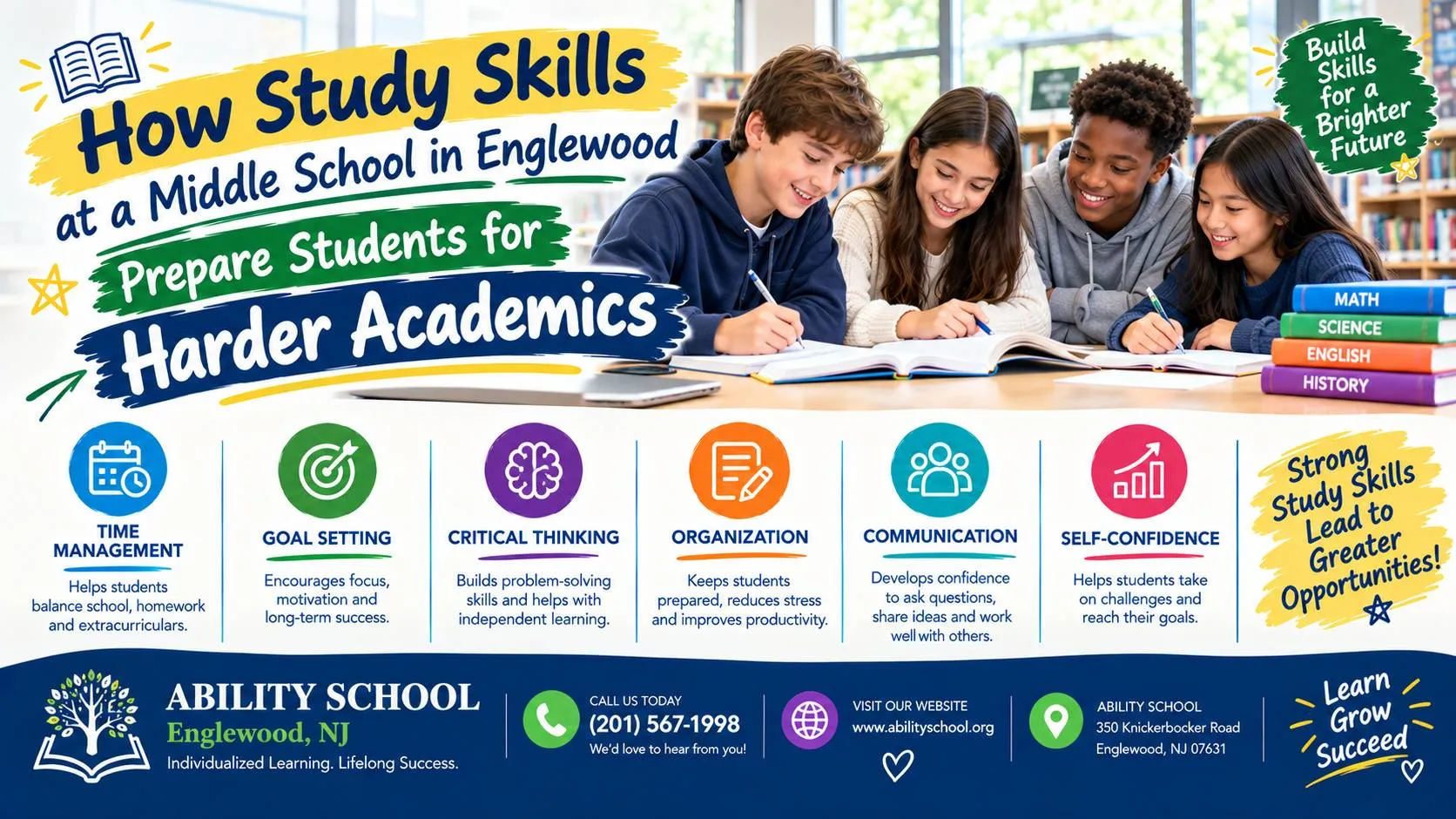

Why can a student spend an evening studying and still struggle to explain the lesson the next morning? The problem may involve more than effort. Reading the same pages, highlighting sentences, and copying notes can create a feeling of preparation without showing what the student has learned.
For families comparing Englewood middle schools, that distinction deserves attention. As coursework becomes more demanding, students need ways to work through unfamiliar material, notice gaps, and ask useful questions. Study skills give them a starting point. They also help parents see the difference between a child who completes assignments and one who can manage the thinking behind them.
Study Skills Begin Where General Instructions End
A direction such as “review the chapter” assumes that students know what review involves. Many need more guidance. Should they learn the vocabulary, explain a process, compare two arguments, or practice solving a problem without an example?
The answer changes how they should prepare. A vocabulary task calls for recalling meanings and using words in context. An essay requires selecting evidence and explaining how it supports a position. Treating both tasks the same way can waste effort.
Ability School includes dedicated study-skills work in its middle school program, with an emphasis on developing independent students.
For a parent considering a middle school in Englewood, the useful question concerns what that independence looks like during an assignment. Can the student identify the task, choose an approach, and explain where progress stopped? Those actions give teachers something specific to address.
Individual Pacing Needs Clear Learning Expectations
Students do not encounter difficulty at the same point. One may follow a science explanation but struggle with the vocabulary. Another may know the terms yet miss the relationship between the ideas.
Giving both students another copy of the same exercise may leave the original problem untouched.
Individualized instruction starts with identifying the gap. Mastery-based progression then asks for evidence that the student has addressed it before adding more demanding material. That evidence might involve explaining a process, applying a concept, or solving a different version of a problem.
Parents researching Englewood middle schools should consider how a program balances flexibility with expectations. Additional time needs a purpose. A student should know what requires attention, what practice will help, and how the teacher will assess progress.
The same principle applies to students who grasp material and need further challenge. Their next step should reflect demonstrated readiness.
Wider Reading Prepares Students for Stronger Written Work
A student can finish a book and still struggle to discuss it. Recalling events differs from explaining a character’s decision or identifying the evidence behind an author’s claim.
Reading across genres gives students different kinds of work to do. Biography raises questions about perspective. Historical fiction invites discussion about the relationship between setting and story. Nonfiction requires readers to examine explanations and supporting details.
Ability School’s middle school program includes fiction, biography, historical fiction, and nonfiction, along with practical projects such as business activities, community service, and playwriting.
For students at a middle school in Englewood, these experiences can connect reading with a purpose beyond finishing the next chapter. A written comparison requires them to select relevant details. A discussion asks them to explain a conclusion and respond when another reader disagrees.
These demands resemble the work students encounter in longer essays and research assignments.
Practical Assignments Reveal Habits That Need Work
An extended project can expose problems that a short worksheet leaves unnoticed. A student may understand the subject but underestimate the time needed. Another may collect information without deciding which sources answer the question.
A business project, for example, brings several tasks together. Students need calculations, records, written explanations, and decisions they can justify. Playwriting presents different demands, including structure, dialogue, revision, and coordination.
Useful study habits support each stage:
- Read the Requirements: Identify the expected outcome before beginning the work.
- Plan the Stages: Separate research, drafting, checking, and revision.
- Check the Evidence: Decide whether a source supports the point.
- Explain the Obstacle: Describe what caused difficulty and what the student attempted.
- Use the Feedback: Connect each correction with a change in the work.
The teacher’s response also counts. Feedback that identifies a missing explanation gives a student a clearer next step than a general instruction to improve.
Recognizing Readiness Beyond Completed Homework
Parents often see the finished assignment. The more revealing moments occur before that point: how the student starts, what happens after a mistake, and whether a correction changes the approach.
Independence does not mean refusing help. A student who asks a precise question may show better judgment than one who continues with a misunderstanding.
Choosing among Englewood middle schools calls for attention to these habits alongside curriculum content. A considered assessment looks at whether students receive clear instruction, practice with demanding tasks, and feedback they can use. Preparation for harder academics grows from that combination of guidance and increasing responsibility.






















Sign in to leave a comment.