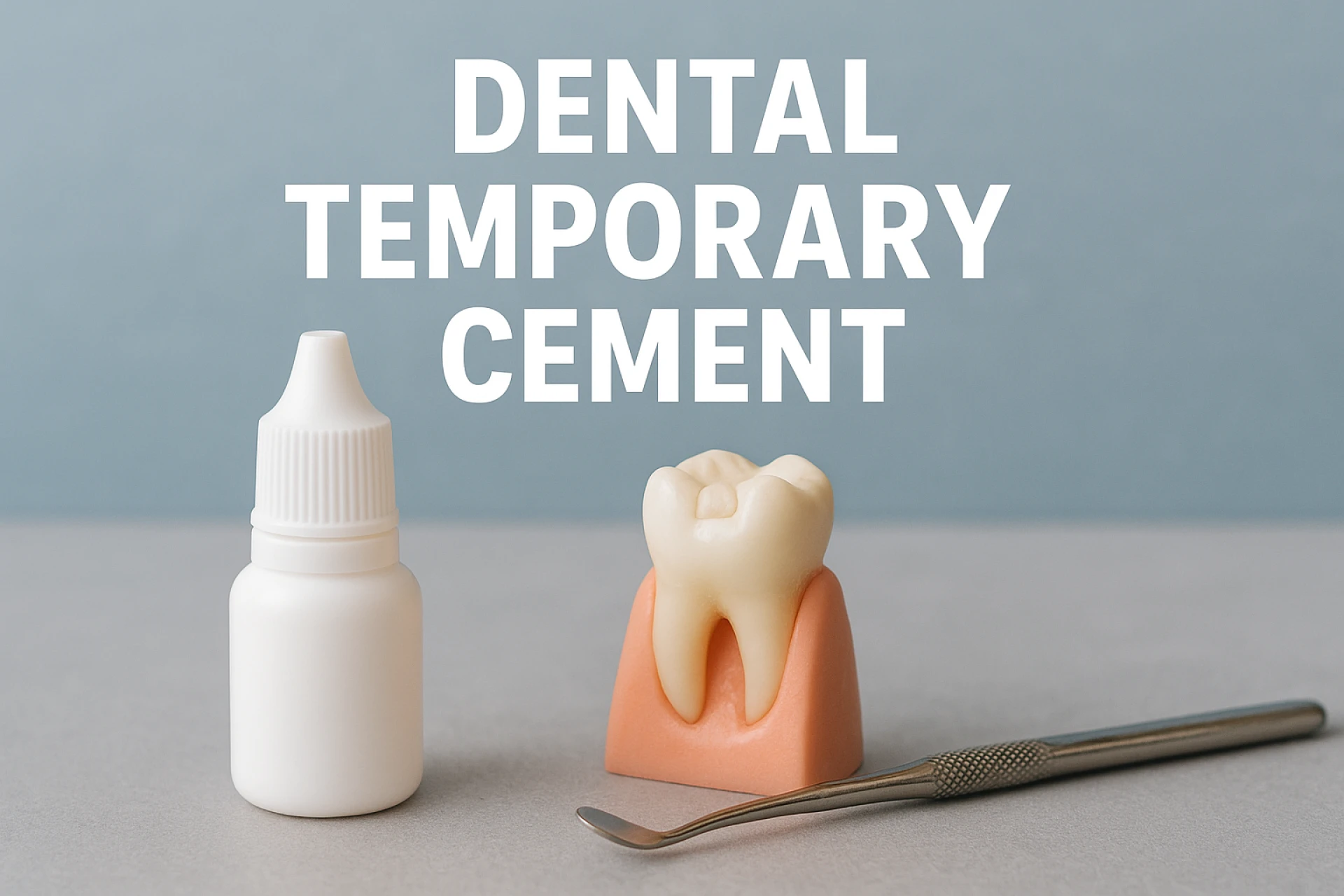

Although temporary cement is designed for short-term use, its material properties directly impact the success of the final restoration. This article explores how temporary cement works, focusing on the science behind its strength, solubility, and biocompatibility.
The Role of Temporary Dental Cement
Temporary cement acts as a holding agent for provisional crowns, bridges, inlays, onlays, and implant restorations. Its purpose is not to create a permanent bond but to provide secure retention while still allowing easy removal later. It must balance strength and flexibility—strong enough to keep the restoration in place during daily activities, yet weak enough that it can be taken off without damaging the tooth structure.
Dentists rely on temporary cement to:
Protect the prepared tooth from sensitivity
- Maintain aesthetics and function during treatment
- Allow the patient to chew, speak, and smile comfortably
- Prevent microleakage and bacterial contamination
- Ensure safe and controlled removal of the temporary restoration
This balance between protection and reversibility is what makes the science behind temporary cements particularly interesting.
Know About the Strength in Temporary Dental Cements
Strength is one of the most important characteristics when selecting a dental temporary cement. The material must withstand biting forces, temperature changes, and mechanical stress from chewing.
1. Tensile and Compressive Strength
Temporary cements typically have lower tensile strength than permanent cements, allowing for easier crown removal. However, they still need sufficient compressive strength to resist intraoral forces. Modern non-eugenol and resin-based temporary cements offer improved mechanical stability compared to traditional zinc oxide–eugenol formulas.
2. Controlled Retention
Temporary cement is engineered to deliver controlled retention. Too much strength can make the provisional difficult to remove, risking damage to the tooth or soft tissue. Too little strength can lead to loose or dislodged crowns, sensitivity, and contamination. Manufacturers fine-tune formulas to maintain this balance through particle size, filler content, and setting chemistry.
Solubility: Why It Matters?
Solubility determines how well the cement resists breakdown in the moist oral environment. If a temporary cement dissolves too quickly, it can compromise the seal and expose the tooth to bacteria or thermal sensitivity.
1. Water Resistance
Quality temporary cement maintains a low solubility profile. Modern formulations—especially non-eugenol types—are designed to resist saliva, food acids, and fluids. This prevents marginal breakdown and extends the lifespan of the provisional.
2. Prevention of Microleakage
When solubility is too high, gaps form at the margin, allowing bacteria and debris to enter. This can lead to inflammation, bad odour, and potential decay under the restoration. Low-solubility temporary cements help maintain a tighter seal, which supports better long-term outcomes when the final prosthesis is cemented.
Biocompatibility: Patient Comfort and Safety
Biocompatibility ensures that the cement does not irritate the pulp, gums, or surrounding tissues.
1. Pulp-Friendly Formulations
Traditional zinc oxide–eugenol cements are soothing to the pulp, making them ideal for sensitive teeth. However, eugenol can interfere with resin-based final cements. This is why non-eugenol temporary cement is now widely preferred for cases involving all-ceramic restorations and resin bonding.
2. Reduced Sensitivity and Irritation
Modern temporary cements are designed to minimise postoperative sensitivity. They contain ingredients that are gentle on tissues and compatible with a wide range of restorative materials, ensuring a comfortable experience for patients.
3. Compatibility with Final Cementation
Biocompatibility also includes ensuring the temporary material does not leave residues that compromise the adhesion of permanent cements. Non-eugenol cements are particularly popular for this reason—they avoid chemical interactions that weaken resin bonding.
Explore Advanced Temporary Cement Solutions for Predictable Dentistry
Understanding how dental temporary cement works helps clinicians choose the best material for each procedure. The performance of a temporary restoration depends heavily on the cement’s strength, solubility, and biocompatibility. A well-formulated temporary cement protects the tooth, maintains function, and supports long-term success when the permanent restoration is placed.
As material science continues to evolve, dentists can expect even greater improvements in retention, sealing ability, and patient comfort—making temporary cement not just a short-term solution but a critical part of successful restorative dentistry.




























Sign in to leave a comment.