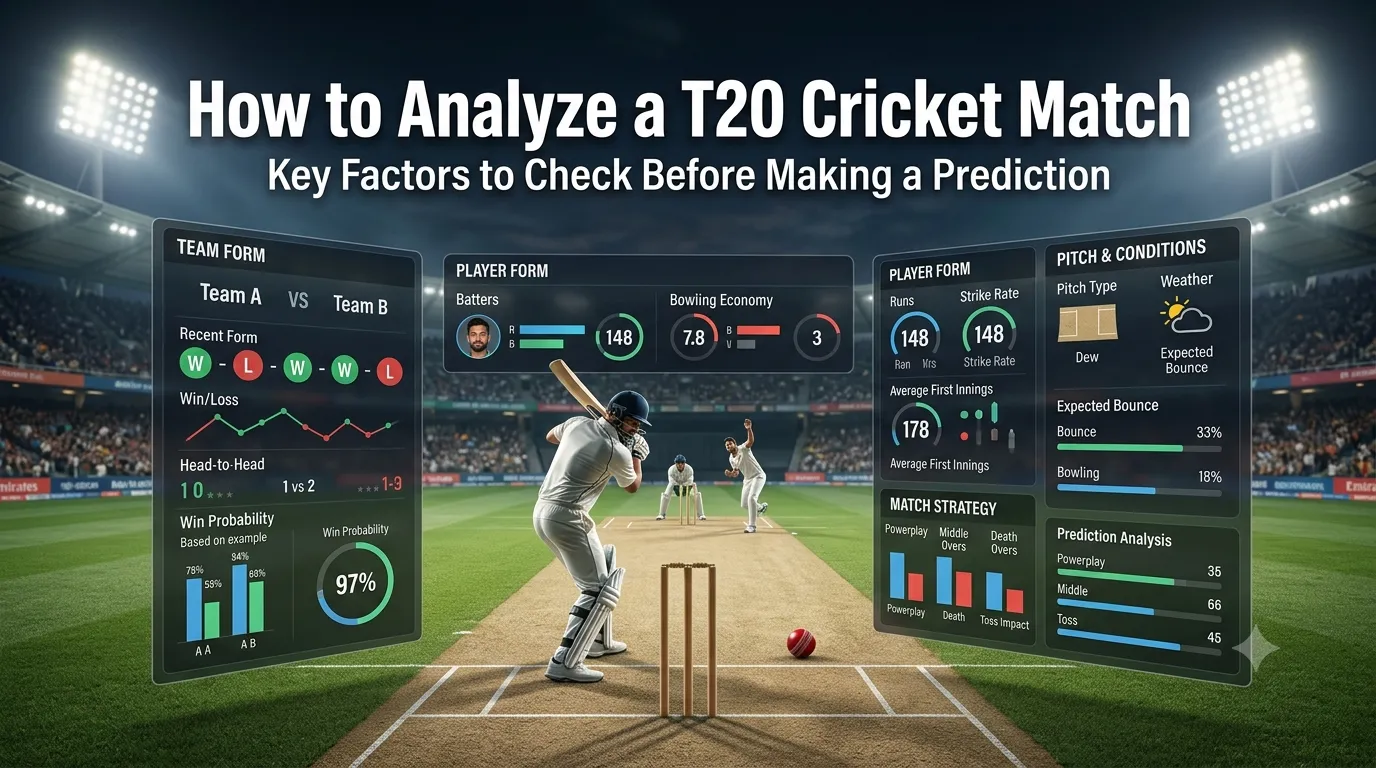


T20 cricket is fast-paced, unpredictable, and full of momentum swings. With only 20 overs per side, a few deliveries can completely change the direction of a match. That makes analyzing a T20 game an interesting exercise for cricket fans who enjoy studying statistics, team combinations, and match conditions.
Whether you follow international T20 cricket, franchise leagues, or domestic competitions, having a structured approach to match analysis can help you understand the game better. However, analysis should never be treated as a guarantee of a particular result.
Start by Looking at Recent Team Form
One of the first things to examine before a T20 match is how both teams have performed recently.
Look at their results from recent games and consider whether performances have been consistent or fluctuating. A team's overall record can provide useful context, but individual matches should also be examined to understand how those results were achieved.
Consider factors such as:
- Recent wins and losses
- Batting performances
- Bowling performances
- Runs scored and conceded
- Performance against similar opposition
- Results in comparable conditions
Recent form is useful information, but it should be considered alongside other factors rather than used on its own.
Examine the Playing XI
Team selection can have a major influence on a T20 match.
Before analyzing the game, check the expected or confirmed playing XI. The absence of a key batter, fast bowler, all-rounder, or wicketkeeper can affect a team's balance.
Also consider whether a player is returning from injury, has recently joined the squad, or has been performing particularly well.
Once the final line-ups are announced, reassessing your analysis can provide a more accurate picture of the teams involved.
Study Individual Player Form
T20 cricket often features short bursts of individual brilliance, making player form an important area to examine.
For batters, look at recent runs, strike rate, consistency, and performance against particular bowling styles. For bowlers, consider wickets, economy rate, recent spells, and effectiveness during different phases of an innings.
All-rounders can be particularly valuable because they contribute in multiple areas.
However, past statistics should be treated as historical information rather than a prediction of what will happen in the next match.
Consider the Pitch and Ground Conditions
The venue can influence how a T20 match develops.
Some grounds may favor high-scoring batting performances, while others can provide assistance to fast bowlers or spinners. Boundary dimensions, pitch characteristics, and previous matches at the venue can all provide useful context.
You can research:
- Average first-innings scores
- Recent results at the venue
- Pace versus spin effectiveness
- Boundary size
- Batting conditions
- Dew or moisture considerations
Understanding the ground can help explain why teams may choose different strategies.
Check the Weather Forecast
Weather conditions can also affect T20 cricket.
Rain may reduce the number of overs, while humidity, wind, or evening dew can influence bowling and batting conditions. In shortened matches, the importance of individual overs can become even greater.
Checking reliable weather information before the match can therefore add another useful element to your analysis.
Compare Batting and Bowling Strengths
Rather than looking only at a team's overall record, compare the strengths of its batting and bowling units.
Ask questions such as:
- Does the team have reliable powerplay batters?
- Who can accelerate during the middle overs?
- Does the team have strong finishers?
- Which bowlers operate effectively at the death?
- Does the bowling attack contain a useful mix of pace and spin?
- How strong is the team's backup depth?
T20 cricket is often decided by how well teams perform during key phases, so looking at the complete squad can be more informative than focusing on one or two star players.
Pay Attention to Powerplay and Death Overs
The powerplay and final overs are particularly important in T20 cricket.
During the powerplay, teams often look to score quickly while taking advantage of fielding restrictions. At the other end of the innings, death-over batting can dramatically increase the final total.
Bowling teams also need specialists who can control scoring during these periods.
Reviewing how teams perform in the powerplay, middle overs, and death overs can give you a clearer understanding of their overall T20 strategy.
Look at the Toss and Match Conditions
The toss can influence tactical decisions, particularly when conditions change during the evening.
Depending on the venue and weather, a captain may choose to bat first or chase a target. Dew, pitch behavior, and historical venue trends can all influence that decision.
The toss should not be treated as a guaranteed indicator of the result. Instead, consider it as one additional piece of information after the teams and conditions are known.
Avoid Relying on a Single Statistic
A common mistake in sports analysis is focusing too heavily on one number.
For example, a team may have an impressive recent record but struggle against a particular style of bowling. Similarly, an individual batter's overall statistics may not reflect their performance against a specific opponent.
A more balanced analysis combines several factors, including:
- Team form
- Player statistics
- Playing XI
- Venue history
- Pitch conditions
- Weather
- Head-to-head information
- Tactical matchups
Using multiple data points can provide greater context while still recognizing that the outcome of a cricket match remains uncertain.
Set Responsible Limits
If match analysis is being used in connection with betting or prediction activities, responsible participation is essential.
Set a clear entertainment budget and never use money needed for everyday expenses. Avoid increasing your spending simply because an earlier prediction was unsuccessful, and do not assume that detailed analysis can guarantee a profitable outcome.
Cricket contains too many variables for any analysis method to eliminate uncertainty.
Keep the Focus on the Sport
Analyzing a T20 match can make watching cricket more engaging. Studying statistics, team combinations, tactics, and conditions can help fans appreciate the strategic side of the format.
At the same time, predictions should remain secondary to enjoying the sport itself.
For more cricket-related content and information, visit Champ11 Official.
Final Thoughts
A thoughtful T20 match analysis should consider the bigger picture rather than relying on one statistic or recent result. Start with team form, examine the playing XI, evaluate player performances, study the venue, check conditions, and compare the strengths of both teams.
Most importantly, remember that analysis provides information—not certainty. Unexpected performances, tactical decisions, weather changes, and individual moments can all influence a T20 match.
If you choose to participate in prediction or betting activities, do so responsibly, only where legally permitted, and never risk more than you can afford to lose.
For additional cricket content, explore Champ11 Official.























Sign in to leave a comment.