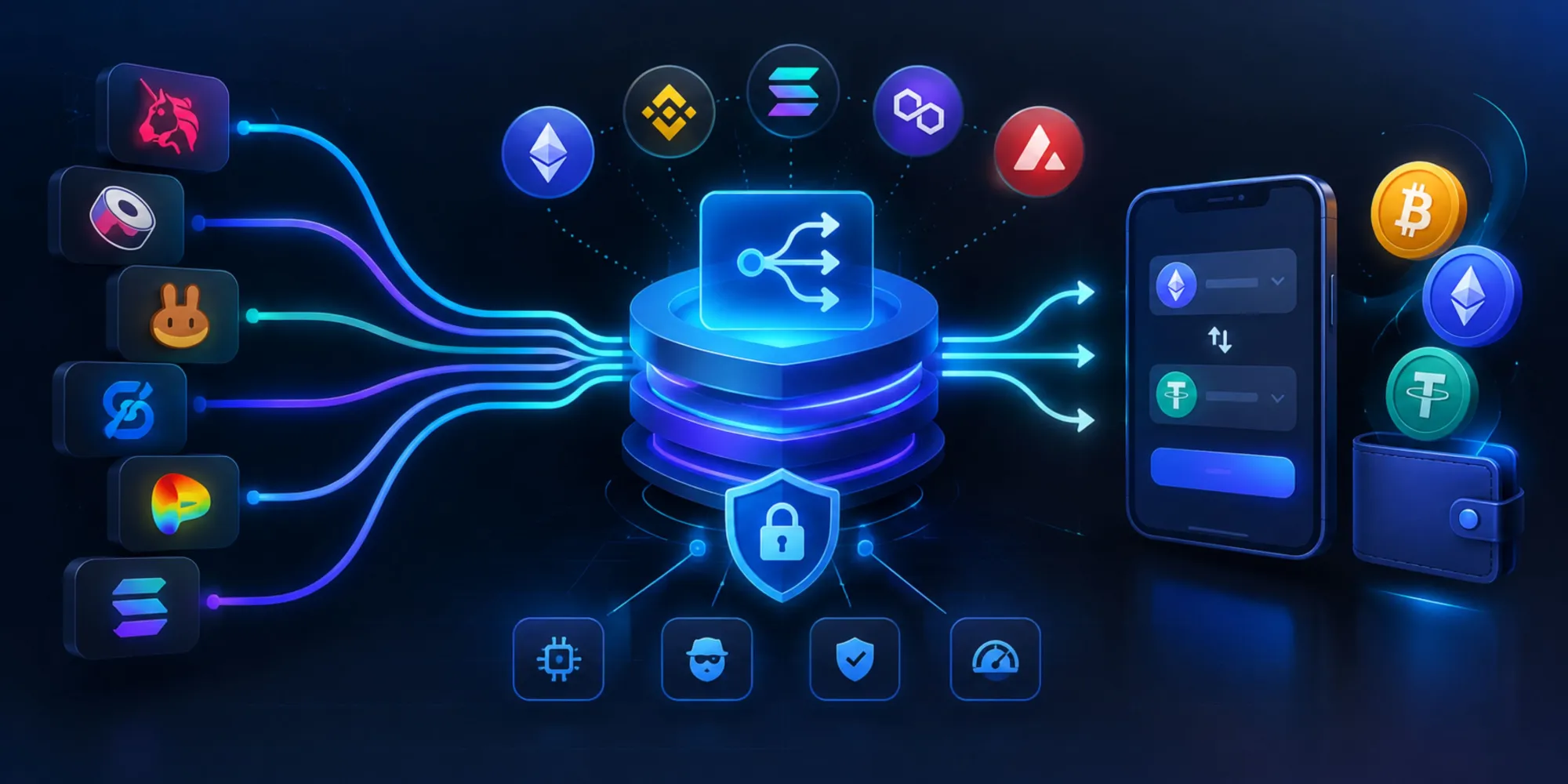

DeFi liquidity is no longer concentrated in a handful of decentralized exchanges. Liquidity is distributed across AMMs, concentrated-liquidity pools, on-chain order books, RFQ networks, private market makers, intent-based systems, and multiple blockchain ecosystems. As a result, building another interface that simply connects users to one DEX is unlikely to create a meaningful competitive advantage.
Modern DEX aggregator development is increasingly about execution quality: finding the right liquidity, splitting orders intelligently, accounting for gas and price impact, protecting trades from MEV, and—when necessary—moving assets across chains.
In 2026, intent-based execution is becoming an important architectural layer. Instead of forcing users to define the exact transaction path, they can specify the desired outcome while solvers compete to fulfill it. This can also reduce exposure to public-mempool attacks such as sandwiching.
For businesses planning this type of platform, choosing an experienced DEX Aggregator Development Partner is therefore less about finding someone who can build a swap interface and more about finding a team capable of designing routing, solver, settlement, security, and liquidity infrastructure.
What Is a DEX Aggregator in 2026?
A DEX aggregator is an execution layer that searches multiple liquidity sources and determines how a trade should be completed. Instead of relying on a single pool, the system can evaluate AMMs, order books, RFQ providers, professional market makers, and intent-based liquidity networks.
Consider a user swapping $100,000 of USDC for ETH.
A basic DEX may execute the entire trade against one pool. A sophisticated aggregator could determine that:
- 35% should go through one AMM
- 25% through another liquidity pool
- 20% through an RFQ provider
- 20% through an intent-based solver
The objective is not simply to find the highest quoted output. The routing engine needs to calculate net execution value after gas, price impact, fees, slippage, bridge costs, and execution risk.
This distinction has become particularly important in 2026. Current aggregator comparisons increasingly evaluate platforms according to liquidity depth, split routing, RFQ access, intent execution, cross-chain capabilities, and MEV protection rather than simply advertised swap rates.
Why Intent-Based Routing Changes DEX Aggregator Architecture
Traditional aggregators generally follow a transaction-oriented model:
User → Quote Engine → Route Calculation → User Signs Transaction → Blockchain Execution
Intent-based architecture changes this to:
User → Signed Intent → Intent Network → Solver Competition → Settlement Contract → Execution
The user specifies an outcome rather than constructing the complete transaction path.
For example:
“Swap 50,000 USDC for at least 49,700 USDT within the next 60 seconds.”
The user does not necessarily need to know which pools, intermediate tokens, or liquidity providers will be used. Solvers compete to find an economically viable way to satisfy those conditions.
Intent-based systems can improve execution by creating competition among solvers and keeping orders away from the traditional public mempool. Current implementations such as 1inch Fusion and other intent-based architectures demonstrate this shift toward outcome-oriented execution.
However, intent-based routing does not eliminate complexity. It introduces new components, including intent distribution, solver infrastructure, validation, auction mechanisms, and settlement contracts. Solver concentration, intent privacy, malicious order flow, and smart-contract vulnerabilities also need to be addressed.
Core Architecture for a Modern DEX Aggregator
A production-grade DEX aggregator should be designed as several interconnected layers rather than a single routing contract.
1. Liquidity Aggregation Layer
The first layer connects the platform to multiple liquidity sources.
Depending on the target market, this can include:
- AMMs
- Concentrated-liquidity DEXs
- On-chain order books
- RFQ providers
- Market makers
- Intent-based liquidity
- Cross-chain liquidity networks
- Bridge protocols
The broader the liquidity network, the greater the opportunity for competitive execution. However, integrating more sources also increases monitoring, normalization, failure handling, and security requirements.
2. Quote and Route Engine
The route engine is the core intelligence of the aggregator.
It should evaluate:
- Token pair
- Pool liquidity
- Expected output
- Price impact
- Gas consumption
- Trading fees
- Slippage
- Route reliability
- MEV exposure
- Bridge costs
- Settlement time
The cheapest-looking route is not necessarily the best route. A route that produces slightly more tokens but requires five additional swaps and substantially higher gas can produce a worse final outcome.
Modern routing systems therefore need to optimize for net execution, not just token output.
3. Split and Multi-Hop Routing
Large trades frequently require more sophisticated routing.
Suppose a user wants to trade $500,000 of ETH for USDC. Sending the entire order through one pool may generate a significant price impact.
A routing engine could instead divide the order among several venues.
Multi-hop routing can also be useful when there is insufficient direct liquidity. For example:
ETH → USDC
may be inferior to:
ETH → WBTC → USDC
if the intermediate markets have substantially deeper liquidity.
However, additional hops increase gas consumption and execution complexity. The routing algorithm should therefore add a hop only when the expected improvement outweighs its cost.
Building MEV Protection Into the Aggregator
MEV protection should not be treated as an optional feature added after the routing engine is complete.
Public blockchain transactions can expose trade information before execution. Searchers may use that information to perform front-running, back-running, or sandwich attacks.
In a sandwich attack, an attacker identifies a pending swap, places a transaction before it, allows the victim's trade to move the market, and then trades afterward to capture the resulting price difference.
A modern DEX aggregator can reduce this exposure through several mechanisms.
1. Private Transaction Routing
Instead of broadcasting sensitive transaction information through the conventional public mempool, transactions can be submitted through private execution channels.
2. Intent-Based Execution
Intent systems can keep the user's desired outcome separate from direct transaction submission while solvers compete to fulfill the order.
3. Batch Auctions
Batch-auction models can aggregate orders and determine execution collectively, reducing certain opportunities for transaction-order manipulation.
4. Solver Competition
Rather than trusting a single execution provider, the aggregator can allow multiple approved solvers to compete for an order.
This creates an important economic layer: the solver that can provide the strongest execution has an incentive to win the order.
MEV protection does not guarantee perfect execution, but private order flow, batch auctions, and solver-based execution can substantially change the attack surface compared with conventional public-mempool swaps.
Cross-Chain DEX Aggregation Is the Next Architectural Challenge
A same-chain swap is only one part of the market.
Users increasingly expect experiences such as:
ETH on Ethereum → USDC on Arbitrum
or
USDC on Base → SOL on Solana
A cross-chain aggregator must therefore solve more than DEX routing.
It needs to evaluate:
- Source-chain liquidity
- Destination-chain liquidity
- Bridge or interoperability providers
- Bridge fees
- Destination gas requirements
- Settlement time
- Bridge security
- Failure and recovery conditions
This is creating a convergence between DEX aggregation and bridge aggregation. Current cross-chain infrastructure increasingly combines DEX routes with multiple bridge providers and intent-based settlement rather than treating swapping and bridging as completely separate operations.
For a new platform, this means the architecture should be modular enough to add cross-chain routing without rewriting the core swap engine.
Essential Features to Include
A competitive DEX aggregator in 2026 should consider the following feature set:
| Feature | Purpose |
| Smart order routing | Finds efficient execution paths |
| Split routing | Distributes large orders across liquidity sources |
| Multi-hop swaps | Accesses deeper indirect liquidity |
| Intent-based trading | Lets users specify outcomes instead of routes |
| Solver network | Creates competition for order fulfillment |
| MEV protection | Reduces front-running and sandwich exposure |
| RFQ integration | Provides firm quotes from professional liquidity providers |
| Gas optimization | Evaluates execution cost alongside price |
| Slippage controls | Defines acceptable execution deviation |
| Cross-chain routing | Supports swaps across blockchain ecosystems |
| Route simulation | Detects likely failures before execution |
| Wallet integration | Enables non-custodial transaction signing |
| Analytics dashboard | Tracks routes, volume, fees and execution quality |
The most important point is that these features should operate as one execution system. Adding them independently does not automatically create better routing.
Security Considerations for DEX Aggregator Development
Security becomes more complicated as the number of integrations increases.
A DEX aggregator may interact with dozens of external smart contracts, bridges, tokens, solvers, and liquidity providers. Each additional integration expands the potential attack surface.
A robust architecture should include:
- Audited smart contracts
- Route validation
- Token allowlists or risk scoring
- Reentrancy protection
- Slippage enforcement
- Deadline validation
- Oracle manipulation safeguards
- Solver authentication and reputation mechanisms
- Bridge risk monitoring
- Transaction simulation
- Emergency controls
- Continuous monitoring
Intent-based systems introduce additional security considerations around solver contracts, relayers, intent validation, and settlement mechanisms. Industry discussions also highlight privacy leakage and solver centralization as important risks that developers need to account for.
Technology Stack for a 2026 DEX Aggregator
A practical architecture could combine:
Frontend: React.js / Next.js
Backend: Node.js / TypeScript
Blockchain Layer: EVM-compatible chains + chain-specific SDKs
Smart Contracts: Solidity
Routing Engine: Graph-based pathfinding + optimization algorithms
Data Layer: PostgreSQL + Redis
Blockchain Data: RPC providers, indexing services and event listeners
Wallets: WalletConnect and chain-specific wallet integrations
Infrastructure: Docker, Kubernetes and cloud-native services
Monitoring: Transaction simulation, route monitoring and security alerts
For intent-based systems, additional infrastructure is required for:
Intent schema → signing → intent propagation → solver bidding → winner selection → settlement
The architecture should also keep liquidity adapters modular. This allows new DEXs, RFQ providers, chains, and bridge networks to be added without modifying the entire routing engine.
How to Build the DEX Aggregator Step by Step
A practical development process can be divided into seven stages.
Step 1: Define the Liquidity Scope
Decide whether the product will initially target one blockchain, multiple EVM networks, Solana, or a broader cross-chain market.
Starting with every chain simultaneously can create unnecessary integration and security complexity.
Step 2: Build Liquidity Adapters
Create standardized interfaces for DEXs, RFQ providers, market makers, bridges, and intent networks.
Step 3: Develop the Routing Engine
Implement quote collection, route scoring, split routing, multi-hop discovery, gas estimation, and slippage calculations.
Step 4: Add Intent Infrastructure
Introduce signed intents, solver APIs, solver selection, auction logic, validation, and settlement contracts.
Step 5: Implement MEV Protection
Choose the appropriate combination of private execution, intent settlement, solver competition, batch auctions, and protected transaction channels.
Step 6: Add Cross-Chain Routing
Integrate bridge and interoperability providers after the core same-chain routing system is stable.
Step 7: Audit and Optimize
Perform smart-contract audits, economic simulations, route testing, transaction-failure testing, and load testing before production deployment.
How to Choose a DEX Aggregator Development Partner
The right DEX Aggregator Development Partner should understand both blockchain engineering and execution economics.
Instead of evaluating a vendor only on whether it can build a swap interface, assess its capabilities in:
- Smart-contract architecture
- DEX and liquidity integrations
- Smart order routing
- Intent-based architecture
- Solver infrastructure
- MEV mitigation
- Cross-chain interoperability
- Wallet integration
- Security auditing
- High-volume transaction infrastructure
This is particularly important because intent-based architecture shifts complexity from the user's interface into backend execution and settlement infrastructure.
A development team such as Debut Infotech can approach the project as an end-to-end DeFi infrastructure build rather than simply a frontend DEX integration. The same broader blockchain engineering capabilities can also support products such as a cryptocurrency white label exchange or a full cryptocurrency exchange development platform when businesses want to combine decentralized and centralized trading infrastructure.
What Will Differentiate DEX Aggregators in 2026?
The next generation of aggregators will compete less on the number of DEXs they connect and more on the quality of their execution layer.
Three developments are particularly important.
First, intent-based execution is shifting users from specifying transactions to specifying outcomes. Solver competition can then determine how those outcomes are achieved.
Second, cross-chain aggregation is merging swapping, bridging, and settlement into a single execution problem. The distinction between a bridge aggregator and DEX aggregator is consequently becoming less clear.
Third, AI-driven execution is emerging as another interface for aggregation. Current industry developments are already exploring programmatic access that allows AI agents to interact with routing infrastructure and execute trades.
This could eventually make the DEX aggregator an invisible execution layer: the user—or an AI agent—states what it wants, while routing engines, solvers, liquidity providers, bridges, and settlement contracts determine the optimal way to achieve it.
Conclusion
Building a DEX aggregator in 2026 requires much more than connecting several decentralized exchanges to a common swap interface. The competitive advantage increasingly comes from intelligent routing, intent-based execution, solver competition, MEV protection, cross-chain liquidity, and security-focused settlement.
The strongest architecture is one that treats the aggregator as an execution infrastructure layer rather than simply a price-comparison tool. It should optimize the final value received by the trader while balancing liquidity, gas, slippage, execution probability, MEV exposure, and cross-chain risk.
For businesses entering this market, selecting an experienced DEX Aggregator Development Partner with expertise across smart contracts, routing engines, intent architecture, and DeFi security can determine whether the resulting platform is merely another swap interface—or a scalable liquidity execution network.





























Sign in to leave a comment.