

Lots of growing teams stall at one point. You need the product to expand. At the same time, you do not want payroll to spike. New work also means new bills. Many groups react by hiring fast. That path feels quick, but it does not stay easy. Each new hire takes time. It costs money. And when plans shift, undoing those hires is hard.
Instead, look at how your software is built. Look at how you deliver changes. Pay attention to how you run the day-to-day work. Also review what kind of help you bring in from outside. When those parts improve, you can grow without just adding staff. Then the team can stay close to the work you actually need, even as demand goes up.
Here are the main ideas for lean teams that want to ship real products and scale with fewer internal hires.
Why "Just Hire More Developers" Doesn't Scale
Hiring seems to be an immediate solution to increasing demands on the product, yet it brings other challenges:
- It may take several months before a newly hired employee starts producing tangible results.
- You have permanent expenses for fixed salaries, benefits, and infrastructure.
- Bigger teams require more coordination, more meetings, and more levels of management.
- Technical debt is accumulated much faster than the team is able to cope with it.
The more sustainable way to approach Software Product Development sees scalability as a systems issue, not a staffing one.
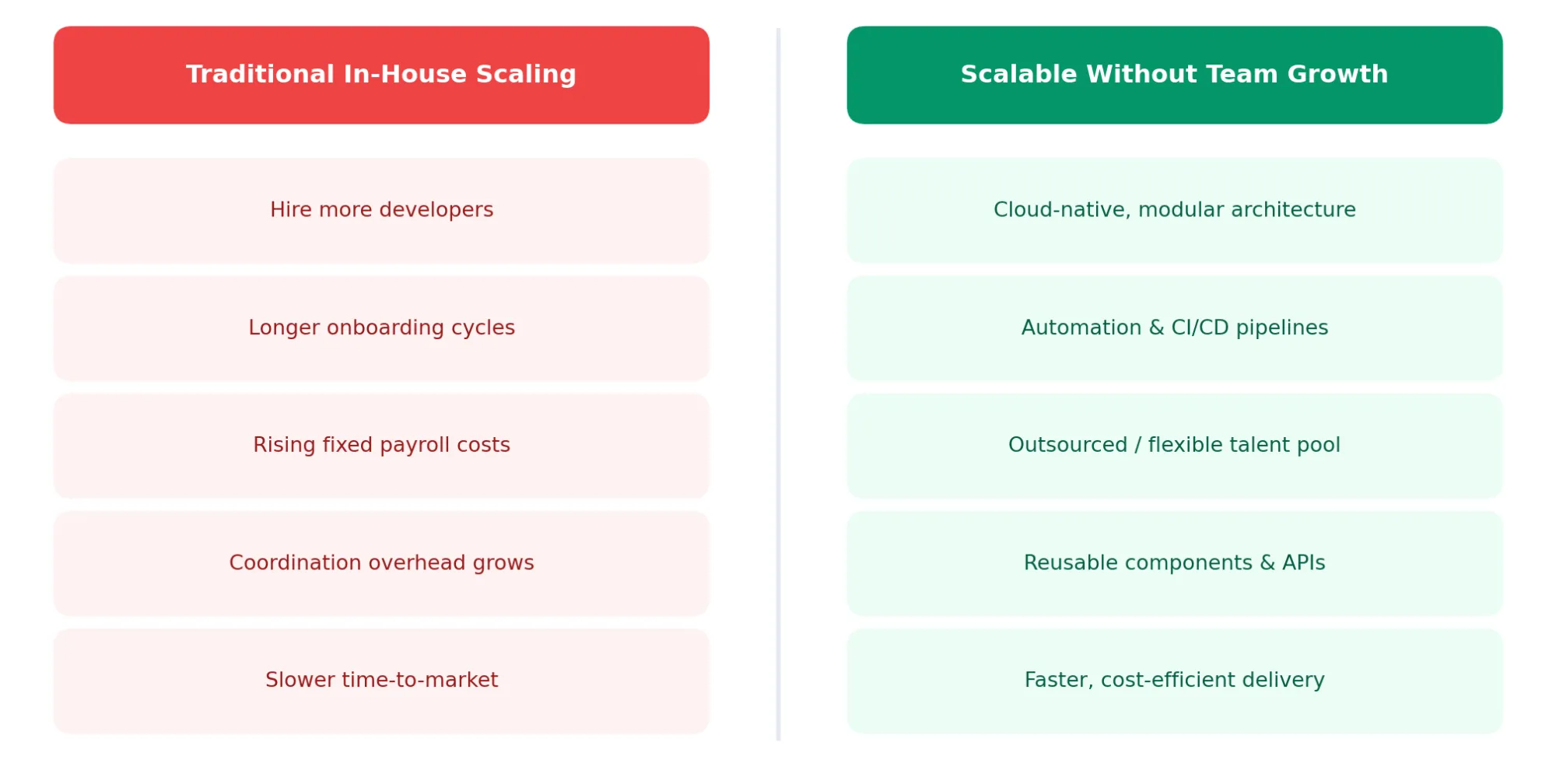
Core Strategies for Scalable Software Product Development
1. Build on Cloud-Native, Modular Architecture
A scalable product starts with the right technical foundation. Cloud infrastructure and modular, microservices-based architecture let your product handle growing user loads without a proportional increase in engineering effort.
- Use managed cloud services (AWS, Azure, GCP) to auto-scale infrastructure on demand.
- Break monolithic applications into independent, reusable modules or microservices.
- Design APIs first, so new features and integrations plug in without rebuilding core systems.
2. Automate Everything You Can
Automation is one of the highest-leverage investments in Software Product Development. It reduces the manual work that would otherwise require more people.
- Set up CI/CD pipelines for automated testing, builds, and deployments.
- Use infrastructure-as-code to provision environments consistently and quickly.
- Automate QA with regression and load-testing suites instead of manual test cycles.
3. Tap Into Outsourced and Flexible Talent
Instead of hiring full-time for every skill set, extend your capacity through outsourcing partners, freelance specialists, or a dedicated development team from a trusted software product development company.
- Bring in specialized expertise (DevOps, security, UI/UX) only when needed.
- Scale team size up or down based on project phase and budget.
- Reduce long-term fixed costs while accessing senior-level skills.
4. Reuse Components and Platforms
Reinventing the wheel for every feature slows teams down. Reusable design systems, shared component libraries, and third-party platforms (payments, authentication, analytics) let a small team ship faster.
- Adopt a design system so UI development doesn't start from scratch each time.
- Integrate proven SaaS tools instead of building non-core features in-house.
- Maintain internal libraries of reusable code and services across products.
5. Use AI-Assisted Development
AI-powered coding assistants, automated code review tools, and intelligent testing frameworks are quietly becoming a force multiplier in modern Software Product Development, letting existing developers do meaningfully more.
- Use AI pair-programming tools to speed up routine coding tasks.
- Apply AI-driven code review to catch issues before they reach production.
Leverage predictive analytics to prioritize the features that matter most.

Choosing the Right Development Partner
For most lean teams, the fastest path to scalable Software Product Development is partnering with an experienced outsourcing or product development firm rather than building every capability internally. When evaluating a partner, look for:
- A proven track record with products at a similar scale to yours.
- Clear communication processes and time-zone compatibility.
- Flexible engagement models from a single specialist to a full dedicated team.
- Strong DevOps and security practices baked into their delivery process.
| Also read: How Software Product Development Accelerates Product Launch Timelines in 2026
Key Takeaways
- Treat scalability as both an architectural and a process issue, not just a manpower issue.
- Focus on cloud infrastructure and automation before scaling the team.
- Leverage outsourcing and flexible labor for access to skill sets on demand.
- Leverage reuse of components, platforms, and AI systems for increasing productivity of your current team.
- Select development partners who will increase your capabilities, not just capacity.
Scaling your software product does not necessarily require scaling your organizational structure. With the right architecture and automation, even small teams can build and ship software many times faster than much larger companies, and demonstrating that great Software Product Development really boils down to efficiency.



























Sign in to leave a comment.