

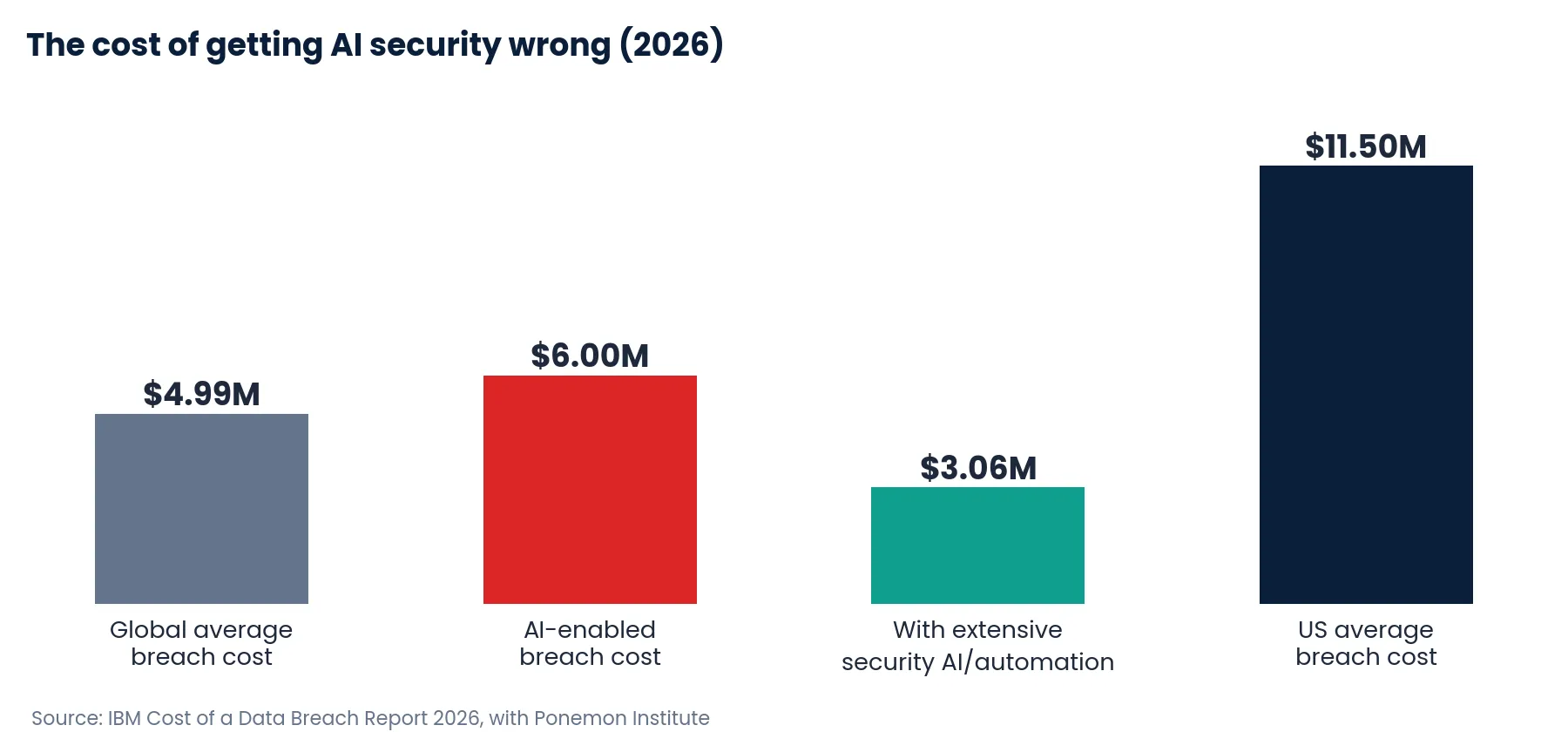
Enterprise buyers now treat AI security as a deal-breaker, not a checkbox. IBM's 2026 Cost of a Data Breach Report puts the global average cost of a breach at $4.99 million, up 12% year over year, and breaches involving AI cost roughly $6 million on average, about $1 million more than the norm. Gartner adds another warning sign: 76% of enterprises now cite data privacy and security as their top AI risk, ahead of accuracy or cost.
For teams offering AI product development services, this changes the brief. Security and compliance can no longer be bolted on after launch; they have to be designed in from day one. This article outlines the frameworks, controls and processes enterprise-ready AI products actually need.
Why Enterprise Buyers Are Getting Stricter
- 92% of organisations hit by an AI-related breach lacked proper access controls for their AI models and data (IBM, 2026).
- Shadow AI — unsanctioned tools touching company data — was a factor in 43% of AI incidents, more than double the prior year.
- Gartner expects more than 50% of large enterprises to face mandatory AI compliance audits.
- 30% of AI security incidents trace back to supply-chain compromise: infected apps, APIs, and third-party plugins.
The pattern is consistent: AI is being adopted faster than it is being governed. Gartner expects 40% of enterprise applications to integrate task-specific AI agents by the end of 2026, up from under 5% in 2025, yet only 24.4% of organisations have full visibility into how those agents communicate. That gap between adoption and oversight is exactly what enterprise security teams are now screening vendors for.
The Frameworks Enterprise Buyers Expect
Procurement and security teams increasingly ask for proof against named frameworks before they'll sign a contract. Knowing which ones apply avoids late-stage deal delays.
| Framework | Applies to | Core focus |
|---|---|---|
| SOC 2 Type II | SaaS & B2B AI vendors | Security, availability, confidentiality controls |
| ISO/IEC 42001 | AI management systems | AI governance, risk & lifecycle management |
| NIST AI RMF | US federal & enterprise buyers | Map, measure, manage AI risk |
| GDPR | EU users / data | Lawful basis, data minimisation, user rights |
| HIPAA | Healthcare data | PHI protection, access controls, audit trails |

Building Security In: A Layered Approach
1. Governance and Policy
- Adopt NIST AI RMF or ISO/IEC 42001 as the governance backbone.
- Document an internal AI usage policy covering approved tools and data types.
2. Data and Privacy
- Apply data minimisation: only collect and retain what the model needs.
- Encrypt data at rest and in transit; more than half of breached organisations had gaps here.
- Map data residency requirements for every region you serve.
3. Access and Identity
- Enforce role-based access control and SSO/SAML for enterprise customers.
- Apply least-privilege scopes to AI agents, not just human users.
4. Model and Application Security
- Defend against prompt injection and validate model outputs before they trigger actions.
- Keep detailed audit logs of prompts, outputs and agent actions.
5. Independent Assurance
- Pursue SOC 2 Type II early; it is the credential most enterprise buyers ask for first.
- Commission regular penetration testing and third-party audits.
These five layers are not sequential milestones you complete once. They form a continuous cycle: governance sets the rules, data and access controls enforce them, model-level defences catch what slips through, and independent audits verify the whole system still holds as the product evolves.
A Practical Compliance Checklist

Where AI Product Development Services Add the Most Value
Specialist AI product development services shorten this path because they bring reusable governance templates, pre-vetted vendor stacks and security architects who have taken products through SOC 2 or HIPAA audits before. That experience matters: organisations using AI and automation extensively in security operations cut breach costs by nearly $1.93 million and shortened breach lifecycles by 65 days, according to IBM.
- Security architecture review before the first line of code is written.
- Compliance-mapped documentation delivered alongside the product, not after.
- Ongoing monitoring for shadow AI and unauthorised integrations.
Common Mistakes to Avoid
- Treating compliance as a launch-week formality instead of a design input.
- Giving AI agents standing access to production data "for convenience."
- Skipping vendor and API security reviews under deadline pressure.
- Leaving audit logging until after the first customer security questionnaire arrives.
The risk is not theoretical. One widely reported 2026 case saw an AI coding agent delete a production database and its backups, one of several failures covered in this look at the real cost of AI coding. Least-privilege scopes and audit logging are what keep a mistake like that contained.
How Long Proper Compliance Takes
Budget realistic time for this work. A SOC 2 Type II audit typically requires 3–12 months of evidence collection before certification, and ISO/IEC 42001 readiness assessments often run in parallel with product development rather than after it. Building these timelines into your roadmap from the start avoids the common trap of promising an enterprise pilot before the controls exist to support it.
| Also read: How to Find an AI Product Development Partner for Production-Ready Solutions
Conclusion
Enterprise buyers are no longer asking whether your AI product works; they are asking whether it can be trusted with their data. With breach costs at record highs and over half of large enterprises facing mandatory AI audits, the products that win enterprise deals will be the ones built with governance, access control, and independent assurance from the start. Partnering with experienced AI product development services is often the fastest way to get there without slowing down delivery.

























Sign in to leave a comment.