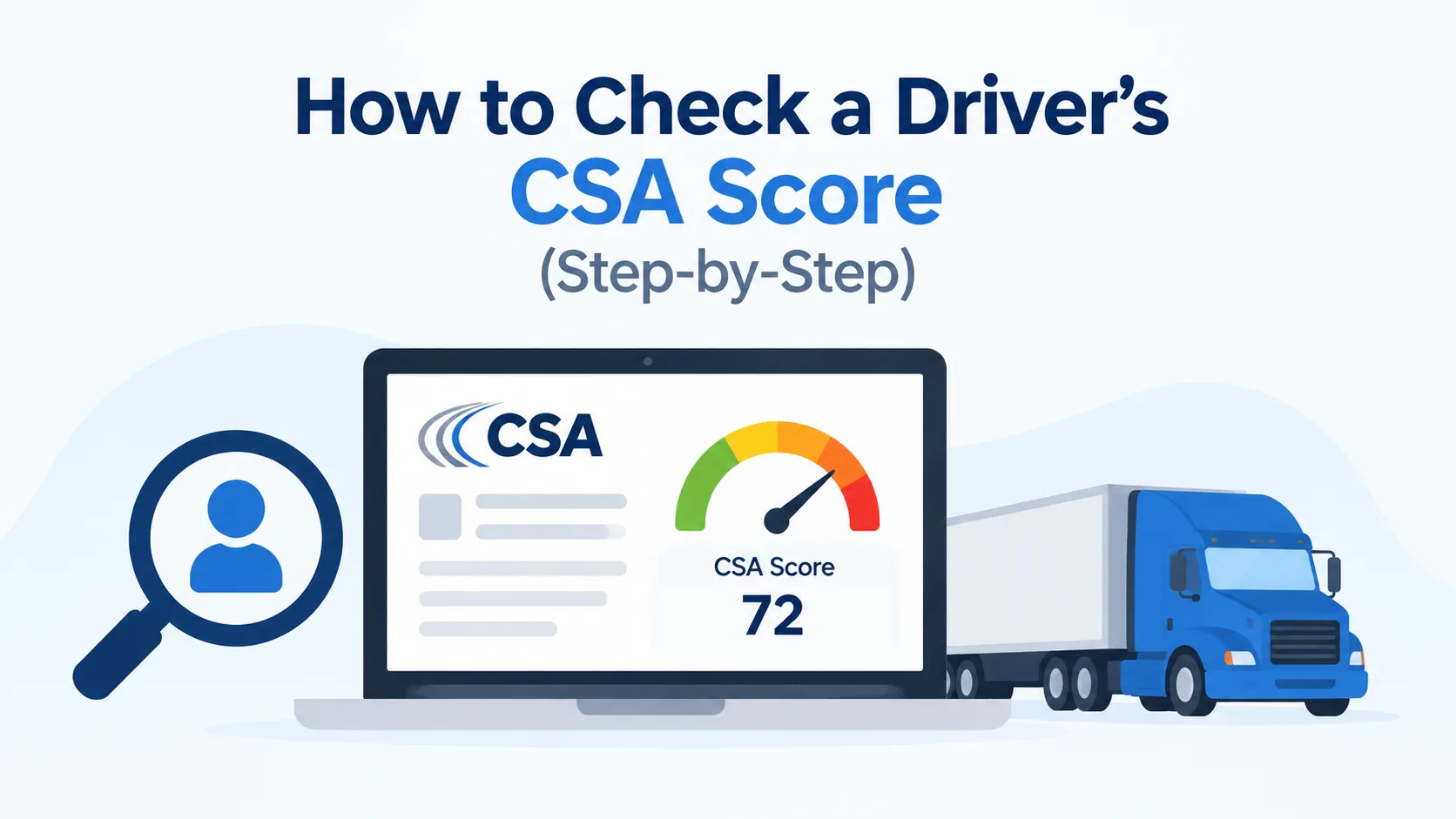

Anyone who works in trucking long enough eventually runs into the term "CSA score." Brokers ask about it before booking a load, insurance underwriters use it to set premiums, and safety managers watch it like a hawk because a bad score can shut down operations. But if you've never had to pull one yourself, the process can feel oddly buried inside government websites that weren't built with ease of use in mind.

This guide breaks down exactly how to check a CSA score step by step, using the same identifiers and public tools that brokers, carriers, and fleet safety teams rely on every day. Before you can look at safety history, though, you need the right starting point, and that almost always means a DOT Number Lookup. Every CSA record in the federal system is tied to a carrier's USDOT number, so getting that number right is the foundation everything else builds on.
Platforms like Carrier90 exist largely to make this first step less painful, since searching by company name, MC number, or address can otherwise mean bouncing between several different government portals. If you already have an MC number instead of a DOT number, running an MC Number Lookup will usually get you to the same destination, since the two identifiers are cross-referenced in FMCSA's records.
Once you have the right identifiers in hand, the actual CSA Score data becomes accessible through FMCSA's own systems, which we'll walk through in detail. Along the way, we'll also touch on related concepts like fmcsa licensing and insurance status, how Largest Fleets tend to be scored differently than owner-operators, and how to spot Chameleon Carriers trying to hide a poor safety history behind a new registration.
By the time you finish reading, you should have a repeatable process you can use for any carrier, whether you're vetting a new hauling partner or just curious about a company you're considering driving for. Let's start with what a CSA score actually is, because that context matters before you go looking one up.
What a CSA Score Actually Measures
CSA stands for Compliance, Safety, Accountability, and it's a program run by the Federal Motor Carrier Safety Administration to track how safely commercial carriers operate. The program relies on a system called SMS, short for Safety Measurement System, which converts roadside inspection data, violations, and crash reports into scored categories.
A common point of confusion is that people ask about a "driver's" CSA score, but the scoring system technically applies to carriers, not individuals. A driver's actions on the road, such as violations found during a roadside inspection, feed into the carrier's overall record, but the score itself belongs to the motor carrier operating under a specific DOT number.
This is why the very first step in checking a CSA score is always identifying the correct carrier, not the driver. Once you understand that relationship, the rest of the process makes a lot more sense.
Why This Data Matters to So Many Different People
Freight brokers use CSA data to decide which carriers they're comfortable booking loads with, since a poor safety record can expose them to liability if something goes wrong. Insurance companies use similar data to price policies, often charging higher premiums to carriers sitting in risky percentile ranges.
Shippers care too, particularly larger companies that could face negligent-hiring claims if they knowingly worked with an unsafe carrier. Even drivers have a stake here, since a driver's employment history under a carrier with a bad CSA record can follow them when they're looking for their next job.
Understanding how to read this data isn't just a compliance exercise. It's practical risk management for anyone whose business depends on trucking.
The Seven BASIC Categories, Explained
Before diving into the lookup process, it helps to understand what's actually being scored. FMCSA organizes safety performance into seven categories known as BASICs, short for Behavior Analysis and Safety Improvement Categories.
These categories are:
- Unsafe Driving — speeding, reckless maneuvers, improper lane changes
- Hours-of-Service Compliance — violations tied to driver fatigue regulations
- Driver Fitness — licensing issues, expired medical certifications, qualification problems
- Controlled Substances/Alcohol — drug and alcohol violations
- Vehicle Maintenance — brake, tire, and lighting defects found during inspections
- Hazardous Materials Compliance — improper hazmat handling or labeling
- Crash Indicator — the frequency and severity of crashes tied to the carrier
Each carrier receives a percentile ranking in the categories that apply to their operation, based on how their violation history compares to similar carriers. It's worth remembering this ranking system as we move into interpreting scores later, because it doesn't work quite the way most people expect.
Step 1: Nail Down the Carrier's DOT Number
The very first thing you need is the carrier's USDOT number, since this is the anchor point for every piece of CSA data that follows. If you already have documentation like a bill of lading, an insurance certificate, or a signed contract, the number is probably printed right on it.
If you don't have it handy, you'll need to search by name instead. A dot number lookup by name through FMCSA's public database usually returns the correct match within the first few results, though generic company names can produce a longer list to sift through.
Adding a city or state to your search narrows things down considerably when a company name is common. If you happen to know the carrier's MC number instead, that works just as well, since an mc number lookup will typically surface the linked usdot number as part of the registration details.
Step 2: Confirm Basic Details Through SAFER
Once you have a DOT number, your next stop is FMCSA's SAFER system, short for Safety and Fitness Electronic Records. This free, public tool gives you a general snapshot of a carrier's operating status, authority type, and fleet size.
Entering the DOT number into SAFER will show you whether the carrier's authority is active, whether they're authorized for property or passenger transport, and roughly how many trucks and drivers they operate. It's a useful first checkpoint before diving into more detailed safety data.
One thing to keep in mind is that SAFER doesn't show detailed BASIC percentile scores on its own. For that level of detail, you need to move on to the actual SMS portal, which is where the real CSA numbers live.
Step 3: Pull Detailed Scores From the SMS Portal
FMCSA's Safety Measurement System is the actual source of CSA percentile data, broken down by each of the seven BASIC categories described earlier. To use it, you enter the carrier's confirmed USDOT number into the SMS search tool.
The resulting dashboard shows percentile rankings for each applicable category, along with details like the number of inspections and violations behind each number. Some categories may display "insufficient data" rather than a percentile, which simply means the carrier hasn't accumulated enough inspections in that area yet.
This isn't necessarily a red flag on its own, especially for newer or smaller carriers. It just means there isn't a large enough sample size to generate a statistically reliable ranking in that particular category.
Step 4: Learn to Read the Percentiles Correctly
This step trips up a surprising number of people, so it's worth slowing down here. CSA percentiles work in reverse compared to how most scoring systems work. A lower percentile means better relative performance, while a higher percentile signals worse performance compared to peer carriers.
For example, a carrier ranked at the 15th percentile in Vehicle Maintenance is performing better than 85% of similar carriers in that category. A carrier at the 90th percentile, on the other hand, is performing worse than 90% of its peers, which puts it much closer to FMCSA's intervention thresholds.
Those thresholds vary depending on the type of carrier and the category involved, with stricter limits typically applied to hazmat and passenger carriers. Crossing a threshold can trigger further scrutiny, warning letters, or in serious cases, audits and enforcement action.
Step 5: Check Licensing and Insurance Status Separately
A strong CSA score doesn't automatically mean a carrier is fully compliant, which is why checking fmcsa licensing and insurance status is a separate but equally important step. A carrier can have a reasonably clean safety record while still operating with lapsed or insufficient insurance coverage.
FMCSA's licensing records show whether a carrier's operating authority is active, revoked, or pending, along with the insurance company currently on file and the type of coverage held. This is typically listed as public liability or cargo insurance, depending on the carrier's operation type.
Reviewing licensing and insurance fmcsa records alongside CSA percentiles gives a far more complete risk picture than looking at either one in isolation. A carrier with decent safety scores but no valid insurance on file is still a serious liability for anyone considering working with them.
Step 6: Look at Raw Inspection and Crash Reports
For anyone doing more thorough due diligence, it's worth going beyond the summary percentiles and reviewing the raw inspection and crash records behind them. These reports include the date, location, and specific nature of each violation, which adds useful context that a single percentile can't provide.
A carrier might show a high percentile in one category simply because of a cluster of minor violations from a single inspection event, rather than a genuine ongoing safety issue. Reading the actual reports helps separate isolated incidents from real patterns of risk.
This level of detail becomes especially valuable when evaluating a driver moving from one carrier to another, or when deciding whether to enter a longer-term business relationship with a new hauling partner.
Understanding Why Some Carriers Show No Score at All
New or smaller carriers frequently show several BASIC categories with no percentile at all, simply labeled as insufficient data. FMCSA requires a minimum number of relevant inspections before it will generate a statistically valid ranking, which protects smaller operators from being unfairly judged on too small a sample.
This means a blank score is not the same thing as a clean record, and it's a mistake to treat the two as equivalent. Anyone running a usdot number lookup on a newer company should keep this limitation in mind rather than assuming the absence of a score is automatically good news.
As these carriers accumulate more roadside inspections over time, their percentile scores will naturally begin to populate. This is one reason experienced brokers often request supporting documentation, such as insurance certificates and references, when vetting newer carriers that don't yet have a full CSA history.
The Problem of Chameleon Carriers
One complication that makes this kind of research more important is the existence of chameleon carriers. These are companies that shut down operations under one name and DOT number, typically after building up a poor safety record, and then re-register under a new name to effectively erase that history.
This practice undermines the entire purpose of CSA scoring, since a carrier with serious past violations can appear to have a clean slate on paper, even if the same trucks, drivers, or ownership are still involved behind the scenes. FMCSA has worked to identify these patterns by cross-referencing company officers, physical addresses, and equipment across different registrations.
Even so, it remains a pattern worth watching for independently. A "new" carrier with only a few months of registration but claims of years of industry experience, or one whose ownership overlaps with a previously shut-down company, deserves closer scrutiny before you agree to work with them.
Reading Red Flags Beyond the Score Itself
A clean CSA score doesn't automatically mean a carrier is trustworthy, and a middling score doesn't always mean a carrier should be avoided outright. Context matters quite a bit here, so it's worth looking at a few supporting details alongside the raw percentile numbers.
Some useful things to check include how long the carrier has held active operating authority, whether their listed address corresponds to a real, verifiable business location, and whether their insurance provider is a recognizable, established company. Carriers that change names, addresses, or insurance providers frequently within short periods are worth a second look before moving forward.
This kind of pattern recognition is easier when you're comparing a carrier's full registration history rather than just a single snapshot in time. Odd details that seem minor in isolation often become much clearer once you can see the full timeline of a company's changes.
How Brokers Build CSA Checks Into Their Workflow
Most established freight brokerages have some version of a CSA check built into their carrier onboarding process. Before approving a new carrier to haul freight, brokers typically confirm the DOT number, review percentile rankings across the relevant BASIC categories, and verify that insurance and operating authority are both current.
Some brokerages set firm internal cutoffs, declining to work with carriers that exceed certain percentile thresholds in categories like Unsafe Driving or Crash Indicator. Others take a more balanced approach, weighing CSA data alongside factors like driver turnover, equipment age, and direct references from other shippers.
Shippers moving high-value or sensitive freight often require their logistics partners to demonstrate this kind of due diligence contractually. In the event of an accident, a shipper's own legal exposure can depend heavily on whether they took reasonable steps to select a safe carrier in the first place.
How Large Fleets Are Scored Differently
Carrier size has a real effect on how CSA percentiles behave, which is worth understanding if you're comparing a small owner-operator against one of the industry's Largest Fleets. Bigger carriers accumulate inspections much faster simply due to volume, which tends to produce more statistically stable percentile scores over time.
A large fleet with thousands of trucks might absorb a handful of serious violations without seeing a dramatic shift in its overall percentile, purely because of how the math averages out across a large number of inspections. A small carrier with only a few trucks can see a much bigger swing in their score from the same number of violations, since each incident carries more relative weight.
This doesn't mean size alone determines safety quality, but it does mean percentile comparisons across very differently sized carriers should be made carefully. A mid-range percentile for a massive national fleet and the same percentile for a five-truck regional carrier can represent very different underlying realities.
Common Mistakes People Make During This Process
One of the most frequent errors is confusing a carrier's overall safety rating with its CSA percentile scores. FMCSA safety ratings, such as Satisfactory, Conditional, or Unsatisfactory, come from a separate compliance review process and are only assigned to a relatively small percentage of carriers, while CSA percentiles update continuously based on ongoing roadside data.
Another common mistake is trying to search by a driver's personal name rather than the carrier's identifying numbers. Since CSA data is tied to carriers rather than individuals, this typically returns nothing useful unless the driver in question also happens to be the registered carrier, which does happen among owner-operators.
People also frequently misread the direction of percentile scores, assuming higher numbers are always better, similar to a school grading scale. As covered earlier, the relationship is actually reversed for CSA data, and this misunderstanding alone can lead to poor vetting decisions if it isn't caught early in the process.
Where a Tool Like Carrier90 Fits Into This
Platforms such as Carrier90 were built to simplify the early identification stage of this process, which tends to be the most time-consuming part for people unfamiliar with FMCSA's systems. Rather than manually cross-referencing separate mc number lookup and lookup dot number searches across different government portals, a consolidated search can return both identifiers along with basic company details in one place.
This kind of tool doesn't replace the need to visit FMCSA's SMS portal for detailed BASIC percentile data, but it does remove friction from the initial identification step, which is often where people get stuck or waste the most time. Once you have a confirmed DOT number in hand, moving on to the actual CSA data becomes considerably faster.
For anyone doing this kind of research regularly, whether for hiring drivers, brokering loads, or underwriting insurance policies, having a fast and reliable lookup step built into a normal workflow saves meaningful time over weeks and months of repeated searches.
Step-by-Step Summary
To bring the entire process together into one clear sequence, here's how it looks from start to finish. First, confirm the carrier's DOT number, either from existing documentation or through a name-based search if you don't already have it.
Second, run that number through FMCSA's SAFER system to confirm basic operating status, authority type, and general fleet information. Third, take that confirmed number into the SMS portal to pull detailed percentile scores across all applicable BASIC categories.
Fourth, interpret those percentiles correctly, keeping in mind that lower numbers reflect better relative safety performance. Fifth, separately verify that the carrier's insurance and operating authority are both current, since this information isn't captured within the CSA percentiles themselves.
Sixth, if anything about the carrier's profile seems inconsistent, such as an unusually clean record paired with a very short registration history, dig into the underlying crash and inspection reports for additional context, and watch for the warning signs associated with chameleon carrier behavior.
What a Strong Profile Looks Like Compared to a Concerning One
A carrier with a generally strong safety profile will typically show low percentiles across most or all relevant BASIC categories, a consistent and unbroken history of active operating authority, and current insurance on file with a recognizable, established provider. Their crash indicator will usually reflect few preventable incidents relative to their overall fleet size and mileage.
A more concerning profile might show multiple categories sitting above intervention thresholds, particularly in Unsafe Driving or Vehicle Maintenance, combined with a surprisingly short operating history despite claims of extensive industry experience. Frequent changes in company name, physical address, or insurance provider are additional details worth investigating further before committing to any kind of business relationship.
It's worth repeating that no single number tells the complete story here. The goal is to build a reasonably full picture using DOT records, percentile data, and supporting documentation together, rather than leaning on any one data point in isolation.
The Limitations Worth Keeping in Mind
CSA data is genuinely useful, but it isn't a flawless measure of safety on its own. Percentiles are relative rankings, which means a carrier's score can shift simply because other carriers around them improved or declined, even if that specific carrier's own violation count stayed completely flat.
The scoring formula also weighs recent violations more heavily than older ones, which means a carrier's percentile can gradually improve over time even without any deliberate safety changes, simply as older incidents age out of the calculation window. This is a known characteristic of how the system works rather than a flaw exactly, but it's worth remembering when comparing scores from different points in time.
Inspection frequency also varies quite a bit by state and by carrier type, meaning two carriers with genuinely similar safety records could show different percentiles purely due to how often they've been inspected. This is part of why FMCSA requires a minimum inspection count before generating a score in any given category in the first place.
Practical Tips for Carriers Trying to Improve Their Standing
For carriers actively working to improve their CSA percentiles, the most effective approach usually involves addressing root causes rather than trying to influence the score directly. This means investing in consistent vehicle maintenance schedules, tightening up hours-of-service compliance through better dispatch planning, and providing targeted driver training focused on whichever BASIC categories show the most violations.
Reviewing inspection reports soon after they happen, rather than waiting for a periodic review, allows a carrier to catch and correct emerging patterns before they accumulate into a bigger percentile problem. Some carriers also use FMCSA's DataQs system to formally dispute inspection results they believe were recorded incorrectly, which is a legitimate part of maintaining accurate CSA data over time.
For individual drivers, the most direct path forward is simply consistent, careful driving and properly maintained equipment, since roadside interactions are the raw material the entire scoring system is built from. Drivers considering a move to a new employer can also do their own homework beforehand, running the same kind of check a broker or shipper would, to avoid unknowingly inheriting a poor safety record they had no hand in creating.
Final Thoughts
Checking a "driver's" CSA score really means checking the score of the carrier that driver operates under, since that's how FMCSA structures the entire system. Once you understand that distinction, the actual process is fairly straightforward: confirm the DOT number, review the SAFER summary, pull detailed percentiles from the SMS portal, and separately verify current insurance and licensing status.
Tools that combine identifier searches in one place can speed up the early steps considerably, but the real value comes from understanding what the percentiles mean and how the underlying formula works. Remember that lower percentiles reflect better relative performance, that missing data isn't the same thing as a clean record, and that raw inspection and crash reports often add context that summary numbers alone can't provide.
The practical takeaway is simple: never rely on a single number in isolation. A thorough CSA check combines a confirmed DOT number, detailed BASIC percentile scores, verified insurance and licensing status, and a look at the underlying inspection history, giving you a far more accurate and reliable picture of a carrier's actual safety record than any one data point could offer on its own.






























Sign in to leave a comment.