


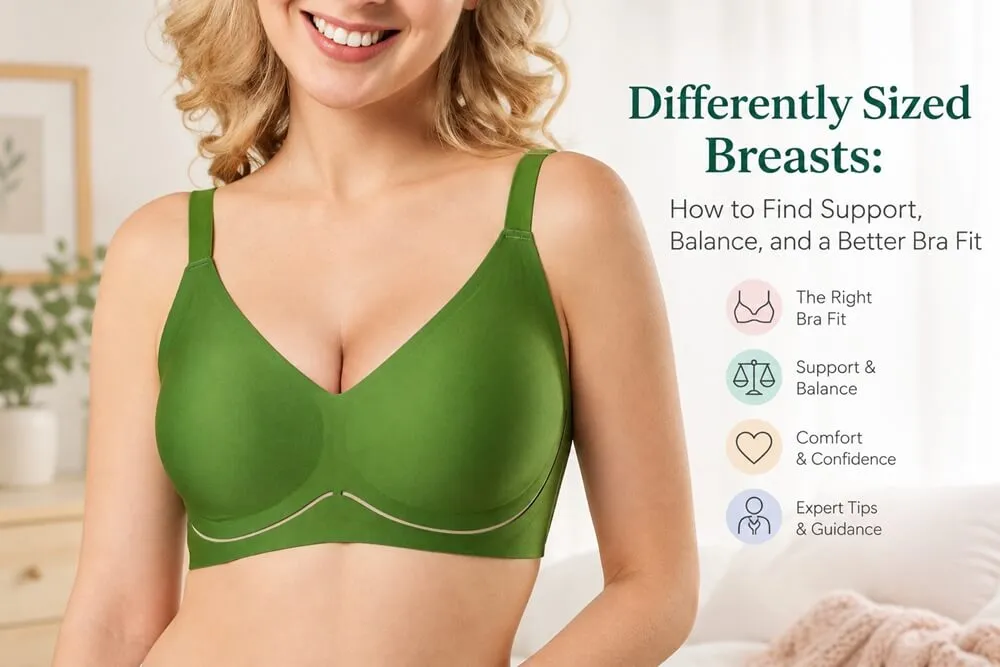
Breasts rarely come as a perfectly matching pair. One may be slightly fuller, sit a little higher, have a different shape, or simply fit a bra cup differently. In fact, having some natural breast asymmetry is common.
The challenge usually begins when you try to put two different shapes into a bra designed with two matching cups.
Maybe one cup fits beautifully while the other has a small gap. Maybe one side feels squeezed while the other still has room. Or perhaps your bra looks fine in the mirror but shifts as soon as you start walking, bending, or reaching.
The good news is that you don't need to find a bra that makes both breasts perfectly identical. You need a bra that fits your fuller side comfortably and gives you enough flexibility to fine-tune the smaller side.
After years of looking at bra construction, fit, and everyday wear, this is the approach I recommend: start with the larger breast, look beyond the size label, and judge the bra by how it behaves on your body—not just how it looks when you first put it on.
Why Uneven Breasts Can Make Bra Shopping Difficult
“Uneven breasts” doesn't always mean that one breast is simply a cup size larger.
The difference may involve:
- Breast volume
- Breast shape
- Upper or lower fullness
- Projection
- Breast position
- Root width
- Nipple position
That matters because two breasts can have similar volume but still need different amounts of space in a cup.
For example, a rigid molded cup may fit one breast beautifully but leave space above the other. A softer stretch cup may adapt much more naturally.
This is why I don't recommend treating asymmetry as simply a question of finding a bigger or smaller bra size. Bra construction matters just as much as the number on the label.
Tarbo Fit Expert Note: When breasts are different sizes, don't try to force both sides to fill the cups in exactly the same way. First make sure the fuller breast has enough room and support. Then fine-tune the smaller side.
The Most Important Rule: Fit the Larger Breast First
If you remember only one thing from this article, make it this:
Fit your bra to the larger or fuller breast first.
Suppose your left breast comfortably fills the cup while your right breast is fuller. If you choose the cup size based on the smaller side, the larger breast may spill over, feel compressed, or have the underwire sitting on breast tissue.
That's not a problem you can fix by simply tightening the strap.
Instead, choose enough cup capacity for the fuller breast. Once that side is comfortably contained, you can deal with the extra space on the smaller side.
A small amount of extra room is usually easier to manage than trying to squeeze a fuller breast into a cup that is too small.
This principle is also reflected in Tarbo's guide to fitting bras for differently sized breasts.
How to Measure When Your Breasts Are Uneven
Measurements are useful, but think of them as a starting point, not the final answer.
1. Measure your underbust
Use a soft measuring tape around your ribcage, directly underneath your breasts.
Keep the tape level around your body. It should feel snug without digging painfully into your skin.
The band is important because it provides much of the bra's foundation.
2. Measure around your bust
Take the measurement around the fullest part of your breasts while standing naturally.
Don't pull the tape extremely tight.
3. Use your measurements to find a starting size
Check the individual brand's size chart because bra sizing can vary between brands and styles. Tarbo's own bra-size guide also emphasizes that measurements are only the first step; the actual fit of the bra still needs to be checked.
4. Identify which breast needs more cup capacity
You don't need to calculate an exact separate cup size for each breast.
Instead, ask:
Which side determines whether this cup is large enough?
Usually, that will be the fuller side.
How to Check the Fit When You Try the Bra On
Once you have a starting size, don't immediately decide whether the bra works based on the front view.
I recommend a simple fitting routine.
Step 1: Put the bra on properly
Fasten the band and adjust the straps.
Then gently scoop the breast tissue into the cups so it is sitting naturally inside the bra.
Step 2: Check the larger breast
Look at the fuller side first.
Ask:
- Is breast tissue spilling over the top?
- Is the cup edge cutting into the breast?
- Is the breast being compressed?
- Is the underwire sitting on breast tissue?
- Does the cup feel too shallow?
If the answer is yes, don't solve the problem by tightening the strap. You may need more cup room or a different cup shape.
Step 3: Check the smaller breast
Now look at the other side.
A little extra space isn't automatically a problem.
What matters is whether there is:
- Significant gaping
- Excessive wrinkling
- Cup movement
- Lack of support
- A visible gap that bothers you under clothing
If the smaller side has a noticeable gap, you can often adjust it with the right bra construction rather than changing the entire size.
Step 4: Check the band
The band should feel secure and stay reasonably level around your body.
If the back of the bra rides upward, don't immediately tighten the shoulder straps. The band may not be providing enough stability.
Step 5: Adjust the straps independently
Your breasts don't have to be identical, so your strap settings don't necessarily need to be identical either.
One strap may need to be slightly shorter than the other.
Just remember that straps should fine-tune the fit—not provide all the support.
Don't Forget the Shape of Your Breasts
Size isn't the whole story.
Breasts can have more fullness at the top, bottom, center, or outer sides. They can also differ in projection or position.
This explains why you can wear the “right” size and still feel like something isn't working.
A deep molded cup, for example, may leave space at the top if your breast is less full there. A flexible or stretch cup may follow your natural shape more easily.
So when shopping, ask two questions:
Does the cup have enough volume?
and
Does the cup have the right shape for me?
Those are different questions.
For more general sizing help, Tarbo's bra-size guide explains how to measure your band and bust and then use the result as a starting point.
Bra Features That Can Help With Uneven Breasts
Removable padding
This is one of the simplest ways to fine-tune a difference between the two sides.
If the smaller breast doesn't completely fill the cup, a removable pad or insert can add a little volume without making the entire bra smaller.
The important word is little.
You don't necessarily need thick padding. The goal is to fill excess space and create a comfortable, balanced fit.
Stretch or flexible cups
Stretch materials can be particularly forgiving when the two breasts don't have exactly the same volume.
Instead of forcing your body into a rigid shape, the material can accommodate small differences more naturally.
Adjustable straps
Independent strap adjustment is useful when the breasts sit at slightly different heights or when one side needs a little more lift.
Soft, flexible construction
If rigid molded cups repeatedly create gaping on one side, try a softer construction.
A flexible cup can sometimes follow the smaller breast more naturally while still providing enough coverage for the fuller side.
Good band support
Don't underestimate the band.
If the band is too loose, the bra may shift from side to side, making asymmetry more noticeable and reducing support.
A stable band gives the cups a much better foundation.
Which Bra Styles Work Well for Uneven Breasts?
There isn't one universal “best bra” for every woman with asymmetry. The right choice depends on how different your breasts are and what you want from the bra.
Wireless bras
Wireless designs can offer a flexible, less structured feel.
They're particularly worth considering for everyday wear when comfort and adaptability are priorities.
However, not every wireless bra fits the same way. Look for a supportive band, adequate coverage, and a cup that can accommodate your fuller side.
T-shirt bras
T-shirt bras can create a smooth appearance under fitted clothing, but rigid molded cups can make gaping more noticeable on the smaller side.
If you like T-shirt bras, look for softer or more forgiving construction, particularly if your asymmetry is noticeable.
Unlined bras
Unlined cups can adapt well to natural breast shapes because there is less rigid material controlling the silhouette.
The trade-off is that natural differences may be more visible under thin clothing.
Push-up bras
Push-up styles can visually balance the breasts, especially when the padding is removable or adjustable.
But be careful with symmetrical fixed padding. If both sides receive exactly the same amount of lift, the difference may still be visible.
Full-coverage bras
More coverage can provide a secure feeling and help contain both breasts comfortably.
This can be useful if your larger breast tends to spill from lower-coverage cups.
What About Seamless Bras?
Seamless bras are worth considering if you want smooth lines under everyday clothing.
A seamless construction can reduce visible cup edges, while flexible materials may accommodate modest differences between the two breasts.
For example, Tarbo's Seamless W-Mesh Jelly T-Shirt Bra – Back Smoothing is an example of a wireless, seamless everyday bra construction. Its design can be considered by women who prioritize a smooth appearance and wire-free feel.
The important point is not that one particular bra will solve every asymmetry. The product still has to fit your individual breast shape and the fuller side comfortably.
Tarbo is a lingerie brand focused on everyday comfort and wireless/seamless designs, but the same fitting principles apply regardless of brand.
A Simple Problem-Solving Guide
| If you notice... | Try this first |
|---|---|
| One cup spills over | Fit the larger breast with more cup room |
| One cup has a small gap | Try a removable insert or more flexible cup |
| One cup wrinkles badly | Check cup shape and breast placement |
| One wire digs into one side | Check whether the wire is sitting on breast tissue |
| The band rides up | Recheck the band size and adjustment |
| One strap slips | Adjust that strap independently |
| The bra shifts during movement | Check band stability and cup containment |
| The breasts look uneven under a T-shirt | Try a smooth, flexible or lightly molded construction |
| Push-up padding looks uneven | Consider removable or adjustable padding |
Five Common Mistakes to Avoid
1. Choosing the bra based on the smaller breast
This can compress the fuller side.
2. Trying to eliminate every tiny gap
A tiny difference between the cups doesn't necessarily mean the bra is wrong.
3. Over-tightening the straps
Your straps shouldn't have to compensate for a poor cup or band fit.
4. Assuming every cup of the same size fits the same
Cup depth, width, padding, material, and construction all affect the actual fit.
5. Judging the bra while standing still
Your body moves all day, so your bra should be tested in motion too.
The 5-Movement Bra Test
This is one of my favorite ways to judge a new bra.
After putting it on, try these five movements:
1. Raise your arms.
Does the band stay in place?
2. Bend forward.
Does either breast escape the cup?
3. Twist your torso.
Does the bra shift?
4. Sit down.
Does the band remain comfortable?
5. Reach forward and overhead.
Do the cups and straps stay where they should?
If the bra only fits when you're standing perfectly still, it isn't really being tested.
Tarbo Fit Expert Note: A good fit should work with your body, not just look good in a mirror. Pay attention to what happens when you move, because that's when small fitting problems become obvious.
How to Make Uneven Breasts Look More Balanced Under Clothes
You don't have to make your breasts look identical. But if you prefer a more balanced appearance, your clothing can influence which bra construction works best.
Under T-shirts
Try:
- Smooth cups
- Seamless construction
- Light lining
- Removable inserts
Under fitted dresses
Look for:
- Stable cups
- Smooth edges
- Secure band support
- Minimal visible seams
Under low-cut tops
Plunge styles can work, but they may leave less room for adjustment if one breast doesn't fill the cup.
A removable insert can sometimes provide a simple solution.
Under loose clothing
You may not need to correct the asymmetry at all.
There is nothing wrong with allowing your natural shape to look natural.
When Should You Consider a Professional Bra Fitting?
If you have tried several sizes and styles but still can't get both sides comfortable, a professional fitting can be useful.
A knowledgeable fitter can look at:
- Band fit
- Cup depth
- Cup width
- Breast root
- Projection
- Underwire placement
- Strap position
- Overall breast containment
This can be particularly helpful when the difference between the two breasts is more noticeable or when standard cup shapes repeatedly cause problems.
When Uneven Breasts Are More Than a Bra-Fitting Issue
Most natural breast asymmetry isn't something you need to “fix.” Cleveland Clinic notes that slightly different-sized breasts are common.
However, a new or noticeable change is different from long-standing natural asymmetry.
Talk with a healthcare professional if you notice a new change in breast size or shape, a lump, unusual nipple discharge, skin changes, swelling, dimpling, or a nipple that suddenly changes direction. These changes don't automatically mean something serious is happening, but they deserve appropriate medical evaluation.
A bra can improve fit and appearance. It cannot tell you why a new physical change has occurred.
Frequently Asked Questions
Should I choose my bra size based on the larger breast?
Generally, yes. Start by making sure the larger breast has enough room and isn't compressed. Then adjust the smaller side with the bra's flexible features or a removable insert.
Is it normal for one breast to be bigger than the other?
Yes. Some degree of natural asymmetry is common.
Can removable pads help with uneven breasts?
They can. A removable insert can add a small amount of volume to the smaller side without changing the fit of the entire bra.
Are wireless bras good for uneven breasts?
They can be, particularly when the bra has a stable band and flexible cup construction. But wireless doesn't automatically mean a better fit. The construction still needs to accommodate your fuller breast.
Are T-shirt bras suitable for uneven breasts?
They can be. Look for smooth but slightly flexible cups if rigid molded cups tend to leave noticeable gaps.
Why does one cup gap while the other fits?
The most obvious reason is different breast volume, but cup shape, breast placement, and cup construction can also contribute.
Should I tighten the strap on the smaller side?
You can adjust the straps independently, but don't tighten one excessively. If the cup or band doesn't fit properly, strap adjustment won't fully solve the problem.
Do I need a different bra size for each breast?
Usually, no. Bras are sold as a pair, so the practical approach is to choose a size that comfortably accommodates the larger breast and then fine-tune the smaller side.
The Bottom Line
Choosing a bra for uneven breasts isn't about finding a way to make your body perfectly symmetrical.
It's about finding a bra that works with the body you actually have.
Start with your measurements, but don't stop there. Fit the larger breast first. Check the band. Pay attention to cup shape and flexibility. Use removable padding when it genuinely helps. Adjust the straps independently. And always test the bra while moving.
Most importantly, don't let a small difference between your breasts convince you that something is wrong with your body.
The best-fitting bra is the one that lets both sides feel comfortably supported while allowing you to move, work, relax, and go through your day without constantly thinking about your underwear.
























Sign in to leave a comment.