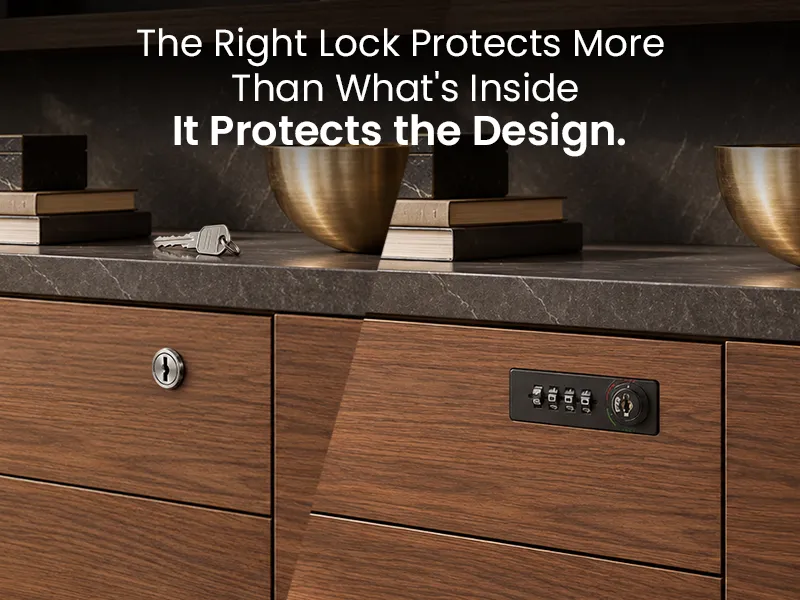

A jewellery vault in a South Delhi farmhouse once sat unopened for three days because nobody could agree on who still had the key. The estate manager had one copy. The housekeeper, temporarily covering while she was on leave, didn't. The homeowner, travelling, was reachable only by a voice note asking someone to "just break it open if you have to." Nobody did — but the incident did something more useful than any showroom demo could: it made everyone in that house rethink what a lock is actually for.
Because a lock isn't just a security decision. It's a decision about who gets access, how often, and under what conditions, which is exactly why hardware for a luxury home in India deserves the same scrutiny as the veneer or the stone. Mechanical versus electronic isn't old technology versus new. It's about matching the mechanism to the ritual, since a study credenza opened twice a week has entirely different needs from a wardrobe drawer opened six times a day.
Quick answer: Choose mechanical furniture locks when physical key operation, no battery dependency, and robust mechanical locking are priorities across multi-drawer stacks, wardrobe shutters, and executive desks. Choose electronic locks when concealed access, credential management, and frequent keyless entry matter more — particularly in handleless cabinetry, vanity compartments, and other areas where visual continuity is the priority.
Consideration 1: Facade Continuity — Will a Visible Key Rosette Interrupt the Millwork?
Designers will specify fluted veneers, sintered stone counters, and imported drawer runners down to the millimetre — and then bolt on a mismatched brass keyhole or a generic cam latch without a second thought. On a handleless, push-to-open veneer front, that keyhole doesn't just look wrong. It breaks the entire visual line the rest of the joinery was built to achieve.
Mechanical locks do require a visible keyhole rosette or escutcheon — though this isn't always a compromise. A matte black, brushed nickel, or brass cylinder can work as an intentional metallic accent against classic timber and decorative hardware, the same way a beautiful hinge is allowed to show.
Where the facade truly needs to disappear, electronic locks solve the problem by hiding entirely. Concealed RFID systems can be integrated behind the cabinet front, keeping the exterior visually uninterrupted — though how well the reader performs through the panel comes down to the reader, antenna, and panel construction, so this is worth confirming with the manufacturer at the specification stage. Where a surface unit is unavoidable, flush capacitive sensors keep the footprint near invisible.
Consideration 2: Staff Management — Who Holds the Key, and How Is Access Delegated?
This is where domestic staffing realities in Indian households tip the decision.
A single physical mechanical key is prone to loss, clutter, and unauthorised duplication; most roadside key-cutting stalls can copy a basic profile in minutes, with no record of it ever happening. Electronic locks solve this differently: biometric fingerprint, PIN, or RFID credentials can be issued temporarily to housekeeping staff, with revocation as simple as switching off a credential on systems that support it. Higher-end systems go a step further, logging timestamped access — something a mechanical key can never offer.
Best applications for each system:
- Mechanical central locking suits multi-drawer desk pedestals and tall wardrobe shutters, where a single cylinder controls an espagnolette rod or a central locking bar across 3 to 4 stacked drawers at once, a natural fit for premium drawer lock systems in executive studies.
- Electronic systems are the better answer for concealed vanity safes, jewellery drawers, and luxury home bar consoles, where daily access speed and a pristine facade matter more than raw pry-resistance.
On upkeep: mechanical locks run on zero batteries and, when made with anti-corrosion brass or stainless steel, hold up against Indian humidity without degrading. Electronic locks typically run on 3 to 4 AAA cells for around 12 months of normal use; better units include an external USB-C emergency port, so a drained battery never strands an owner outside their own drawer.
Consideration 3: Climate Resilience — High-Torque Mechanical Leverage or Motor Stall Under Humidity?
Choosing the best lock for luxury cabinetry in India means accounting for environmental and household dynamics that standard hardware catalogues rarely mention.
Monsoon humidity and mechanical binding. Across coastal belts — Mumbai, Chennai, Alibaug — and the northern plains through monsoon season, humidity can climb high enough to affect timber, veneer, and cabinet tolerances. Premium Indian millwork relies on 18 mm to 25 mm Boiling Water Proof (BWP) marine plywood or high-density fibreboard. Structurally, it performs well — but organic veneers and solid timber lipping still absorb ambient moisture and expand.
That seasonal swell creates a real problem for the low-torque DC micro-motors inside electronic locks. As cabinet components swell or shift out of alignment, the added friction asks more of any motor-driven latch, which is exactly why installation tolerances and emergency-release provisions matter most in humid environments. A mechanical key sidesteps this entirely: a little inward pressure on the drawer face while turning the key clears the latch even when the millwork has expanded.
The structural security fallacy. A common misconception in residential design is equating smart access with forced-entry protection. Access verification and physical security are two different specifications — a biometric reader confirms who's authorised to open a compartment, but the strength of the lock itself still comes down to the latch, locking bolts, mounting method, and cabinet construction. For high-value storage, like jewellery, cash, documents, pairing a premium drawer lock system with robust mechanical locking components adds a layer of physical resistance that access control alone doesn't provide.
Where Each System Makes More Sense
For high-value storage, physical locking strength becomes the more important specification, so the choice is best made zone by zone rather than treating one system as the default for the whole house:
- Entertainment and bar cabinets: concealed electronic/RFID, for a clean facade and the added benefit of child safety.
- Master vanity or walk-in safe drawers: a dual approach: biometric electronic lock for daily convenience, backed by a mechanical deadbolt on the inner lockbox.
- Study credenzas and document drawers: precision mechanical central locking, since access is infrequent and battery drain during long idle periods is a real risk.
This layered approach is increasingly how mechanical vs electronic furniture lock specifications are being approached in premium Indian projects. Brands like Hettich offer a broad collection of furniture locks, letting designers secure stacked executive drawers with a single key turn while maintaining integrated anti-tilt protection.
A Quick Specifier's Checklist
- Panel thickness: Confirm backset and cylinder length against 19 mm/25 mm marine ply + veneer sandwiches
- Emergency override: Any electronic lock should have a mechanical override key or external power port
- Finish matching: Visible mechanical hardware should match drawer runners and hinge finishes
- Installation precision: Follow the manufacturer's drilling and routing dimensions precisely; misalignment can affect both latch engagement and electronic sensing
Head-to-Head Specification Matrix
| Architectural Metric | Precision Mechanical Locks | Hidden Electronic / Keyless Locks |
| Visual disruption | Low to moderate; visible cylinder/escutcheon | Very low when concealed or flush-mounted |
| Power dependency | None | Usually battery-powered |
| Access method | Physical key | PIN, RFID, biometric or other credential, depending on system |
| Access management | Simple; physical key control | Easier to assign/revoke credentials on supported systems |
| Emergency access | Key itself provides access | Should include mechanical override or emergency power provision |
| Physical security | Depends on cylinder, bolt, locking bar and cabinet construction | Depends on latch/bolt, housing, mounting and cabinet construction |
| Maintenance | Low; no battery replacement | Requires battery/credential management |
| Best suited to | Infrequently accessed, multi-drawer or central-locking applications | Frequently accessed concealed compartments and handleless cabinetry |
Manufacturers like German engineering firm Hettich offer engineered mechanical systems — from interchangeable-cylinder platforms to concealed central locking bars — built specifically for integration into slim, flush cabinetry, rather than retrofitted onto it later. Get the choice right, zone by zone, and the vault that once sat locked for three days becomes the exception nobody has to worry about again.






















Sign in to leave a comment.