
Choosing the right medical device manufacturing partner can affect product quality, regulatory compliance, production costs, and time to market. A good partner should do more than build medical devices. They should understand your product, follow strong quality processes, manage production risks, and support your needs as production grows.
Before signing an agreement, review the manufacturer’s experience, quality system, production capabilities, regulatory knowledge, communication, and ability to scale.
1. Check Medical Device Manufacturing Experience
Start by looking at the manufacturer’s experience with products similar to yours. Ask about the types of medical devices they have produced, materials they use, production methods, and markets they serve.
Relevant experience can help reduce production problems and improve communication between your engineering and manufacturing teams.
Ask questions such as:
- Have you manufactured similar medical devices?
- Do you have experience with my device type and materials?
- Can you support both low volume and larger production runs?
- Can you provide references or examples of past work?
A manufacturing partner should also understand how design decisions affect production, quality, and cost.
2. Review the Quality Management System
Quality should be one of your main selection criteria. Ask the manufacturer to explain its quality management system, inspection process, documentation, traceability, and corrective action procedures.
FDA’s Quality Management System Regulation, or QMSR, became effective on February 2, 2026. The regulation incorporates ISO 13485:2016 by reference and applies to finished device manufacturers that intend to commercially distribute medical devices in the United States.
Ask whether the manufacturer has processes that support applicable FDA and ISO requirements. You should also understand how they manage quality records, supplier controls, risk management, and production changes.
3. Evaluate Production Capabilities
Your partner should have the equipment, people, and processes needed for your product.
Depending on the device, this may include:
- CNC machining
- Injection molding
- Assembly
- Testing and inspection
- Packaging
- Sterilization support
- Cleanroom production
- Process validation
Do not focus only on current production needs. Consider what you may need after launch.
4. Ask About Regulatory Support
Medical device manufacturing involves more than producing physical parts. Documentation, process controls, testing, and quality records can all affect regulatory compliance.
Ask how the manufacturer supports regulatory requirements and whether its quality team can work with your regulatory and engineering teams.
The FDA QMSR is designed to align US medical device quality requirements more closely with ISO 13485 and other international regulatory approaches.
5. Consider Cost, Capacity, and Scalability
Price matters, but the lowest quote may not provide the best long term value. Compare quotes based on the complete manufacturing process.
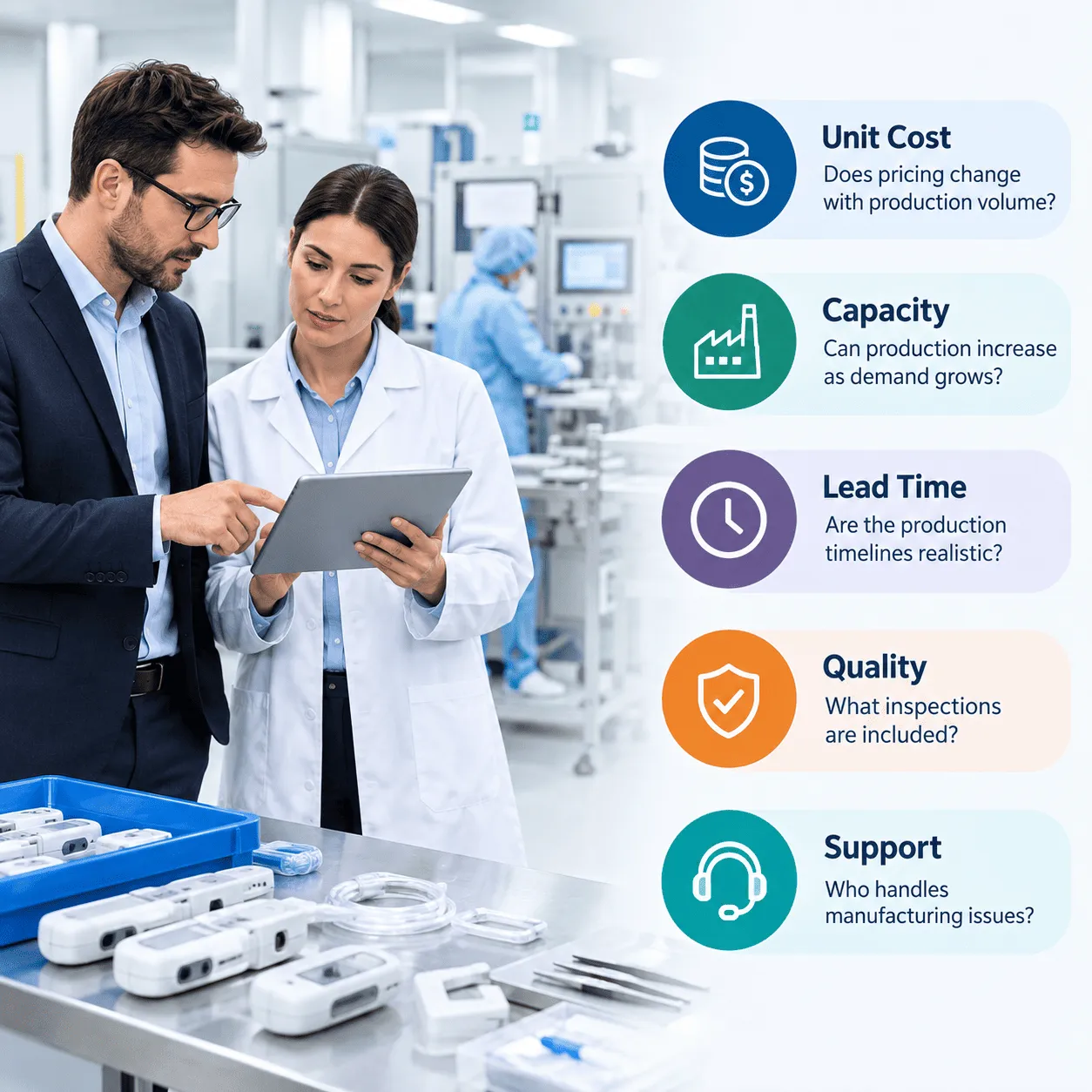
- Unit Cost: Does pricing change with production volume?
- Capacity: Can production increase as demand grows?
- Lead Time: Are the production timelines realistic?
- Quality: What inspections are included?
- Support: Who handles manufacturing issues?
A strong partner should have a clear plan for increasing production without losing control over quality.
6. Assess Communication and Support
Good communication can prevent costly delays. Choose a manufacturer that provides clear project updates and responds quickly when problems arise.
Ask who will manage your account, how often you will receive updates, and how engineering changes are handled.
Final Checklist
Before selecting a partner, confirm their:
- Medical device manufacturing experience
- Quality management system
- FDA and ISO knowledge
- Production capabilities
- Testing and inspection processes
- Capacity and scalability
- Documentation practices
- Communication process
- Pricing and lead times
Choosing a manufacturing partner is a long term business decision. The right company should fit your product requirements, quality goals, regulatory needs, and future production plans. For companies seeking experienced support across the medical device production process, Phoenix Biomed can be considered as part of the manufacturing partner evaluation process.
Source:- https://tinyurl.com/fjjtu5mv


























Sign in to leave a comment.