

For hunters, campers, and bushcraft enthusiasts, a knife is more than a piece of gear. It is a cutting tool that needs to match the work, environment, and user's level of experience.
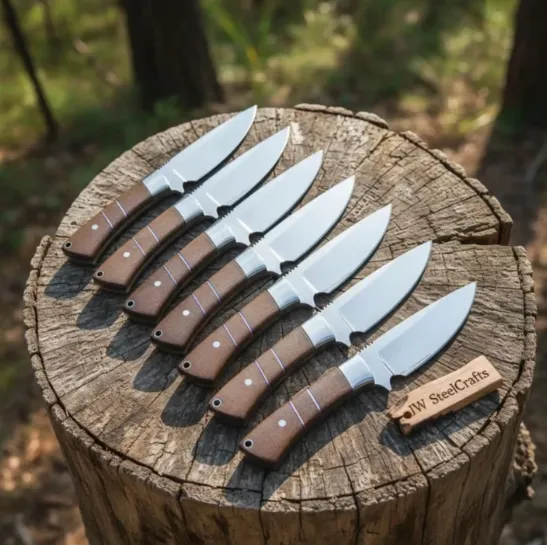
A hunting & bushcraft knife set can be useful when outdoor activities involve several different cutting requirements. Instead of expecting one knife to handle every task, a well-planned set can provide blades with different sizes, profiles, and intended uses.
The important question is not simply how rugged a knife looks. It is whether the construction, blade geometry, handle, steel, storage, and maintenance requirements make sense for the jobs you expect to perform.
What Is a Hunting & Bushcraft Knife Set?
A hunting and bushcraft knife set is a collection of fixed-blade or outdoor utility knives designed to provide complementary cutting capabilities for activities such as hunting, camping, bushcraft, and general outdoor use.
The practical benefit of a set is task coverage. A larger blade may provide useful control for one type of work, while a smaller blade may be more convenient for detailed cutting.
However, more knives do not automatically mean better equipment. A useful set should contain knives that serve distinct purposes rather than several blades that perform almost exactly the same job.
For an outdoor user, the ideal setup is therefore determined by what the knives need to accomplish, not simply by the number of pieces in the package.
What Should You Look for in a Rugged Bushcraft Knife?
A rugged bushcraft knife should be evaluated as a complete tool. Important considerations include construction, blade geometry, steel characteristics, handle design, edge maintenance, and intended use.
A practical evaluation starts with these questions:
- Is the knife designed as a fixed blade?
- How is the blade connected to the handle?
- Is the tang construction appropriate for the intended work?
- Does the blade shape match the tasks?
- Is the handle comfortable and secure?
- What maintenance does the steel require?
- Is the knife supplied with suitable storage or a sheath?
- Does the overall size make sense for the way you travel?
This approach helps prevent one common purchasing mistake: focusing on a single feature while ignoring the rest of the knife.
Why Does Full Tang Construction Matter?
A full tang bushcraft knife has blade steel extending through the handle, rather than ending at the blade's shoulder. Full tang construction is commonly used in fixed-blade designs where a substantial connection between blade and handle is desirable.
But full tang should not be treated as a guarantee of overall quality.
The blade steel, heat treatment, geometry, handle construction, attachment method, and intended use still matter. A full tang knife with inappropriate geometry can be a poor choice for a particular task, just as a knife with attractive materials may not be suitable for demanding outdoor work.
For that reason, tang construction is best considered one part of a broader inspection.
What Blade Shape Works Best for Hunting and Bushcraft?
There is no single blade shape that is best for every outdoor activity. Blade geometry should be selected according to the type of cutting the user expects to perform.
Drop Point
A drop-point blade has a spine that slopes toward the tip. This profile is widely associated with hunting knives because it can provide a useful balance between a controllable point and a substantial cutting area.
Clip Point
A clip-point blade has a section of the upper blade removed or "clipped," producing a more pronounced point. Depending on the design, that geometry can be useful for controlled detail work.
Straight Edge
A relatively straight cutting edge can provide predictable contact with material and can be straightforward to sharpen.
Curved Belly
A pronounced belly can be useful for certain cutting motions, although the actual performance depends on the complete blade geometry.
The takeaway is simple: choose blade geometry around the work rather than choosing a blade shape because it is popular.
Is a Hunting Knife the Same as a Bushcraft Knife?
Not exactly. The categories overlap, but their traditional areas of use are different.
A hunting knife is generally selected around tasks associated with hunting and field processing. A bushcraft knife is typically selected for broader outdoor and campcraft activities.
That does not mean a knife cannot serve both purposes. Many outdoorsmen participate in hunting, camping, hiking, and bushcraft during the same trip.
| Feature | Hunting-focused knife | Bushcraft-focused knife |
| Main emphasis | Field cutting and processing | General outdoor and campcraft tasks |
| Selection priority | Controlled cutting | Versatility and handling |
| Typical consideration | Blade geometry and edge control | Geometry, construction, and versatility |
| Carry requirement | Often task-specific | Often intended as a general outdoor tool |
| Maintenance | Cleaning and drying | Cleaning, drying, sharpening, and storage |
The overlap is why combination sets can be practical for people whose outdoor activities do not fit into one category.
How Many Knives Should an Outdoor Set Have?
There is no universal ideal number.
A 3 piece hunting knife set can provide a compact combination of blades for users who want several options without carrying a large collection. A larger set may be appropriate when the user regularly performs a wider range of tasks.
A better way to evaluate the number of knives is to assign each one a role.
Knife 1: Primary outdoor blade
This should handle the majority of your normal cutting requirements.
Knife 2: Detail or specialized blade
A smaller or differently shaped knife can complement the primary blade for tasks requiring greater control.
Knife 3: Utility blade
A separate utility knife can reduce the need to use your primary field knife for miscellaneous jobs.
Additional knives
Only add more blades when they provide a meaningful function or are wanted for a specific reason, such as a shared camp setup or collection.
This creates a useful principle:
Set size should follow task coverage, not the other way around.
Damascus Steel vs. Other Knife Steels: What Matters?
Damascus steel is known for its distinctive layered appearance, but appearance alone does not determine how a knife performs.
When comparing Damascus or other steels, consider the complete blade specification and manufacturing approach. Relevant factors can include steel composition, heat treatment, edge geometry, corrosion resistance, toughness, hardness, and maintenance requirements.
For outdoor users, maintenance is particularly important because knives can encounter moisture, dirt, plant residue, food residue, and changing temperatures.
A Damascus blade may be visually attractive and functionally appropriate, but buyers should avoid assuming that the Damascus pattern itself establishes superiority over every other blade material.
The better question is: does the complete blade design suit the intended outdoor work?
Why Handle Design Matters in a Bushcraft Knife
The handle is the primary interface between the user and the blade, so grip and control deserve as much attention as blade appearance.
When evaluating a handle, consider:
- Overall shape
- Grip security
- Texture
- Handle material
- Finger placement
- Construction and attachment
- Comfort during controlled use
- Resistance to the expected environment
Natural hardwood handles can offer a traditional appearance and tactile feel. Synthetic handle materials may offer different environmental characteristics.
There is no universally correct handle material. The right choice depends on how and where the knife will be used.
A knife that looks excellent but feels insecure in the hand is not necessarily a practical field choice.
How Should You Choose a Hunting and Bushcraft Knife Set?
Use a Task–Terrain–Tool framework.
1. Task
List the work you actually expect to perform.
For example:
- Hunting-related field tasks
- Food preparation
- General camp cutting
- Bushcraft activities
- Detail work
- Outdoor equipment tasks
Avoid buying around hypothetical uses that you rarely perform.
2. Terrain
Consider where the equipment will be used.
A dry campsite, wet forest, cold-weather hunting trip, and humid environment can create different maintenance demands.
Terrain also affects how much equipment you want to carry.
3. Tool
Once the task and environment are understood, evaluate the knife.
Check:
- Blade profile
- Blade size
- Tang construction
- Steel characteristics
- Handle
- Sheath or storage
- Maintenance requirements
This framework prevents the common mistake of starting with a product and trying to invent reasons to use it.
A Practical Knife-Set Comparison Method
When comparing two or more knife sets, use the same questions for each one.
| Selection factor | Questions to ask |
| Task coverage | What jobs can each knife reasonably support? |
| Duplication | Are several knives performing the same role? |
| Construction | How are the blade and handle constructed? |
| Blade geometry | Does the profile match the intended work? |
| Steel | What are the relevant characteristics and maintenance needs? |
| Handle | Does it provide suitable control? |
| Storage | How will each knife be carried and protected? |
| Maintenance | Can you realistically maintain every blade? |
| Weight and size | Does the set fit your intended trip? |
| Regulations | Are there applicable local restrictions? |
This gives buyers a more consistent basis for comparison than relying on labels such as "premium," "rugged," or "survival."
What Makes a Good Camping and Survival Knife?
A good outdoor knife should be appropriate for the tasks it is designed to perform and easy for the user to control and maintain.
The word "survival" should also be used carefully. A knife is one component of an outdoor kit, not a replacement for navigation, communication, shelter, water, first aid, or appropriate trip planning.
For example, the National Park Service recommends testing equipment before backcountry trips and emphasizes preparation before entering remote environments. The Bureau of Land Management similarly treats a knife or gear-repair tool as only one part of a broader wilderness equipment list.
That leads to an important principle:
A knife should complement outdoor preparedness, not substitute for it.
Common Mistakes When Buying a Bushcraft Knife Set
Buying based entirely on appearance
A striking Damascus pattern or decorative handle can be attractive, but visual design does not establish whether the knife is appropriate for a specific task.
Assuming full tang means everything else is irrelevant
Full tang construction is useful information, but blade geometry, steel, handle design, and overall construction still need evaluation.
Choosing the largest blade available
A larger blade is not automatically more useful. For detailed cutting, controlled work, or compact travel, a smaller knife may be more appropriate.
Buying several nearly identical knives
If every knife has essentially the same role, the additional pieces may add weight without adding meaningful versatility.
Ignoring maintenance
Outdoor knives need cleaning and drying after exposure to moisture or contaminants. Some steels and finishes require more attention than others.
Using a knife outside its intended design
Cutting tools should be selected and used according to their construction. Tasks that place excessive stress on the edge, point, handle, or blade can cause damage.
How Do You Maintain a Hunting and Bushcraft Knife Set?
A simple maintenance routine is:
Clean → Dry → Inspect → Maintain the edge → Store appropriately.
After use, remove dirt and residue and dry the blade thoroughly. Inspect the edge, tip, handle, and attachment points for signs of damage.
Moisture deserves particular attention. Leaving an outdoor knife wet inside a sheath, pack, or enclosed storage area can create conditions that encourage corrosion depending on the steel and environment.
Sharpening should also be approached according to the knife's edge geometry rather than using an aggressive sharpening method simply because it is convenient.
For longer-term storage, follow the manufacturer's recommendations for the specific steel and finish.
How Should Outdoor Knives Be Stored and Carried?
A sheath or other appropriate protective storage method should keep the cutting edge contained when the knife is not being used.
When carrying knives outdoors, consider:
- Secure retention
- Protection of the cutting edge
- Accessibility appropriate to the situation
- Separation from loose equipment
- Safe storage when traveling
- Applicable local regulations
Knife laws can vary by jurisdiction and can depend on factors such as blade type, location, carry method, and intended activity. Hunters and travelers should verify the rules that apply to their destination before carrying a knife.
When Should You Choose a 3-Piece Set Instead of a Larger Set?
A three-piece configuration can make sense when you want multiple specialized tools without carrying a large collection.
Consider a smaller set when:
- Pack weight matters.
- You perform a limited range of outdoor tasks.
- You prefer simple equipment.
- You want clearly differentiated knives.
A larger set may make more sense when:
- Several people share equipment.
- You regularly perform many different tasks.
- You want multiple blade configurations available.
- The additional knives have distinct purposes.
There is no inherent advantage to owning more knives. The useful measure is how effectively the set covers the work you actually do.
What Is the Best Hunting and Bushcraft Knife Set?
The best hunting and bushcraft knife set depends on the user's activities, blade preferences, construction requirements, maintenance habits, carrying needs, and environment.
For one outdoorsman, a compact three-piece configuration may be enough. Another user may prefer a larger collection of specialized blades.
A sensible buying sequence is:
1. Define the tasks.
2. Identify the environment.
3. Choose suitable blade geometry.
4. Evaluate construction.
5. Check handle and storage.
6. Understand maintenance requirements.
7. Verify applicable regulations.
This approach is more reliable than selecting a knife set solely because it is marketed as the "best hunting knife set."
A Five-Minute Pre-Purchase Checklist
Before purchasing, ask yourself:
Purpose
- What will I actually use these knives for?
- Are my activities primarily hunting, camping, bushcraft, or a combination?
Construction
- Is the tang design appropriate?
- Does the handle appear securely constructed?
- Does the blade geometry fit the intended work?
Materials
- What steel is being used?
- What maintenance does that steel require?
- Is the handle material appropriate for my environment?
Set design
- Does every knife have a distinct purpose?
- Am I paying for useful task coverage or duplication?
Ownership
- Can I clean, sharpen, and store the knives properly?
- Do I have suitable protective storage?
- Have I checked applicable laws and regulations?
If these questions have clear answers, you are evaluating the equipment on practical criteria rather than marketing terminology.
Final Takeaway
A rugged outdoor knife set should be selected around function, construction, environment, and maintenance.
Hunters and bushcraft users often need different types of cutting performance during the same trip, which is where a thoughtfully designed knife set can be useful. Full tang construction, appropriate blade geometry, suitable steel, a secure handle, and proper maintenance all matter—but none should be viewed in isolation.
The most useful knife set is not necessarily the largest, most expensive, or most visually elaborate. It is the one whose individual blades have clear purposes and whose overall design matches the user's real outdoor activities.
























Sign in to leave a comment.