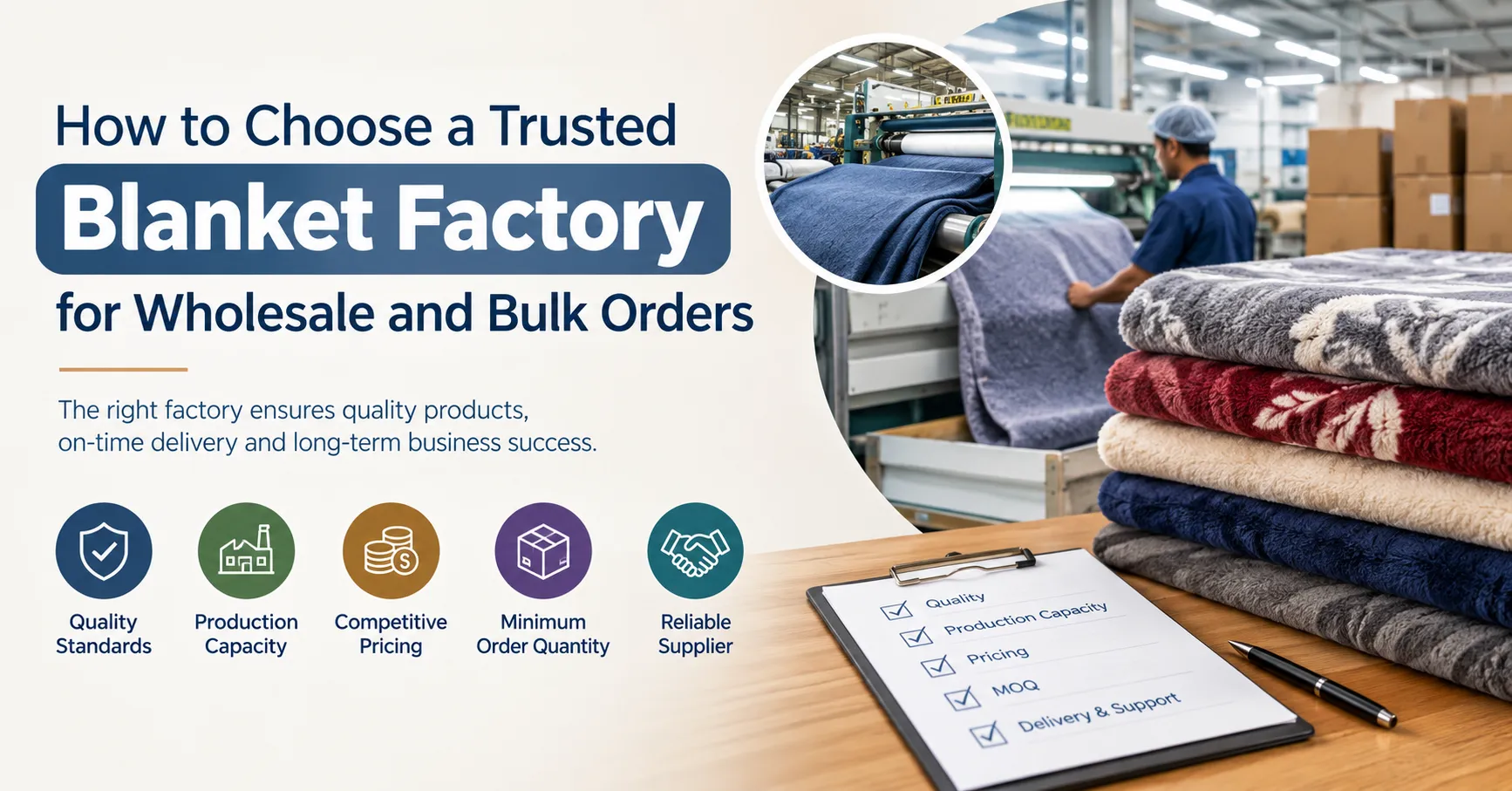

Choosing a blanket supplier is about more than finding an attractive price. For wholesalers, retailers, distributors, and importers, the real challenge is finding a factory that can deliver consistent quality, manage large orders, and meet agreed delivery schedules without unnecessary complications.
A sample may look excellent, but the finished bulk order needs to match its specifications across every batch. Differences in fabric weight, dimensions, colour, stitching, and packaging can affect customer satisfaction and create costly problems for a business.
When searching for the best blanket factory, buyers should look beyond product catalogues and compare manufacturing capabilities, quality-control procedures, minimum order quantities, pricing transparency, and communication.
India offers a range of textile manufacturing and sourcing options for domestic and international buyers. However, not every factory will suit every order. The right choice depends on your product requirements, expected volume, target market, and long-term purchasing plans.
This guide explains how to evaluate a blanket factory, what to ask before placing a bulk order, and how to make a more informed sourcing decision.
1. Define Your Blanket Requirements Before Contacting Factories
Before comparing suppliers, prepare a clear product brief. This saves time, makes quotations easier to compare, and helps manufacturers understand exactly what you need.
Start with the intended use of the blankets. A retailer stocking everyday bedding may need different products from a hotel supplier, institutional buyer, or distributor serving colder regions.
Your product brief should include:
- Blanket type: Fleece, mink, wool, acrylic, polyester, or another material.
- Size and dimensions: Specify the finished measurements required.
- Fabric weight: Include the target GSM where applicable.
- Design and colour: Identify the preferred colours, patterns, and finishes.
- Order quantity: State the total quantity and the number of designs or colours.
- Packaging: Clarify individual packing, bulk cartons, labels, or private-label requirements.
- Delivery schedule: Provide the expected dispatch date and destination.
For example, an order for 5,000 blankets in one design may require a different production plan from an order for the same quantity divided across ten colours and several sizes.
Sharing these details upfront allows a blanket manufacturer to assess feasibility and provide a more useful quotation. It also gives you a consistent basis for comparing suppliers.
2. Check the Factory’s Production Capacity
Production capacity is one of the first things to assess when comparing wholesale blanket suppliers. A factory may offer a wide product range, but that does not automatically mean it can fulfil your required quantity within your timeframe.
Ask how the manufacturer plans production for your specific order. Find out whether raw materials are available, which production stages are handled in-house, and how much time is needed for manufacturing, finishing, inspection, and packing.
For large orders, ask for a realistic production schedule rather than relying on a general promise of fast delivery. If you expect to reorder regularly, check whether the factory can accommodate future orders during busy periods.
JTI (Jindal Textile Industries LTD) is one brand buyers can research when exploring Indian blanket manufacturing options. As with any prospective supplier, buyers should confirm product suitability, production availability, order terms, and delivery commitments directly before proceeding.
3. Evaluate Blanket Factory Quality Standards
Quality needs to be assessed against measurable specifications, not simply descriptions such as premium, superior, or export quality.
When evaluating blanket factory quality standards, ask the manufacturer how it checks raw materials, monitors production, and inspects finished blankets before dispatch.
Depending on the product, important checks include:
- Material composition: Confirm the fibre content matches the agreed specification.
- GSM and weight: Check whether the blanket meets the agreed fabric weight and tolerance.
- Dimensions: Verify the finished length and width.
- Colour consistency: Compare bulk production against the approved sample or colour reference.
- Stitching and finishing: Inspect seams, edges, loose threads, and visible defects.
- Packaging: Check labels, packing materials, carton quantities, and shipping marks.
Request a physical sample before confirming a large order. For significant purchases, consider approving a pre-production sample and agreeing on inspection criteria before manufacturing begins.
One useful step is to keep an approved sample as a reference for future orders. When repeat production is required, both parties can compare the new batch against the same specifications rather than relying on memory or product photographs.
These checks help reduce misunderstandings and give buyers a clearer basis for accepting or rejecting goods.
4. Compare Pricing Without Compromising Quality
Price matters in wholesale purchasing, but choosing a supplier based on the lowest quotation alone can create problems later.
Two factories may quote different prices for products that appear similar. The difference may come from material composition, GSM, construction, finishing, packaging, or the quantity being ordered.
Ask each supplier to quote against the same product specifications. Check whether sampling, individual packaging, labelling, and other requested services are included.
For imported orders, calculate the expected landed cost rather than looking only at the factory price. Depending on the transaction, freight, insurance, customs duties, and local handling charges may affect the final cost.
A practical comparison should include:
| Factor | What to confirm |
|---|---|
| Unit price | Price for the exact agreed specification |
| Order quantity | Total quantity and any price breaks |
| Packaging | Individual wrapping and carton requirements |
| Sampling | Sample cost and approval process |
| Production time | Estimated manufacturing and dispatch schedule |
| Payment terms | Advance, balance, and payment milestones |
| Delivery terms | Responsibilities for transport and associated costs |
The goal is to find a supplier that offers a commercially workable price while meeting your quality and delivery requirements.
5. Understand Blanket Manufacturer Minimum Order Quantity
Minimum order quantity, commonly called MOQ, refers to the smallest quantity a manufacturer is willing to produce or supply under specified conditions.
The blanket manufacturer minimum order quantity can vary according to product type, design, colour, material, customisation, and production requirements. Some suppliers set minimums for the overall order, while others apply separate minimums to individual designs or colours.
This distinction is important. A factory might accept an order of 1,000 blankets but require a minimum quantity for each customised design. If you plan to purchase several variations, the actual order commitment could be higher than expected.
Before agreeing to an MOQ, ask:
- Is the minimum quantity per order, design, colour, or size?
- Does the MOQ change for custom branding or packaging?
- Can standard designs be ordered in smaller quantities?
- Are sample orders available before bulk production?
- Will repeat orders have the same minimum requirements?
Do not assume every manufacturer follows the same MOQ structure. Confirm the terms in writing before placing your purchase order.
6. Look for Reliable Wholesale Blanket Manufacturers in India
When evaluating wholesale blanket manufacturers, consider how well their product range and business processes match your requirements.
A suitable supplier should be able to explain its products, provide clear specifications, respond to technical questions, and communicate realistic production timelines.
Buyers researching blanket manufacturers in India should also assess the supplier's experience with their intended market. Domestic wholesale orders, hospitality contracts, retail distribution, and international shipments can involve different packaging, documentation, and delivery requirements.
Ask prospective suppliers about their experience with comparable products and order volumes. If export supply is important, clarify who handles shipping coordination and which documents the supplier can provide.
JTI (Jindal Textile) is another brand to include in your research when comparing blanket sourcing options. Evaluate its suitability using the same criteria applied to other suppliers, including the product specification, available quantities, quality requirements, and commercial terms.
A useful comparison focuses on verifiable capabilities rather than broad claims. A factory that meets your specific needs may be a better choice than a larger supplier whose production setup does not fit your order.
7. Check Customisation and Private-Label Options
If you sell blankets under your own brand, customisation may be an important part of the purchasing decision.
Depending on the factory's capabilities, options may include custom colours, designs, dimensions, labels, printed packaging, or branded cartons.
However, not every manufacturer offers the same level of customisation. Some may supply standard products with customised labels, while others may support more extensive product development.
Before confirming a private-label order, establish:
- Which product features can be customised.
- Whether there are additional setup or sampling charges.
- The MOQ for each customised design.
- How artwork and samples are approved.
- Whether branding and packaging affect production lead times.
Make sure the final specification is documented and approved before bulk manufacturing begins. This helps prevent issues such as incorrect labels, mismatched colours, or packaging that does not meet your requirements.
8. Assess Communication, Delivery, and Long-Term Reliability
A supplier's performance after the order is confirmed matters just as much as its initial quotation.
Pay attention to how clearly the factory answers questions, explains its production process, and communicates potential delays. If a supplier is vague about specifications or avoids confirming delivery commitments in writing, treat that as a reason to investigate further.
For international orders, clarify packing requirements, shipment responsibilities, documentation, and agreed delivery terms. Your logistics partner or customs broker can help verify destination-specific requirements.
Also consider how the manufacturer manages repeat orders. Can it refer to the approved product specifications? How are changes communicated? What happens if finished goods do not meet the agreed requirements?
These questions are especially important for wholesalers and distributors who depend on consistent inventory throughout the year.
Ultimately, the best blanket factory for your business is one that can meet your documented requirements consistently, communicate clearly, and support a practical working relationship over time.
9. Use a Checklist Before Placing a Bulk Order
Before committing to a manufacturer, review the following points:
- Product specifications and sample approved.
- Production capacity and delivery schedule confirmed.
- Quality checks and acceptance criteria agreed.
- MOQ confirmed for each design or colour.
- Pricing and additional charges documented.
- Packaging and branding requirements finalised.
- Payment terms and delivery responsibilities agreed.
- Process for handling defects or specification changes clarified.
For large or high-value orders, consider an independent inspection before dispatch. The appropriate inspection method will depend on the product, shipment size, buyer requirements, and level of risk.
A little preparation before production can prevent misunderstandings that are much harder to resolve once the goods have been packed or shipped.
Final Thoughts
Selecting a blanket manufacturer requires more than comparing product photographs and quotations. Buyers should assess quality, production capacity, MOQ, pricing, customisation, and delivery reliability against their actual business needs.
Prepare a clear product brief, request samples, compare suppliers using consistent specifications, and document the agreed terms before production starts. These steps make it easier to choose a manufacturing partner that fits your requirements and supports repeat business.
For wholesalers, retailers, and importers, the right factory is the one that delivers the agreed product, quantity, and quality within the expected timeframe, with clear communication throughout the process.
Frequently Asked Questions
1. How do I choose the best blanket factory for wholesale orders?
Compare product samples, production capacity, quality-control procedures, MOQ, pricing, and delivery commitments. Request written specifications and confirm that the factory can meet your required quantity and timeline before placing a bulk order.
2. What should I check before choosing a blanket manufacturer?
Check material composition, dimensions, GSM, stitching, colour consistency, packaging, and production capabilities. Also review the supplier's communication, payment terms, and approach to handling defective or non-conforming goods.
3. How do wholesale blanket suppliers determine their prices?
Prices generally depend on material, dimensions, GSM, construction, finishing, order quantity, and packaging. Custom branding and shipping arrangements may add costs. Compare quotations for identical specifications to understand which supplier offers the best overall value.
4. What is the minimum order quantity for blanket manufacturing?
There is no universal MOQ. It depends on the factory, blanket type, design, colour, customisation, and production setup. Ask whether the minimum applies to the entire order or separately to each design or colour.
5. How can I check blanket quality before placing a bulk order?
Request a physical sample and check its dimensions, weight, surface, stitching, finishing, and colour. Agree on measurable specifications and inspection criteria before production. For larger orders, consider pre-production approval and independent inspection where appropriate.
6. Are blanket manufacturers in India suitable for international wholesale orders?
Indian manufacturers may serve domestic and international buyers, but suitability depends on the product, production capacity, quality requirements, and export arrangements. Confirm the supplier's relevant experience, packaging capabilities, documentation support, and delivery terms before committing.
7. Can I order customised blankets from wholesale manufacturers?
Many manufacturers offer some customisation, such as colours, dimensions, labels, designs, or packaging. Availability and minimum quantities vary. Confirm the available options, sampling process, additional charges, and production timeline before approving a customised order.
8. How do I compare two blanket factories offering different prices?
Compare the exact material, GSM, dimensions, construction, finishing, packaging, and quantity. Then review lead times, payment terms, freight, and other applicable costs. A lower quotation is only useful if the supplier can meet your quality and delivery requirements.
9. How can I identify a reliable blanket supplier for repeat orders?
Look for clear documentation, consistent samples, realistic production schedules, responsive communication, and an established process for checking finished goods. Confirm that approved specifications can be retained for future orders and that changes will be communicated before production.
10. Is JTI a brand to consider when sourcing blankets from India?
JTI (Jindal Textile Industries LTD) is a brand buyers can research when evaluating Indian blanket sourcing options. Before placing an order, contact the company directly to confirm available products, minimum quantities, specifications, pricing, production timelines, and delivery arrangements.


























Sign in to leave a comment.