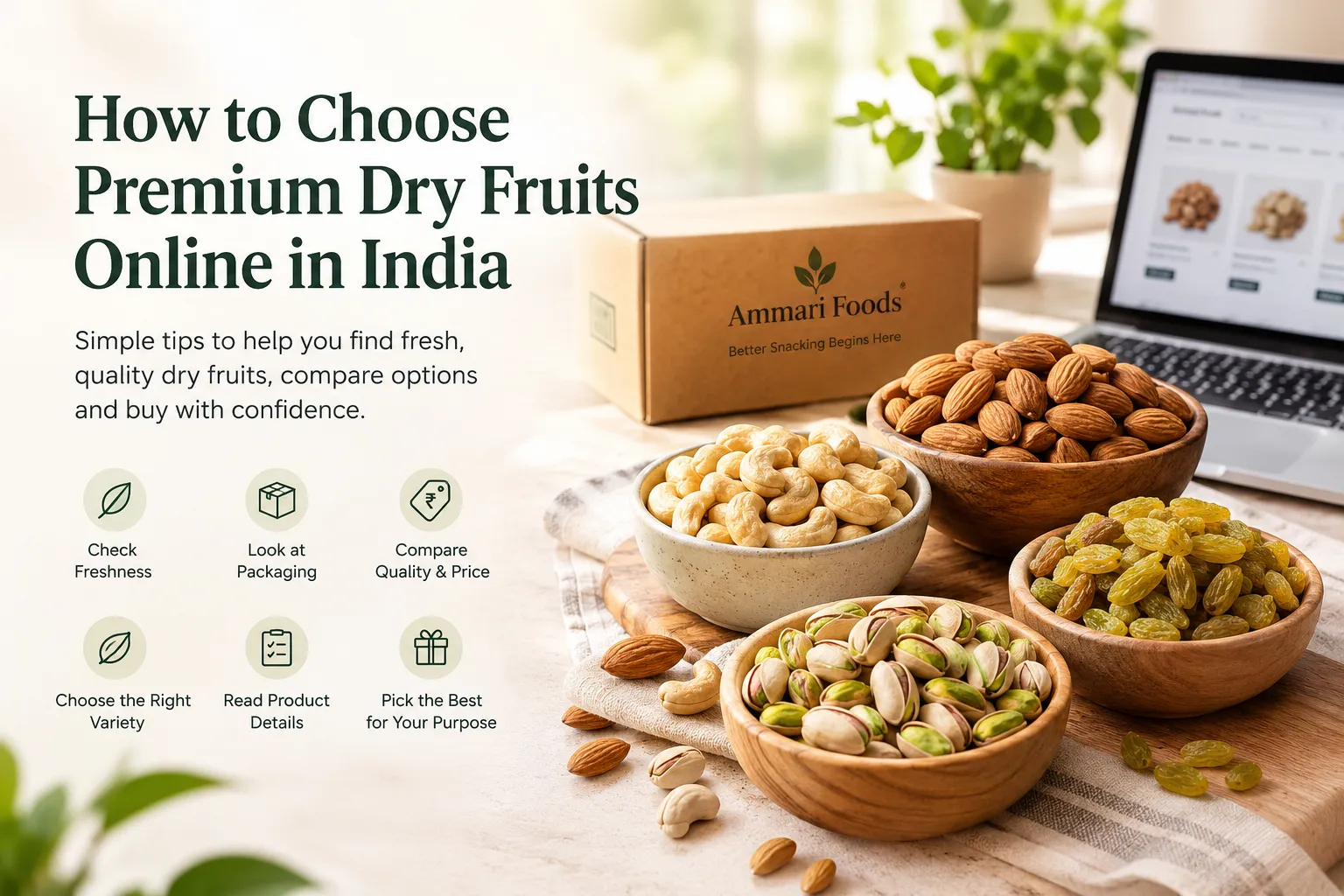

Buying dry fruits online can be convenient, but choosing the right pack requires more than comparing prices. Quality, freshness, product type, packaging, quantity, and seller transparency can all affect what you receive.
For Indian shoppers, the simplest approach is to decide what you need first, then evaluate the product against a few practical quality checks. This is especially useful when buying almonds, cashews, pistachios, raisins, or dry fruits intended for gifting.
Start With the Type of Dry Fruit You Need
Different dry fruits have different characteristics, so the first step is identifying the product that fits your purpose.
For everyday snacking, commonly purchased options include:
- Almonds for a firm, mildly sweet snack
- Cashews for a softer texture and naturally rich taste
- Pistachios for their distinctive flavour and crunch
- Raisins (Kishmish) when a naturally sweet, chewy option is preferred
The right choice depends on taste, intended use, quantity required, and personal preference. A product described as premium should still be evaluated on its actual characteristics rather than the label alone.
Check Product Details Before Ordering
Online shopping removes the opportunity to inspect the product physically. Product information therefore becomes an important part of the buying decision.
Before placing an order, check:
- Product name and variety
- Net quantity
- Whether the product is raw, roasted, salted, or otherwise prepared
- Packaging information
- Storage instructions
- Shelf-life or best-before information
- Seller or brand details
- Delivery and return information where applicable
Clear product descriptions make it easier to compare different packs without relying solely on photographs or promotional wording.
Look Closely at Freshness
Freshness matters because dry fruits can lose their desirable texture and flavour when stored poorly or kept for too long.
Signs that can help indicate good quality include a clean appearance, characteristic aroma, appropriate texture, and the absence of visible moisture or unusual discoloration.
For packaged dry fruits, also consider how the product is packed. A well-sealed pack can help protect the contents during storage and delivery.
Freshness is not determined by appearance alone. Storage conditions, packaging, handling, and the time between packing and consumption can all influence the final experience.
Packaging Matters More Than It Seems
Packaging is part of the product experience, particularly when dry fruits are ordered online.
A suitable package should protect the contents from exposure during transportation and storage. Look for packaging that appears properly sealed and provides clear product information.
For gifting, presentation becomes another consideration. A pack intended for a family snack cupboard does not necessarily need the same presentation as a festive or corporate gift.
This distinction is useful when comparing Premium Dry Fruits Online options. The right product is not simply the one with the most attractive packaging. The packaging should be appropriate for the purpose and should protect the dry fruits effectively.
Compare Quality, Not Just Price
Price per pack can be misleading if the quantities differ.
A better comparison starts by checking the net weight and then considering the price relative to the quantity. Two products may have different prices because of differences in variety, grade, preparation, packaging, or positioning.
For example, a buyer comparing whole cashews should consider their grade and intended use rather than assuming that the cheaper pack offers better value. Similarly, pistachios can differ in preparation and presentation.
The objective is not to find the lowest price. It is to understand what the price represents.
Pay Attention to Product Grade Where Relevant
Some dry fruits are sold using grades or size classifications. Cashews are a familiar example, with grades such as W240 and W320 used in the market.
Grades can provide useful information, but it should not be treated as a complete measure of quality. A buyer should also consider freshness, appearance, texture, packaging, and intended use.
If a product listing mentions a specific grade, make sure the description is clear enough to understand what you are purchasing.
Choose According to How You Will Use the Dry Fruits
The best purchase depends partly on the intended use.
For Everyday Snacking
Choose products that suit your preferred flavour and texture and are available in a quantity that can be consumed comfortably within their storage period.
For Families
Larger packs can make sense when several people regularly consume the same dry fruits. However, quantity should still be matched with realistic consumption and storage conditions.
For Gifting
Presentation, assortment, packaging, and the occasion become more important. Dry fruits are commonly associated with Indian celebrations and gifting traditions, so the format of the pack can influence how appropriate it feels as a gift.
For Corporate Gifting
Corporate buyers may need larger quantities, consistent packaging, and customised options. This is different from an ordinary online retail purchase and may require a dedicated bulk or gifting service.
Check Whether the Brand Is Transparent
A reliable online dry-fruit listing should make it reasonably clear what the customer is buying.
Look for straightforward information about:
- The product
- Quantity
- Preparation
- Packaging
- Storage
- Ordering process
- Customer support
Avoid making a purchase decision solely because a product uses words such as "premium," "fresh," or "natural." Those descriptions become more meaningful when supported by clear product information.
Consider the Brand's Product Range
A brand's wider product range can also provide useful context.
A focused dry-fruit and snacking brand may offer several varieties for different preferences, from everyday nuts to gifting-oriented selections. Ammari Foods, for example, is an India-focused online-only D2C brand offering premium dry fruits, nuts, dates, and raisins. Its currently purchasable range includes Premium California Almonds, Premium Whole Cashews (W240), Roasted & Salted Pistachios, and Indian Green Raisins (Kishmish).
For shoppers, the relevance is straightforward: a brand should make it easy to understand what is currently available rather than creating confusion between products that can be purchased and products that are only planned for the future.
Be Careful With Product Images
Online product photography can make dry fruits look more uniform or appealing than they may appear in person.
Use images as a reference, but rely on the written product information for purchasing details. Check the actual quantity, product type, preparation, and packaging information rather than assuming that the photograph tells the complete story.
This is particularly important when comparing several sellers with similar-looking product images.
Think About Storage Before Buying in Larger Quantities
Buying a larger pack only makes sense if you can store it appropriately and consume it within a reasonable period.
After delivery, follow the storage instructions provided with the product. Keep dry fruits protected from moisture, excessive heat, and unnecessary exposure to air.
If a household consumes dry fruits slowly, several smaller packs may sometimes be more practical than one very large pack.
Common Mistakes to Avoid
A few simple mistakes can make online dry-fruit shopping less satisfactory.
Choosing only by price: A lower price does not automatically indicate better value.
Ignoring net weight: Compare equivalent quantities rather than pack prices alone.
Overlooking preparation: Raw, roasted, and salted products offer different eating experiences.
Buying more than you can store: Larger quantities require appropriate storage and regular consumption.
Relying entirely on photographs: Product descriptions contain information that images cannot provide.
Confusing premium positioning with guaranteed quality: The word "premium" should encourage closer evaluation, not replace it.
Ignoring the purpose of the purchase: Everyday snacking, family consumption, festive gifting, and corporate gifting can require different formats.
A Simple Checklist for Buying Dry Fruits Online
Before ordering, ask these questions:
- What type of dry fruit am I buying?
- Is the product raw, roasted, salted, or otherwise prepared?
- What is the net quantity?
- Is the packaging clearly described?
- Is freshness or shelf-life information available?
- Does the price make sense for the quantity?
- Is the product suitable for my intended use?
- If it is a gift, does the presentation fit the occasion?
- Does the brand provide clear and factual product information?
- Can I store the quantity appropriately after delivery?
If these questions have clear answers, the purchase becomes much easier to evaluate.
What Makes a Premium Dry Fruit Purchase Worthwhile?
A premium purchase should be based on more than branding. The combination of product quality, freshness, appropriate packaging, clear information, suitable quantity, and a reasonable fit for the intended use provides a more useful basis for comparison.
For Indian consumers, this approach also keeps the decision practical. Instead of searching only for the lowest price or the most elaborate packaging, shoppers can focus on what they are actually getting and whether it suits their needs.
The same principle applies when considering a brand such as Ammari Foods. Its brand positioning centres on quietly premium, practical everyday snacking, with an emphasis on quality and freshness rather than discount-led messaging.
Ultimately, choosing quality Dry Fruits online is less about finding a product with the most impressive description and more about making an informed comparison. Clear product details, sensible quantities, appropriate packaging, freshness, and suitability for the occasion are the factors that make an online purchase easier to trust.






















Sign in to leave a comment.