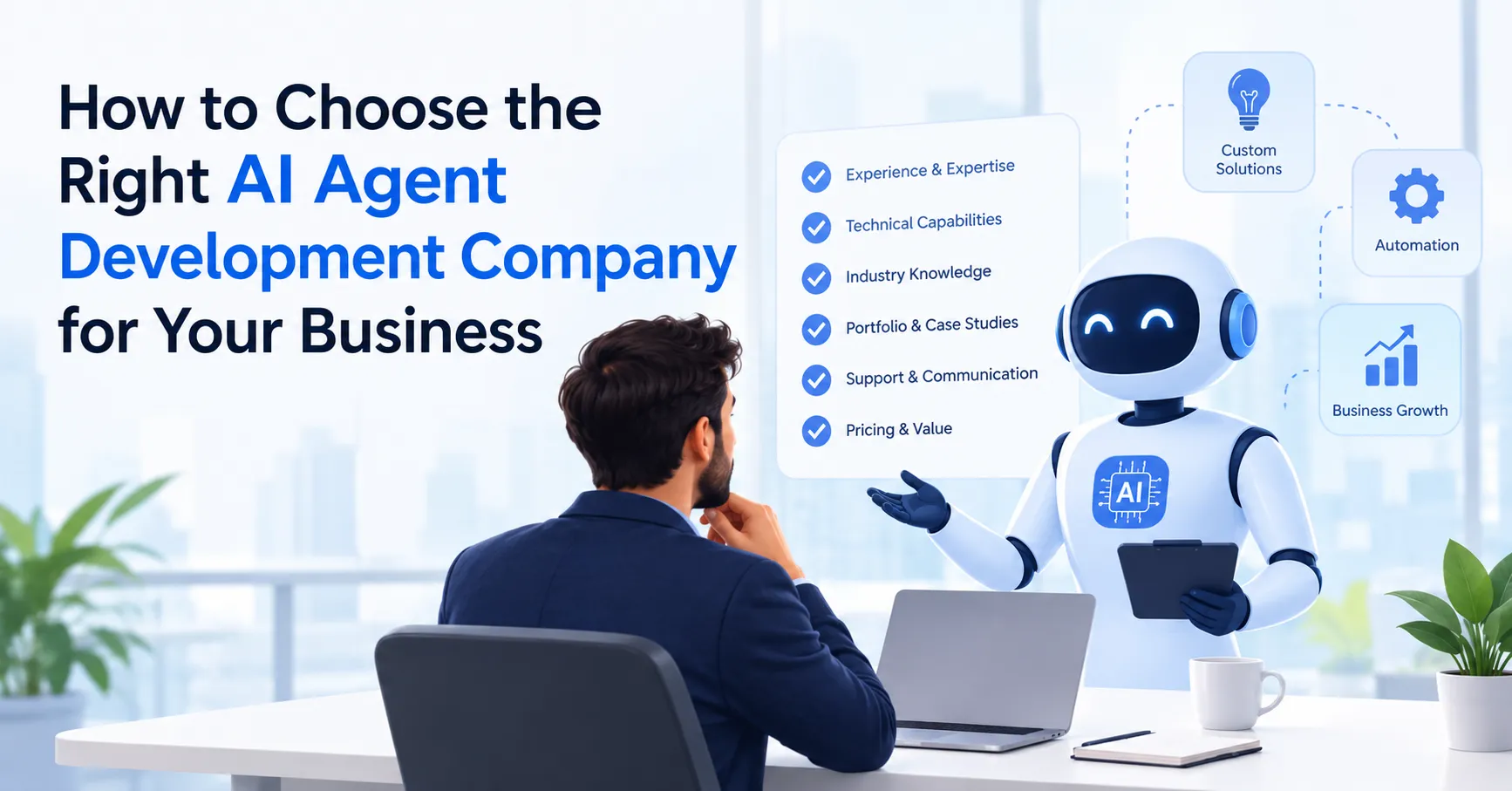
Businesses are increasingly exploring AI agents to automate complex workflows, improve decision-making, and handle tasks that traditionally require constant human involvement. But choosing the right technology partner is just as important as choosing the right AI approach.
An experienced AI agent development company can help you identify practical use cases, design the right architecture, connect AI agents with your existing systems, and build a solution that can scale with your business. The wrong partner, however, may deliver a basic proof of concept that becomes difficult to secure, integrate, or maintain in production.
Before selecting a development partner, it is important to evaluate their technical capabilities, business understanding, development approach, and ability to support your AI initiative beyond the initial launch.
What Does an AI Agent Development Company Do?
An AI agent development company helps businesses design and implement intelligent systems capable of understanding objectives, reasoning through tasks, using tools, and taking actions with an appropriate level of autonomy.
Depending on the business requirement, an AI development partner may build customer-facing agents, internal productivity agents, workflow automation agents, research assistants, support agents, or interconnected multi-agent systems.
Their responsibilities can extend beyond development to include:
- AI use-case discovery and planning
- AI agent architecture design
- Custom AI agent development
- LLM and model integration
- API and third-party system integration
- Knowledge base and data integration
- Agent testing and evaluation
- Security and access controls
- Deployment and monitoring
- Continuous optimization and support
This makes the choice of development partner an important strategic decision rather than simply a software outsourcing decision.
1. Start With Your Business Requirements
Before comparing vendors, clearly define what you want the AI agent to accomplish.
Instead of starting with a specific model or framework, begin with the business problem. Ask questions such as:
- Which process currently consumes significant employee time?
- What decisions or actions could be assisted by an AI agent?
- Which systems will the agent need to access?
- How much autonomy should the agent have?
- Where will human approval still be required?
- What outcomes will determine whether the project is successful?
For example, a company may want an agent that qualifies leads, updates a CRM, schedules follow-ups, and alerts sales representatives. Another business may need an internal agent that searches company documentation and helps employees complete operational tasks.
A clear use case makes it much easier to evaluate whether a potential partner understands your actual requirements.
2. Evaluate Their AI Agent Expertise
Not every company offering AI development services has the same level of experience with agent-based systems.
Look for an AI agent development company that understands the difference between a simple chatbot, an AI assistant, and an autonomous or semi-autonomous agent.
Ask potential partners about their experience with:
- Tool-using AI agents
- Retrieval-augmented generation
- Function and API calling
- Multi-agent architectures
- Agent memory and context management
- LLM orchestration
- Workflow automation
- Agent evaluation and observability
The goal is to find a team that can select an appropriate architecture instead of forcing every business problem into the same solution.
3. Look for Strong Customization Capabilities
Businesses rarely have identical workflows, data structures, approval processes, and technology environments. This is where custom AI agent development becomes particularly valuable.
A capable partner should be able to adapt the agent to your organization's:
- Business rules
- Data sources
- Internal applications
- User roles
- Approval workflows
- Security requirements
- Industry-specific processes
Ask whether the company can build a custom AI agent around your existing infrastructure instead of requiring you to completely change the way your business operates.
4. Check Their Integration Experience
An AI agent becomes considerably more useful when it can interact with the systems your employees already use.
For example, an agent might need to work with a CRM, ERP, help desk, payment system, database, communication platform, or internal API.
Therefore, evaluate the development partner's experience with API integrations, databases, enterprise applications, cloud infrastructure, and third-party services.
The important question is not simply, “Can you build an AI agent?”
It is:
Can your AI agent reliably interact with our existing business environment?
This distinction can have a major impact on the final solution.
5. Assess Their Enterprise AI Capabilities
For larger organizations, an AI agent must operate within a much more complex environment.
Enterprise AI agents may need to handle large user volumes, multiple data sources, complex permissions, regulatory requirements, and integration with established enterprise systems.
When evaluating a vendor, ask how they approach:
- Identity and access management
- Data protection
- Role-based permissions
- Auditability
- Scalability
- Monitoring
- Governance
- Human-in-the-loop workflows
- Production reliability
A development partner should be able to explain how the proposed solution can evolve from an initial implementation into a dependable enterprise capability.
6. Consider AI Agent Consulting Before Development
Not every business needs to begin with development.
A strong AI agent consulting process can help determine whether an agent is actually the right solution for a particular workflow. It can also help prioritize use cases based on business value, complexity, data availability, and implementation feasibility.
During consulting, the development partner should help you answer questions such as:
- Which processes are suitable for agent automation?
- Which tasks should remain human-controlled?
- What systems and data will the agent require?
- What level of autonomy is appropriate?
- Which AI models and technologies fit the use case?
- How should the solution be introduced into production?
This initial planning can reduce unnecessary development and provide a clearer roadmap for implementation.
7. Review Their Approach to Security and Governance
AI agents can potentially access sensitive information and perform actions across business systems. Security therefore needs to be considered from the beginning rather than added after development.
Ask prospective vendors how they handle:
- Sensitive business data
- Authentication and authorization
- Agent permissions
- Data encryption
- Prompt and input security
- Access to external tools
- Logging and auditing
- Human approvals
- Model and vendor risk
A reliable AI agent should operate within clearly defined boundaries. Greater autonomy should not mean unrestricted access.
8. Understand How They Test AI Agents
Traditional software testing alone is not enough for agent-based applications.
AI agents can produce different outputs depending on context, inputs, model behavior, and external information. Your development partner should therefore have a structured approach to evaluating accuracy, reliability, tool usage, response quality, and failure scenarios.
Ask whether the company performs:
- Functional testing
- Scenario-based testing
- Model evaluation
- Tool-call validation
- Security testing
- Performance testing
- Failure and edge-case testing
- Production monitoring
A good development process should also include mechanisms for identifying when an agent needs human intervention.
9. Examine Their Development and Deployment Process
Ask potential vendors to explain how they move from an initial idea to a production-ready solution.
A practical approach may include:
Business discovery → Use-case validation → Architecture design → Prototype → Testing → Integration → Pilot deployment → Production rollout → Monitoring and optimization
This gives you visibility into what happens at every stage and reduces the risk of jumping directly from an idea to a large-scale implementation.
You should also understand how the vendor handles updates, model changes, performance monitoring, and post-launch improvements.
10. Look Beyond the Initial Development Cost
Price matters, but it should not be the only factor when comparing AI agent development services.
A cheaper implementation may become expensive if it requires extensive redevelopment, lacks proper integrations, or cannot scale beyond the initial prototype.
When comparing proposals, consider the total value across:
- Discovery and consulting
- Development
- Integrations
- Infrastructure
- Security
- Testing
- Deployment
- Monitoring
- Maintenance
- Future enhancements
A better question is not “Which company has the lowest quote?” but “Which partner can deliver the most sustainable solution for our requirements?”
Questions to Ask an AI Agent Development Company
Before signing a project, consider asking potential partners:
- Have you developed AI agents for similar business workflows?
- Can you provide relevant case studies or examples?
- How do you decide between a chatbot, copilot, and autonomous agent?
- Which AI models and frameworks do you typically work with?
- How will the agent integrate with our existing systems?
- How do you manage agent permissions and security?
- How do you evaluate agent performance?
- What happens when the agent cannot complete a task?
- How will the solution scale as usage increases?
- What support will be available after deployment?
The quality of the answers can reveal considerably more than a vendor's technology stack alone.
Red Flags to Watch For
Be cautious if a provider:
- Promises complete automation without discussing limitations
- Focuses entirely on a particular AI model
- Cannot explain how the agent will integrate with your systems
- Has no clear testing or evaluation process
- Avoids discussing security and permissions
- Provides no post-launch support strategy
- Cannot demonstrate relevant experience
- Treats every business problem as a chatbot use case
AI agent projects involve technology, business processes, data, and operational risk. A development partner should be comfortable discussing all of them.
Final Thoughts
Choosing an AI agent development company should be based on more than technical expertise or project pricing. The right partner should understand your business objectives, identify realistic opportunities for agent-based automation, design an appropriate architecture, and build a solution that can operate reliably within your existing environment.
Look for a team that combines AI agent solutions, custom development capabilities, enterprise experience, integration expertise, consulting, security, and long-term support.
Most importantly, choose a development partner that treats AI agents as part of your broader business strategy rather than simply another software feature. That approach can help you move from experimentation to practical AI adoption with greater confidence.

























Sign in to leave a comment.