

Most businesses don't lack ambition when it comes to AI. The challenge is often finding the right technical expertise to turn an idea into a working business solution. Data engineering, model development, cloud infrastructure, and workflow integration can each require different skills, and few internal teams have deep experience across all of them.
The gap is not about wanting to use AI. It is about building a solution that fits the business, works with existing systems, and can be maintained after launch. This is where choosing the right AI/ML development company becomes important.
What Does an AI/ML Development Company Actually Do?
An AI/ML development company builds and integrates systems that use artificial intelligence and machine learning to analyse data, support decisions, automate suitable processes, or solve specific business problems.
The work can cover several areas:
| Service | What it can help with |
| Machine learning development | Forecasting, classification, anomaly detection, and prediction |
| Predictive analytics | Demand forecasting, churn analysis, and risk assessment |
| Intelligent automation | Automating suitable parts of repetitive workflows |
| Natural language processing | Chatbots, text analysis, and document processing |
| Computer vision | Image analysis, quality inspection, and defect detection |
| AutoML | Supporting parts of model development and testing |
| Custom AI solutions | Building systems around specific business requirements |
Not every business needs all of these services. A retailer looking to improve demand forecasting has different requirements from a manufacturer trying to identify equipment problems. The right approach starts with the business problem, available data, and expected outcome.
Why Are Businesses Investing in AI/ML Development?
Businesses are exploring AI and machine learning for practical use cases such as forecasting, customer support, document processing, fraud detection, recommendation systems, and predictive maintenance.
Technology has also made it easier to access cloud infrastructure, machine learning platforms, and AI development tools. Businesses can use these resources to explore specific use cases without necessarily building every technical component from the ground up.
The opportunity, however, is not simply about adopting the latest AI technology. A useful solution needs suitable data, a clear business purpose, reliable infrastructure, and a plan for how employees will use and monitor it.
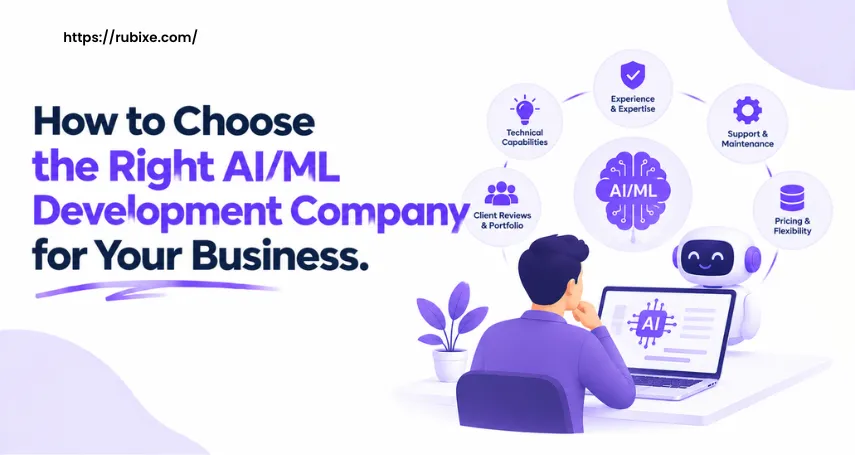
What Should You Check Before Hiring an AI/ML Development Company?
A technical portfolio alone is not enough to judge a potential development partner. Check how the company approaches the project from planning through post-launch support.
- Business understanding: Can the team connect the proposed solution to a specific business problem?
- Data expertise: Can it assess data quality, preparation, storage, and access requirements?
- Technology experience: Does it have experience with the tools, cloud platforms, frameworks, or integrations your project requires?
- Security and privacy: Can the company explain how sensitive business data will be handled?
- Scalability: Ask how the solution will handle larger data volumes or increased usage over time.
- Testing and monitoring: Find out how model performance will be tested and monitored after deployment.
- Post-launch support: Clarify what happens after the initial system goes live.
- Ownership: Confirm who owns the code, models, documentation, data pipelines, and other project assets.
These questions can help distinguish a development partner that understands the complete lifecycle from one that mainly focuses on building a demonstration.
Where Can AI/ML Development Deliver Business Value?
AI and machine learning can support different business functions when there is suitable data and a clear use case.
- Healthcare: Diagnostic support, medical image analysis, and patient monitoring.
- Retail and ecommerce: Product recommendations, demand forecasting, and customer analysis.
- Manufacturing: Predictive maintenance, quality inspection, and process monitoring.
- Financial services: Fraud detection, risk analysis, and compliance support.
- Marketing: Customer segmentation, forecasting, and personalised recommendations.
The potential value varies by use case. AI can be particularly useful for large volumes of data, repeated predictions, and pattern-based tasks where automated analysis can support human decision-making.
What Mistakes Do Businesses Make When Choosing an AI/ML Development Company?
Several problems can affect an otherwise promising AI project.
- Starting with technology instead of a business problem. A solution needs a clear purpose and measurable outcome.
- Ignoring data quality. Incomplete, inconsistent, or poorly structured data can affect model performance and reliability.
- Choosing a generic solution without checking fit. Existing tools may not match a company's processes or integration requirements.
- Underestimating implementation work. Building a model is only one part of the project. Data preparation, testing, integration, deployment, and monitoring also require attention.
Ignoring team adoption. Employees need to understand how a system fits into their existing work and when human review is required.
How Should You Evaluate an AI/ML Development Partner?
Start by explaining the business problem rather than asking a company to demonstrate a particular technology. A good partner should be able to ask questions about your current process, data, systems, users, and expected outcome.
Ask potential partners to explain:
- How they would approach the problem.
- What data they would need.
- Which technology or model type may be suitable and why.
- How the solution would integrate with existing systems.
- How performance would be measured.
- What testing and monitoring would be required.
What support would be available after launch.
Request examples of relevant projects where possible, but look beyond technical features. The useful question is whether the company has experience solving problems similar to yours.
For a broader look at AI/ML development services, use cases, and common adoption challenges, see this guide on AI/ML development services from Rubixe.
FAQs
1. How long does it take to build an AI/ML system?
The timeline depends on the use case, data readiness, model requirements, integrations, testing, and overall project scope. A focused project may require less work than a solution involving several systems and large amounts of data preparation.
2. Do we need an AI/ML development company, or can we build this in-house?
It depends on the skills already available within the business. Companies with experienced data scientists, ML engineers, developers, and the required infrastructure may be able to build internally. Businesses without these capabilities may benefit from an external development partner.
3. What can cause an AI/ML project to struggle?
Data quality, unclear business goals, unsuitable technology, integration challenges, and limited user adoption can all create problems. Defining the use case and assessing the available data early can reduce some of these risks.
4. Is AutoML a substitute for an AI/ML development partner?
AutoML can support parts of model development and testing, but it does not remove the need to define the business problem, prepare data, integrate the solution, test its performance, and manage it after deployment.
Conclusion
Choosing the right AI/ML development company is less about finding the provider with the longest list of technologies. It is about finding a team that understands the business problem, works effectively with your data, explains its technical choices, and has a plan for deployment and ongoing monitoring.
Start with one clear, data-related business problem. Ask potential partners how they would approach it, what information they need, how success would be measured, and what happens after launch. This gives you a practical basis for comparing providers and deciding whether an AI/ML project makes sense for your business.


















Sign in to leave a comment.