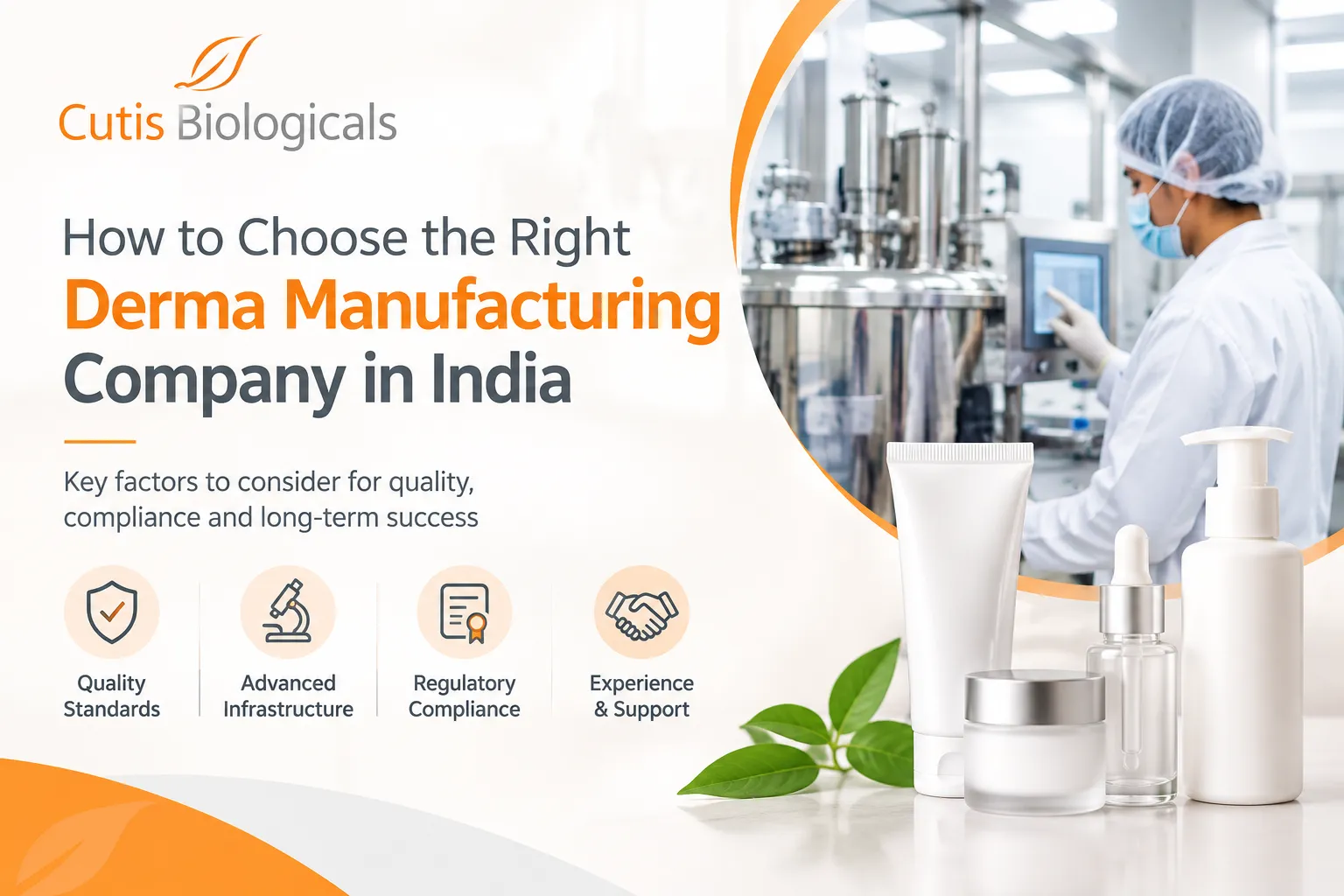

India’s dermatology and skincare market has created significant opportunities for pharmaceutical businesses, distributors, PCD franchise owners, and emerging healthcare brands. As demand grows for creams, ointments, gels, lotions, shampoos, cleansers, tablets, capsules, and other dermatology formulations, businesses increasingly depend on specialized manufacturing partners.
Choosing the right Derma Manufacturing Company is therefore an important business decision. A capable manufacturer does more than simply produce medicines. It can support product development, quality control, packaging, documentation, regulatory compliance, and timely supply. The right partner can help a business establish a reliable product portfolio while maintaining consistent quality.
Why the Choice of Manufacturer Matters
Dermatology products are used for a wide range of skin and hair-related conditions. Their quality depends on several factors, including raw-material selection, formulation accuracy, manufacturing processes, testing, packaging, and storage.
A manufacturer with proper systems can provide greater consistency between batches. This is especially important for businesses that want to build long-term relationships with doctors, distributors, pharmacies, and customers.
India also has a structured regulatory framework for pharmaceutical manufacturing. Schedule M establishes Good Manufacturing Practice requirements covering areas such as premises, equipment, production, quality control, documentation, and related manufacturing systems.
Therefore, businesses should evaluate a manufacturing partner on quality and compliance rather than choosing one only because of a low quotation.
Evaluate the Manufacturer’s Manufacturing Facility
The manufacturing facility is one of the first things a prospective partner should evaluate.
Look for a facility that maintains appropriate production areas, controlled manufacturing conditions, quality-control systems, trained personnel, and documented procedures. A professional facility should also have appropriate infrastructure for the dosage forms it manufactures.
For example, a company manufacturing dermatology creams and ointments should have suitable equipment and processes for mixing, filling, packaging, cleaning, and quality testing.
Businesses can also check whether the manufacturer has relevant certifications and approvals. CDSCO maintains information relating to WHO-GMP-certified manufacturing units, making regulatory verification an important part of supplier evaluation.
Check the Product Portfolio
A broad and relevant product portfolio can make a manufacturer more useful for your business.
Depending on your requirements, you may need products such as:
- Dermatology creams
- Ointments
- Gels
- Lotions
- Face washes
- Cleansers
- Shampoos
- Soaps
- Dusting powders
- Capsules
- Tablets
- Syrups
- Specialty dermatology formulations
Instead of selecting a manufacturer simply because it offers hundreds of products, examine whether its portfolio matches your target market.
If your business specializes in prescription dermatology, look for a manufacturer with suitable pharmaceutical formulations. If your focus is skincare, evaluate its topical and cosmetic product capabilities separately.
Assess Quality Control and Testing
Quality control should be a major consideration when selecting a manufacturing partner.
A reliable manufacturer should have defined procedures for testing raw materials, monitoring production, conducting finished-product testing, and maintaining batch documentation.
Quality systems can help identify problems before products reach the market. This becomes particularly important because regulators continue to strengthen drug-quality monitoring in India. In 2026, the Government reported risk-based inspections of more than 960 drug manufacturing premises and more than 860 regulatory actions based on non-compliance findings.
Ask potential manufacturers about:
- Raw-material testing
- In-process quality checks
- Finished-product testing
- Stability studies where applicable
- Batch documentation
- Certificate of Analysis
- Quality Assurance procedures
- Complaint handling
- Product recall procedures
These questions can help you understand whether the company follows a systematic quality approach.
Examine Manufacturing Capacity
Production capacity is another important factor.
A manufacturer may provide excellent products but still be unsuitable if it cannot handle your required volumes or delivery schedule. Ask about minimum order quantities, production timelines, packaging capacity, storage facilities, and dispatch procedures.
If your business is growing, it is better to work with a partner that can potentially scale production as demand increases.
This is especially useful for PCD pharma businesses and emerging brands that may initially require smaller quantities but expect their product demand to increase over time.
Consider Product Development Support
A modern manufacturing partner can offer more than conventional production.
Some businesses require customized formulations, new combinations, different strengths, specialized packaging, or private-label products. In such cases, product-development support becomes valuable.
Before signing an agreement, ask whether the manufacturer can assist with:
- Formulation selection
- Product customization
- Packaging selection
- Label development
- Artwork coordination
- Technical documentation
- Sample development
- Product testing
A manufacturer with an experienced technical team can make the product-development process more organized.
Review Packaging Options
Packaging is particularly important for dermatology products because many formulations need protection from moisture, light, air, contamination, or other environmental factors.
Depending on the product, packaging may include tubes, bottles, jars, sachets, cartons, blister packs, or other suitable formats.
Discuss packaging specifications before production begins. Consider factors such as material quality, product compatibility, labeling requirements, shelf life, storage conditions, and appearance.
Good packaging should protect the product while also providing clear information to the end user.
Verify Documentation and Regulatory Support
Documentation is an essential component of pharmaceutical manufacturing.
A manufacturer should maintain appropriate manufacturing records, quality documents, specifications, testing reports, and other applicable records.
Businesses should also understand which party is responsible for regulatory submissions, product permissions, labels, artwork, and other compliance requirements.
CDSCO explains that drug manufacturing and related regulatory activities operate under the Drugs and Cosmetics framework, with central and state regulatory authorities having defined responsibilities.
Clear responsibilities between the manufacturer and business owner can reduce misunderstandings later.
Compare Pricing Without Compromising Quality
Cost naturally matters when selecting a manufacturing partner. However, the lowest quotation should not automatically be considered the best option.
A very low price may sometimes reflect differences in packaging, formulation specifications, testing, minimum order quantities, or other commercial factors.
Instead of comparing only the final price, compare the complete offering.
Consider:
- Product quality
- Raw materials
- Packaging
- Testing
- Certifications
- Minimum order quantity
- Production timeline
- Technical support
- Documentation
- Transportation and logistics
A slightly higher initial cost can be worthwhile if it provides better consistency, service, and reliability.
Check Reputation and Experience
Experience can provide valuable insight into a manufacturer's capabilities.
Before finalizing a partner, research its history, product range, manufacturing facility, customer feedback, and industry experience. Ask for relevant business documentation and verify the information independently where possible.
You can also request samples before placing a larger production order. Reviewing samples can help assess product appearance, texture, packaging, labeling, and overall quality.
Discuss Minimum Order Quantities
Minimum order quantity, commonly called MOQ, can significantly affect a new business.
Large MOQs may create inventory and cash-flow challenges for startups. On the other hand, very small production quantities may not always be commercially viable for the manufacturer.
Discuss your expected demand honestly and determine whether the manufacturer's MOQ aligns with your business model.
A flexible manufacturer may be more suitable for a growing brand that plans to increase its volumes gradually.
Look for Reliable Delivery
A quality product is useful only when it reaches the market on time.
Delayed production can affect distributors, pharmacies, PCD franchise partners, and customer relationships. Ask manufacturers about average production timelines and how they handle urgent or repeat orders.
It is also useful to understand their logistics process, dispatch documentation, transportation arrangements, and communication procedures.
Why Specialized Dermatology Manufacturing Can Be Beneficial
Dermatology is a specialized pharmaceutical segment. Products can differ significantly in terms of formulation, dosage form, packaging, stability, and usage.
A manufacturer experienced in dermatology can therefore bring relevant technical knowledge to the production process.
For businesses entering this segment, working with a specialized partner can simplify product selection and manufacturing planning.
Companies such as Cutis Biologicals operate in the dermatology and skincare manufacturing space, providing businesses with opportunities to explore specialized product portfolios and manufacturing partnerships.
Final Checklist Before Selecting a Manufacturer
Before making the final decision, ask yourself:
- Does the manufacturer have suitable facilities?
- Are its relevant licenses and certifications verifiable?
- Does it have experience with dermatology formulations?
- Does it maintain strong quality-control systems?
- Can it meet your expected production volume?
- Are the MOQ and pricing commercially practical?
- Can it provide suitable packaging?
- Is documentation handled systematically?
- Can it deliver products within the required timeline?
- Does the company offer adequate technical and customer support?
If the answer to most of these questions is yes, the manufacturer may be worth considering for a long-term partnership.
Conclusion
Selecting a manufacturing partner is one of the most important decisions for businesses entering the dermatology market. The right Derma Manufacturing Company should combine manufacturing capabilities, quality systems, regulatory awareness, product expertise, dependable delivery, and professional communication.
Rather than focusing only on price, businesses should evaluate the complete manufacturing ecosystem. A reliable partner can help maintain product consistency, support business growth, and create a stronger foundation for a dermatology product portfolio.
With careful research and proper due diligence, pharmaceutical entrepreneurs, PCD companies, distributors, and skincare brands can select a manufacturing partner that supports their objectives while maintaining appropriate quality and compliance standards.
FAQs
1. What does a derma manufacturing company do?
A derma manufacturing company produces dermatology and skincare formulations such as creams, ointments, gels, lotions, shampoos, tablets, capsules, and other products for pharmaceutical and healthcare businesses.
2. What should I check before choosing a dermatology manufacturer?
Check manufacturing facilities, applicable licenses and certifications, quality-control systems, product portfolio, production capacity, MOQ, pricing, packaging options, documentation, and delivery capabilities.
3. Is GMP certification important for a derma manufacturer?
Yes. GMP establishes important requirements for pharmaceutical manufacturing, including production controls, premises, equipment, quality systems, documentation, and quality control. India's Schedule M provides the GMP framework for pharmaceutical products.
4. Can a derma manufacturer support private-label or third-party manufacturing?
Many specialized manufacturers offer third-party or private-label manufacturing services, although the exact services, product categories, MOQs, and regulatory responsibilities vary by manufacturer.
























Sign in to leave a comment.