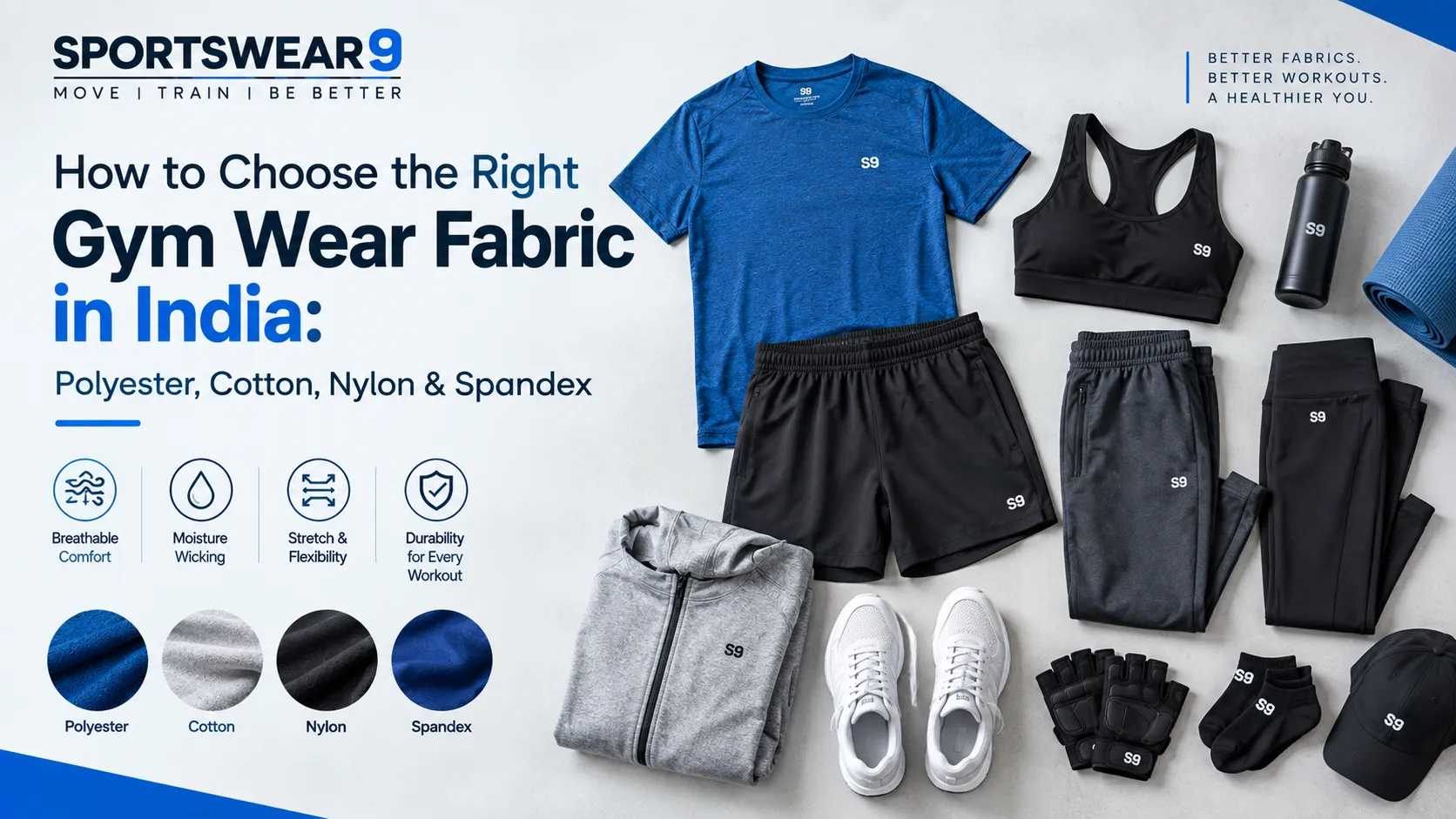

How to Choose the Right Gym Wear Fabric in India

Choosing gym wear is usually about the design, colour, fit, style and price. Once your workout starts, fabric becomes more important.
A T‑shirt that feels comfortable while you are shopping may become heavy after 30 minutes of training. Leggings that look good may feel restrictive during squats. A cotton T-shirt can feel soft at the beginning, but it can become damp when you sweat heavily.
That is why choosing the right gym wear fabric should depend on what you do during your workout.
Polyester, cotton, nylon and spandex each have different characteristics. Importantly, they are often blended rather than used alone. A polyester T‑shirt, for example, can behave differently from a polyester‑spandex training top.
For Indian gym‑goers, the decision also needs to consider heat, humidity, sweating, air‑conditioning and outdoor training.
Instead of asking, "Which fabric is the best?" ask:
“Which fabric combination makes the most sense for my workout?”
That is the approach this guide follows.
What Makes a Good Gym Wear Fabric?
A good workout fabric should help you move comfortably without becoming a distraction.
Before buying gym wear, look at these six characteristics:
1. Moisture management – How well does the garment handle sweat?
2. Drying speed – Does it dry quickly after you sweat?
3. Stretch – Can you squat, lunge, bend and reach comfortably?
4. Breathability – Does the garment allow airflow?
5. Durability – Can it handle workouts and washing?
6. Shape retention – Does it return to its original shape after stretching?
There is another factor that shoppers often miss: construction.
Two garments can contain the same fibre but feel completely different because of their knit, thickness, finishing, fit and stitching. Your existing Sportswear9 content also highlights moisture‑wicking construction, breathability, stretch, lightweight construction, durability and comfortable seams as considerations when evaluating workout clothing.
So don’t judge gym wear by the fibre name printed on the label.
Polyester Gym Wear: Practical for Sweat‑Heavy Workouts
Polyester is one of the materials used in performance sportswear.
Its main advantage is practicality. Polyester garments can be lightweight, durable and quick‑drying, making them useful for workouts where you expect to sweat. Polyester is also frequently engineered into moisture‑management fabrics for activewear.
Polyester works for:
- Gym training
- Cardio
- HIIT
- Running
- Sports training
- Workout T‑shirts
- Shorts
- Lightweight activewear
For someone training in India, polyester can be particularly useful during sweaty sessions because a suitable performance construction can move moisture away from the skin and dry quickly.
However, not every polyester garment is automatically high‑performance.
A thick ventilated polyester T‑shirt can still feel uncomfortable.
Best approach
Look beyond "100 % polyester”.
Check whether the garment also offers:
- Lightweight construction
- Moisture‑wicking finish
- Ventilation or mesh panels
- Suitable stretch
- Comfortable fit
For a look at men’s workout‑shirt fabrics, you can also read Sportswear9’s What Fabric Is Best for Men’s Workout T‑Shirts?.
Cotton Gym Wear: Comfortable, But Not for Every Workout
Cotton is familiar, soft and comfortable.
That makes it a popular choice for gym wear and low‑intensity activities.
The limitation appears when sweating becomes heavy.
Cotton absorbs moisture rather than functioning like a moisture‑wicking synthetic performance fabric. As a result, A cotton T-shirt can become noticeably heavier and remain damp for longer during a workout.
Cotton can make sense for:
- Walking
- Light strength training
- Stretching
- Low‑intensity workouts
- Warm‑ups
- athleisure
It can also work well when personal comfort matters more than maximum sweat management.
For example, someone doing a short weights session in a well‑air‑conditioned gym may be perfectly comfortable in a cotton T‑shirt.
If you’re doing a cardio session in a hot environment, cotton may not be your first choice.
Cotton Isn't Automatically Unsuitable for Gym Wear
This distinction matters.
Cotton isn't automatically unsuitable for exercise. The better question is whether its characteristics match your workout.
Nylon Activewear: Smooth Feel and Strong Performance
Nylon is another fibre used in activewear.
One of its advantages is its comfortable feel. Nylon can also provide durability and flexibility, particularly when combined with elastane or spandex.
Nylon blends are commonly found in garments such as:
- Leggings
- Training tights
- Fitted shorts
- Yoga wear
- Sports bras
- Performance bottoms
For women looking at gym leggings for women nylon‑spandex blends can be worth considering when softness, stretch and a smooth hand feel are priorities.
The trade‑off is usually cost. Nylon‑based performance garments can be more expensive than polyester options.
So nylon isn't necessarily the "best" fabric for everyone.
It is simply another option with a balance of feel, stretch, durability and price.
Spandex: The Stretch Specialist
Spandex is different from polyester and cotton because it is usually not the fabric in a garment.
Instead, it is commonly added in small amounts to provide stretch and recovery.
This is particularly important for clothing that needs to follow body movement.
Spandex is commonly used in:
- Leggings
- Sports bras
- Compression T‑shirts
- Training tights
- Fitted shorts
- Stretch workout tops
It can make a difference when you’re performing movements such as:
- Squats
- Lunges
- Deadlifts
- Shoulder presses
- Stretches
- Running
- Yoga poses
Technical‑textile guidance also identifies spandex as a fibre commonly used in sportswear because of its flexibility.
More stretch isn’t automatically better.
A garment still needs the fabric weight and construction. Excessive compression or an unsuitable cut can make clothing uncomfortable when the fabric itself is highly stretchy.
Polyester vs Cotton vs Nylon vs Spandex
| Fabric | Main Strength | Works Well For | Main Limitation |
| Polyester | Sweat management and durability | Gym, cardio, running | Feel and odour retention can vary |
| Cotton | Softness and comfort | Light workouts, casual wear | Holds moisture |
| Nylon | Smooth feel and flexibility | Leggings, training, yoga | Can cost more |
| Spandex | Stretch and recovery | Fitted activewear, compression | Usually needs to be blended |
The important takeaway is that spandex isn’t really competing with polyester or cotton in the same way. It often works alongside them.
That is why blends are so common in activewear. Polyester can provide durability and moisture management while spandex contributes stretch; nylon can provide a feel while spandex improves flexibility.
The Best Gym Wear Fabric Depends on the Workout
Instead of choosing one material for your entire wardrobe, match the fabric to your activity., match the fabric to your activity.
For strength training
Look for:
- Polyester‑spandex or nylon‑spandex
You want stretch for squats, presses and other movements without the garment becoming restrictive.
For running and cardio
Priorities:
- Lightweight polyester or performance blends
Sweat management and quick drying become more important as workout intensity increases.
For HIIT
Consider:
- Lightweight polyester‑spandex
HIIT involves repeated movement. Usually produces sweat, so both mobility and moisture management matter.
For yoga and stretching
Consider:
- Nylon‑spandex or other soft stretch blends
The priority is freedom of movement and comfortable contact against the skin.
For walking or light workouts
Cotton or cotton blends can work well.
You don’t necessarily need performance fabric for every activity.
What About Gym Wear for Women?
Women often need to evaluate the fabric across the entire outfit because different garments have different jobs.
For example:
- Gym T‑shirt: breathable and moisture‑managing fabric
- Gym leggings: stretch, opacity, comfort and shape retention
- Sports bra: support, stretch and secure fit
- Shorts: mobility, comfort and sweat management
This is why choosing a complete gym wear set for women simply because all the pieces look similar isn’t always the best approach.
The fabric and construction should suit the activity.
If you’re building a wardrobe, Sportswear9’s guide to Gym Wear for Women: What to Wear for Different Types of Workouts can help match clothing choices to different workouts.
For leggings specifically, you can also compare Gym Leggings vs Tights: How to Choose the Right Pair.
Don’t Ignore Fabric Construction
This is where many gym‑wear comparisons become too simplistic.
The label might say polyester. That does not tell you everything.
Pay attention to:
1. Fabric weight – lightweight fabric can feel excellent for cardio, while a heavier fabric may provide a level of coverage and structure.
2. Stretch – A fitted garment should allow the movement required by your workout without pulling
3. Ventilation – Mesh or strategically placed breathable sections can improve comfort during sweaty sessions.
4. Seams – Poorly positioned seams can irritate repeated movements.
5. Fit – Even excellent fabric cannot compensate for the wrong size. This is particularly important for sports bras, leggings and compression wear.
What Is the Best Gym Wear Fabric for Indian Weather?
India does not have one workout climate.
A gym in Delhi during summer is different from an air‑conditioned gym in Bengaluru. Outdoor running in Mumbai is different from weight training in a climate‑controlled facility.
Still, sweat management becomes especially important during humid conditions.
For high‑sweat workouts, lightweight performance fabrics and suitable blends are generally more practical than heavy moisture‑absorbing garments. Indian activewear guides similarly emphasise lightweight performance fabrics and ventilation for summer training.
A practical approach is:
- Hot + sweaty workout → performance polyester/blend
- Strength training → stretch performance blend
- Yoga/stretching → soft stretch blend
Light workout → cotton can be reasonable.
Mixed training → versatile polyester‑spandex blend
This gives you a much better starting point than simply searching for the "best fabric”.
Sportswear9's Practical Approach to Gym Wear Fabric
At Sportswear9, the way to think about gym clothing is not simply "synthetic vs natural."
The better question is:
What are you asking the garment to do?
A person doing heavy strength training needs freedom of movement.
A runner needs lightweight sweat‑managing clothing.
Someone doing yoga needs softness and stretch.
Someone training regularly in India's months needs clothing that does not become unnecessarily heavy or uncomfortable as sweat builds up.
That is why fabric, construction and fit should be considered together.
Your workout should determine the garment—not the way.
For guidance on choosing clothing, see Sportswear9s How to Choose Comfortable Gym Wear for Women.
FAQs About Gym Wear Fabric
Which fabric is best for gym wear?
There is not one winner. Polyester performance blends are practical for sweat‑heavy workouts, while nylon blends can offer a feel and stretch. Cotton can work well for exercise.
Is cotton good for gym workouts?
Yes, for moderate workouts. However, cotton absorbs sweat, so it may become uncomfortable during high‑intensity sessions.
Is polyester better than cotton for gym wear?
For sweat‑heavy workouts, polyester performance fabrics are generally more practical because they can dry faster and manage moisture differently from cotton. For comfort during workouts, some people may prefer cotton.
Is nylon good for gym leggings?
Yes. Nylon is commonly used in leggings because of its feel, durability and compatibility with fibres such as spandex.
Why is spandex used in gym clothes?
Spandex adds stretch. Helps garments recover their shape. It is particularly useful in leggings, sports bras, compression clothing and fitted workout apparel.
Is polyester‑spandex good for workouts?
It can be a good combination for training because polyester can provide performance and moisture management while spandex adds stretch and recovery. The actual performance still depends on the garment's construction.
What fabric is best for gym wear in India?
For workouts in various conditions, lightweight performance fabrics and suitable blends are generally a practical choice. For low‑intensity exercise, cotton and cotton blends can also work.
Final Verdict: Don't Choose Gym Wear by Fabric Name Alone
The best gym wear fabric is not simply polyester, cotton, nylon or spandex.
Each has a role.
Polyester is practical for sweat‑heavy training.
Cotton prioritises everyday comfort.
Nylon offers a feel and useful durability.
Spandex provides the stretch needed for movement.
For activewear, the real answer lies in the combination of fibre, construction, fit and workout type.
So before buying your pair of gym leggings, workout T‑shirt, shorts, or sports bra, do not just ask:






















Sign in to leave a comment.