How to Choose the Right Mobile Application Development Company for Your Business

A mobile application can become an important part of a business's customer experience, internal operations, or digital product strategy. However, building one successfully requires more than finding developers who can write code. An experienced mobile app development company can help businesses translate their requirements into a practical product while considering design, technology, integrations, testing, security, and future growth.
With so many development companies available, knowing what to evaluate can make the selection process easier and help businesses avoid costly mistakes.
Start With Your Business Requirements
Before contacting development companies, define what you want the application to accomplish.
You do not need to have every technical detail figured out. However, you should have a reasonable understanding of the business problem, target users, and expected outcome.
Consider questions such as:
- Who will use the application?
- What problem will it solve?
- Is it intended for customers, employees, partners, or multiple groups?
- Which platforms are required?
- What are the essential features?
- Does the application need to connect with existing systems?
- How might the product develop in the future?
Having clear answers helps potential development partners understand the project and provide more relevant recommendations.
Look Beyond the Company Website
A polished website does not necessarily tell you how well a development team will handle your project.
Look for evidence of actual experience.
A company's portfolio can provide useful information about the types of applications it has developed, the industries it has worked with, and the technical challenges it has handled.
Pay attention to whether the portfolio contains projects similar to your requirements.
For example, if your application requires payment integration, real-time communication, location services, or enterprise system integration, experience in those areas can be more valuable than a long list of unrelated projects.
Evaluate Technical Expertise
Different applications require different technologies.
A development company should be able to explain why a particular technology stack is appropriate instead of simply recommending whatever framework its developers already use.
Depending on your project, the team may recommend native development for iOS or Android, or a cross-platform approach using technologies such as React Native or Flutter.
The decision should consider:
- Application functionality
- Performance requirements
- Target platforms
- Device capabilities
- Existing infrastructure
- Development resources
- Long-term maintenance
A good development partner should explain the reasoning behind its recommendation in terms that business stakeholders can understand.
Consider UI and UX Capabilities
Users do not experience your source code. They experience the application interface.
An application with excellent technical architecture can still struggle if users find it difficult to navigate.
Ask potential development partners how they approach UI/UX design.
A thoughtful process may include:
Research → User flows → Wireframes → Prototypes → Visual design → Usability feedback → Development
This gives the business an opportunity to identify usability issues before they become expensive development changes.
Ask About Development Methodology
It is useful to understand how the development team manages projects.
Some companies use agile methodologies with development divided into smaller iterations. Others may follow different approaches depending on the project.
Rather than focusing only on terminology, ask practical questions:
- How frequently will we review progress?
- How are requirements documented?
- How are changes handled?
- Who will communicate project updates?
- How are development milestones defined?
- How will feedback be incorporated?
A transparent process can make a significant difference when a project lasts several months.
Check How They Handle Integrations
Many business applications need to communicate with other systems.
Your mobile application may need to connect with a CRM, ERP, payment gateway, inventory system, booking platform, analytics service, or custom backend.
Integration experience should therefore be part of your evaluation.
Ask the development company whether it has experience working with the systems your application needs to connect with.
Also ask how it plans to handle API failures, authentication, data synchronization, and changes to third-party services.
These details may not be visible in the application's interface, but they can have a major effect on reliability.
Don't Ignore Security
Security should be discussed before development begins rather than after the application is completed.
Depending on your product, the application may handle customer information, business records, account credentials, transactions, or other sensitive data.
Ask potential development partners about their approach to:
- Authentication
- Authorization
- Secure API communication
- Data protection
- Access controls
- Secure storage
- Input validation
- Security testing
The exact requirements will depend on the application, but a development partner should demonstrate that security is considered throughout the development lifecycle.
Ask How They Approach Testing
Testing should not be treated as the final activity before launch.
Mobile applications need to work across different devices, screen sizes, operating system versions, and network conditions.
Ask what types of testing are included in the development process.
This may involve:
- Functional testing
- Compatibility testing
- Performance testing
- Usability testing
- Security testing
- API testing
- Regression testing
Also ask whether testing takes place throughout development or only shortly before deployment.
Continuous testing can help identify problems earlier.
Think About Scalability
Your first release may have a relatively small user base, but what happens if the application becomes successful?
The development architecture should account for possible growth.
Consider whether the development partner has experience with applications that need to handle increasing numbers of users, transactions, data, or integrations.
A scalable application may require careful decisions around APIs, databases, cloud infrastructure, caching, authentication, and application architecture.
You do not necessarily need to build everything for millions of users on day one, but the architecture should not make future growth unnecessarily difficult.
Understand Post-Launch Support
Launching the application is only the beginning of its lifecycle.
After release, you may need bug fixes, operating system compatibility updates, performance improvements, security updates, and new features.
Ask potential development partners what happens after the application goes live.
Important questions include:
- Is post-launch support available?
- How are bugs reported?
- How quickly are critical issues addressed?
- Are maintenance services available?
- Can the same team continue developing new features?
Having a clear post-launch arrangement can prevent uncertainty after deployment.
Review Communication and Project Management
Technical ability is important, but communication can determine how smoothly the project progresses.
A development team may be technically strong but difficult to work with if communication is inconsistent.
Before signing a contract, understand:
- Who your primary contact will be
- How often you will receive updates
- Which communication tools will be used
- How meetings will be scheduled
- How decisions and requirements will be documented
- How issues will be escalated
Clear communication can help prevent misunderstandings between business and technical teams.
Be Careful With Extremely Low Quotes
Cost is naturally an important consideration, but the cheapest proposal is not always the most economical choice.
A very low initial quote may exclude important activities such as testing, UI/UX design, deployment, integrations, or post-launch support.
Instead of comparing only the final price, compare what each proposal actually includes.
Look at:
- Scope
- Features
- Design
- Development
- Testing
- Integrations
- Deployment
- Documentation
- Maintenance
- Support
A slightly higher initial investment may provide better value if it reduces technical debt and unexpected expenses later.
Ask for a Clear Project Scope
Before development begins, make sure the scope is documented.
The project agreement should clarify what will be delivered, which platforms are included, expected milestones, responsibilities, and how additional requirements will be handled.
This does not mean every future feature needs to be decided immediately.
Instead, it creates a shared understanding of what the first release includes.
A clearly defined scope can also make budget and timeline discussions more realistic.
Discuss Ownership and Access
Businesses should also understand who owns the application and its associated assets.
Clarify ownership of:
- Source code
- UI/UX designs
- Documentation
- Database
- Cloud infrastructure
- App store accounts
- Third-party service accounts
Make sure you understand how access will be handled during and after the project.
This is particularly important if you plan to work with different teams in the future.
Compare Companies Based on Fit, Not Just Size
A large development company is not automatically the best choice, and a small team is not automatically better.
The right partner depends on your requirements.
A large organization may have broader resources, while a smaller specialized team may provide more direct communication.
Consider the company's:
- Relevant experience
- Technical capabilities
- Communication style
- Project management process
- Availability
- Industry knowledge
- Long-term support
- Understanding of your business
The goal is to find a team that fits the project rather than simply selecting the company with the largest portfolio.
Ask Questions Before Making a Decision
Before choosing a development partner, arrange a detailed discussion about your project.
Some useful questions include:
- Have you developed applications similar to ours?
- Which technology would you recommend and why?
- How will you approach UI/UX?
- How will the application connect with our existing systems?
- What testing will be performed?
- How will the application be prepared for future growth?
- What happens after launch?
- Who will manage our project?
- How will changes to requirements be handled?
- What will be included in the final project cost?
The quality of the answers can tell you a lot about how seriously the company approaches development.
The Right Partner Should Understand the Product
Ultimately, selecting a development company is about more than technical skills.
The development partner should understand what you are trying to accomplish and be willing to question assumptions when necessary.
A strong team can help identify technical risks, suggest practical solutions, improve user flows, and prepare the application for future requirements.
The relationship should feel like a collaboration rather than simply handing over a list of features and waiting for the finished product.
Conclusion
Choosing the right mobile application development company can have a significant impact on the success of your project.
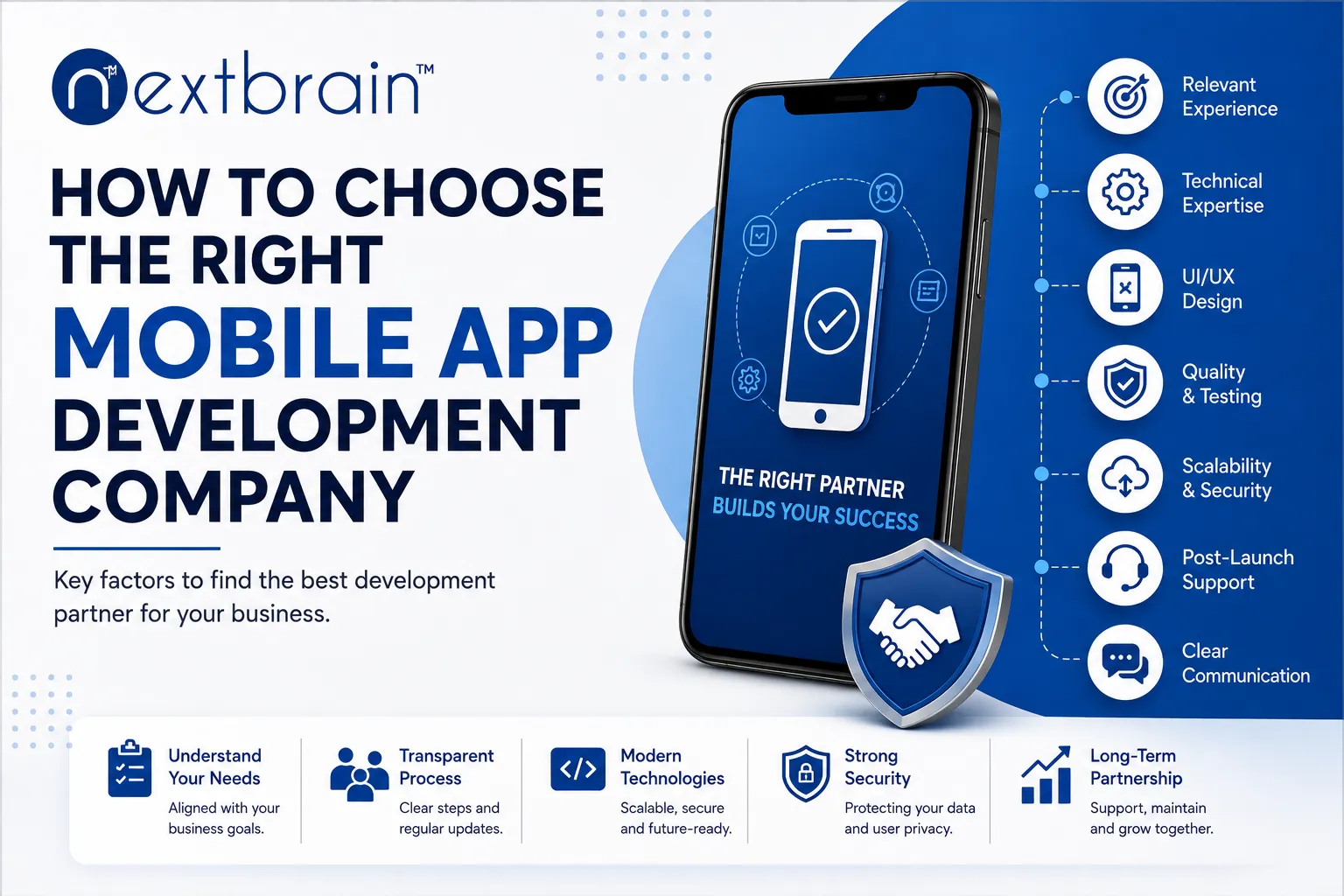
Instead of focusing only on price, evaluate the complete picture: technical expertise, relevant experience, UI/UX capabilities, development methodology, integrations, security, testing, scalability, communication, and post-launch support.
Start with clear business requirements, compare a small number of suitable companies, ask detailed questions, and make sure the project scope and responsibilities are clearly understood before development begins.
The right development partner should not only help you build an application. It should help you create a product that can provide value to users today and continue to evolve as your business grows.
If you are planning a new application or want to discuss your mobile development requirements, contact Nextbrain today to discuss your project and explore a development approach aligned with your business goals.
Frequently Asked Questions
1. How do I choose the right mobile application development company?
Start by defining your business requirements and then evaluate potential companies based on relevant experience, technical expertise, UI/UX capabilities, communication, testing, integrations, scalability, and post-launch support.
2. Should I choose a company based on the lowest development cost?
Not necessarily. A lower quote may exclude important services or result in compromises in quality. Compare the complete scope, deliverables, technology, testing, support, and long-term value before making a decision.
3. Should I choose native or cross-platform mobile development?
It depends on your application's requirements. Native development can be appropriate when platform-specific functionality or performance is critical, while cross-platform development can be useful when supporting iOS and Android with shared code is a priority.
4. What should a development company provide after launch?
Depending on the agreement, post-launch services can include bug fixes, security updates, operating system compatibility updates, performance improvements, monitoring, maintenance, and development of new features.
5. How important is communication when choosing a development partner?
Communication is extremely important because mobile development involves continuous decisions and feedback. Clear project updates, documented requirements, defined responsibilities, and an accessible point of contact can help keep development aligned with business goals.





Sign in to leave a comment.