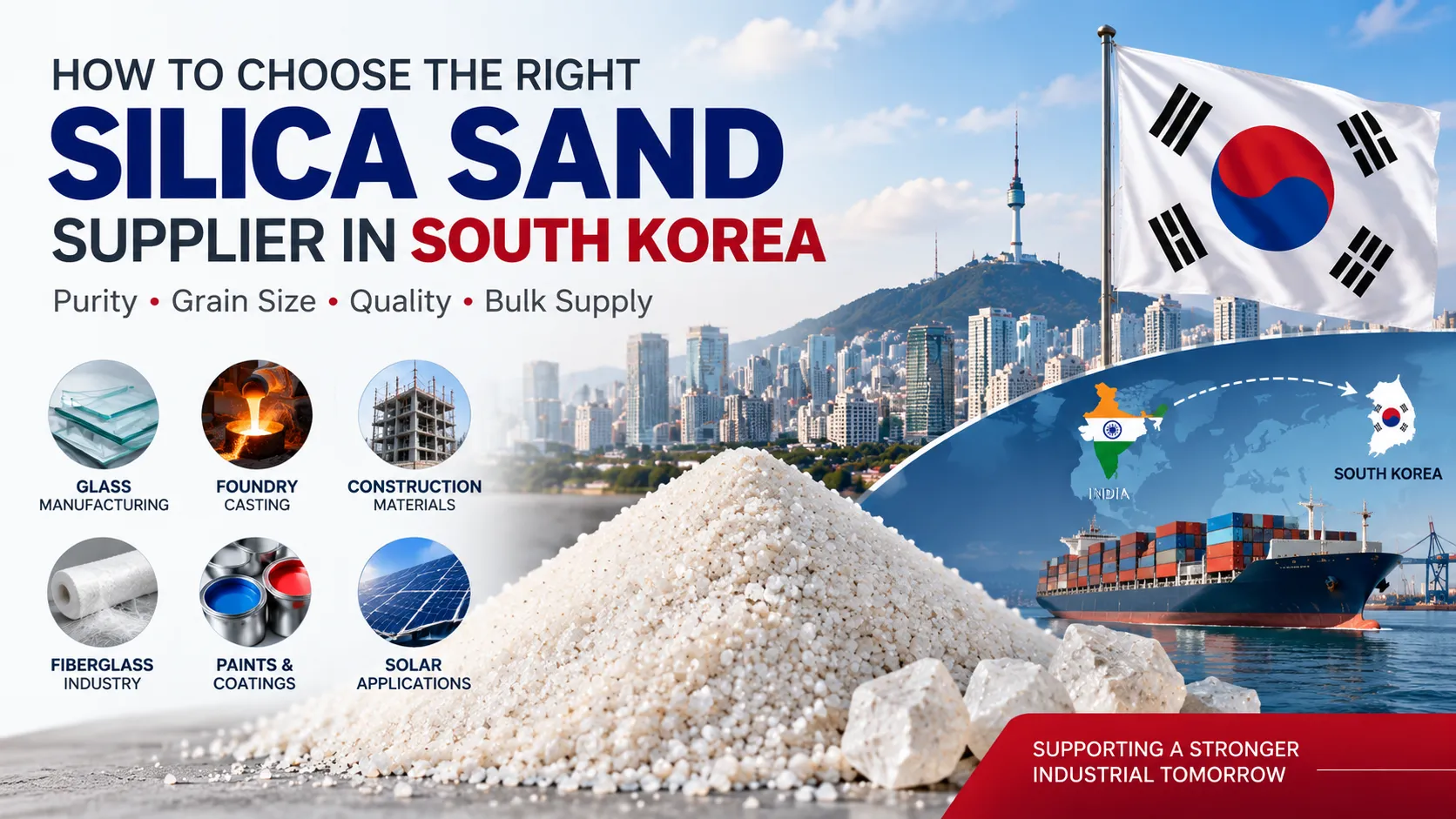

South Korea has a highly developed industrial and manufacturing sector, with silica sand used across glass manufacturing, foundry casting, fiberglass, construction, chemicals, paints and coatings, ceramics, filtration, and solar-related applications. Because each industry has different technical requirements, selecting the right silica sand is an important part of maintaining consistent production.
For businesses comparing Silica Sand Suppliers in South Korea, the decision should go beyond simply finding the lowest price. Silica content, iron and contaminant levels, grain size, processing quality, bulk availability, documentation, and delivery reliability can all influence whether a particular material is suitable for industrial use.
This guide explains the main factors South Korean manufacturers and importers should consider when selecting an industrial silica sand supplier.
Understand Your Application First
Before contacting suppliers, it is important to understand how the silica sand will be used.
Different applications require different material characteristics.
For example:
- Glass manufacturing may require high silica content and low iron levels.
- Foundry casting may require specific grain sizes and consistent grain distribution.
- Fiberglass production may require controlled chemical composition.
- Construction materials may require suitable particle size and cleanliness.
- Paints and coatings may require controlled particle characteristics.
- Solar-related applications can place greater importance on purity and low iron content.
The South Korean market includes all of these applications, so there is no single specification that works for every manufacturer.
A good supplier should first understand the application and then recommend a suitable grade.
Check Silica Purity
One of the first things industrial buyers should evaluate is silica content.
High-purity silica sand contains a high proportion of silicon dioxide (SiO₂), with controlled levels of other minerals and contaminants.
This is particularly important for applications where the chemical composition of the raw material can influence the finished product.
Businesses searching for High Purity Silica Sand Korea should ask suppliers for detailed chemical specifications rather than relying only on general product descriptions.
Important parameters may include:
- SiO₂ content
- Fe₂O₃ or iron content
- Al₂O₃
- CaO
- MgO
- Moisture
- Other relevant impurities
The required limits will depend on the intended application.
For example, glass and solar-related applications may have stricter requirements than some general construction applications.
Why Low Iron Content Matters
Iron is one of the impurities that can be particularly important for certain silica sand applications.
In glass manufacturing, excessive iron can influence the color and optical characteristics of the finished glass. For applications requiring greater clarity or transparency, lower iron levels may therefore be preferred.
The same consideration can apply to solar-related manufacturing where transparency and optical performance are important.
This is why buyers should not look only at total SiO₂ content. A silica sand product can have high silica content while still requiring careful evaluation of its iron and other impurity levels.
When comparing Silica Sand Suppliers in South Korea, ask for complete chemical specifications and, where appropriate, a Certificate of Analysis.
Evaluate Grain Size and Distribution
Grain size is another important factor in industrial silica sand.
Different applications require different particle-size ranges.
Foundry Applications
Foundries may need carefully controlled grain sizes to achieve the required combination of mold strength, permeability, surface finish, and casting performance.
Glass Manufacturing
Controlled grain distribution can support consistent batching and processing.
Construction
Different construction products may require fine, medium, or coarse silica sand depending on the formulation.
Industrial Fillers
Paints, coatings, and other formulations may require specific particle characteristics.
A reliable supplier should be able to provide the required grain size and maintain consistency between batches.
The South Korea silica sand supply page specifically highlights consistent grain composition as a quality characteristic for industrial applications.
Look at Processing and Cleanliness
Raw silica sand may require processing before it is suitable for a particular industrial application.
Depending on the source and required specification, processing can include:
- Washing
- Screening
- Grading
- Drying
- Classification
- Impurity removal
- Quality inspection
Proper processing can help achieve cleaner material and more controlled particle characteristics.
For industries that require consistent raw materials, carefully processed silica sand can be preferable to material with significant variation.
The processing method should match the final application.
Consider Contaminant Levels
Industrial buyers should also evaluate contaminant levels.
The importance of specific contaminants varies by industry, but buyers may need to review:
- Iron
- Clay
- Organic matter
- Other mineral impurities
- Moisture
Lower contaminant levels can be particularly important for applications requiring cleaner raw materials.
For this reason, businesses evaluating Industrial Silica Sand South Korea should request a technical specification sheet and confirm that the product meets their production requirements.
Choose a Supplier With Reliable Quality Control
A supplier's quality-control process can be just as important as the mineral itself.
For recurring industrial procurement, manufacturers need confidence that today's shipment will perform similarly to the next shipment.
A good quality-control process may include:
- Raw-material inspection
- Washing and processing checks
- Particle-size testing
- Chemical analysis
- Moisture testing
- Final product inspection
- Batch documentation
A Certificate of Analysis can help buyers verify the characteristics of individual shipments.
For large-volume procurement, consistent documentation also makes it easier for technical teams to monitor supplier performance over time.
Ask for a Sample Before a Large Order
If you are working with a new supplier, requesting a sample can be a useful step.
A sample allows your technical team to evaluate the material before committing to a large shipment.
Depending on the application, testing may include:
- SiO₂ content
- Iron content
- Particle-size distribution
- Moisture
- Contaminant levels
- Processing behavior
- Application-specific performance
For example, a foundry may test the sand's behavior in its molding system, while a glass manufacturer may evaluate chemical composition and melting performance.
Sample approval can reduce the risk of purchasing a large quantity of unsuitable material.
Evaluate Bulk Supply Capability
For industrial manufacturers, supplier capacity matters.
A supplier may offer excellent material but still be unsuitable if they cannot provide the required volume consistently.
When comparing suppliers, ask about:
- Minimum order quantity
- Monthly production capacity
- Bulk availability
- Containerized shipments
- Packaging options
- Lead time
- Repeat-order capability
The South Korea silica sand supply model includes bulk and recurring procurement support for industrial requirements.
This type of supply arrangement can be particularly useful for manufacturers with continuous production.
Packaging Is Also Important
The right packaging depends on the order quantity, handling system, warehouse facilities, and transportation method.
Before placing an order, buyers should discuss:
- Bagged or bulk supply
- Packaging size
- Container loading
- Product labeling
- Moisture protection
- Handling requirements
For international shipments, packaging should also be suitable for the transportation distance and expected handling conditions.
Proper packaging helps protect the material and makes unloading and storage easier at the destination.
Consider Export and Logistics Experience
If you are sourcing silica sand internationally, product quality is only one part of the decision.
The supplier should also have experience managing international shipments.
A capable Silica Sand Exporter to South Korea should be able to coordinate:
- Commercial documentation
- Packing information
- Certificate of Analysis
- Quality documentation
- Container loading
- Shipping arrangements
- Port coordination
- International logistics
The South Korea supply model includes bulk silica sand, containerized shipments, export documentation, quality inspection, and logistics coordination.
For manufacturers depending on regular deliveries, this export capability can make procurement more predictable.
Why India Can Be an Important Sourcing Option
South Korean buyers looking for international sources may consider India for industrial silica sand.
India has an established industrial mineral sector and export infrastructure, allowing suppliers to serve international customers with processed mineral products.
A Silica sand exporter from India to South Korea may be able to offer:
- Bulk quantities
- Export-grade material
- Different particle-size options
- Application-specific specifications
- Containerized shipments
- Quality documentation
- Long-term supply arrangements
However, buyers should evaluate the individual supplier rather than assuming that all Indian silica sand has the same quality.
Processing, source material, testing, and quality-control procedures can differ between suppliers.
Compare Total Procurement Cost, Not Just Price
Price per ton is important, but it should not be the only factor.
A supplier offering a lower price may not necessarily provide the lowest overall procurement cost if the material has inconsistent quality, unsuitable grain size, higher contamination, or unreliable delivery.
Buyers should consider:
Material Cost + Processing + Packaging + Freight + Documentation + Handling + Delivery
A slightly higher-quality material may provide better overall value if it improves production consistency and reduces quality-related issues.
This is particularly important for large-scale manufacturing where raw-material variation can have a greater impact.
Where to Buy Silica Sand in Korea?
Businesses searching for Where to buy silica sand in Korea should first define their application and technical requirements.
Local distributors can be suitable for smaller quantities or urgent requirements. However, manufacturers with regular and larger consumption may also consider direct sourcing from international exporters.
When comparing options, look at:
- Product purity
- Grain size
- Iron content
- Contaminant levels
- Processing
- Bulk capacity
- Packaging
- Documentation
- Delivery reliability
- Long-term supply capability
This approach can help buyers select a supplier based on actual manufacturing needs rather than simply location.
Buy Silica Sand in South Korea: Questions to Ask Suppliers
Businesses planning to Buy Silica Sand in South Korea should ask suppliers clear technical and commercial questions.
Product Questions
- What is the SiO₂ content?
- What is the iron content?
- What particle sizes are available?
- Is the material washed and processed?
- What contaminant levels can be expected?
Quality Questions
- Is a COA available?
- How is the material tested?
- How is batch consistency maintained?
- Can samples be provided?
Supply Questions
- What quantities can you supply?
- Is bulk supply available?
- Can you support recurring orders?
- What packaging options are available?
Export Questions
- Do you export from India to South Korea?
- Which ports are used?
- What export documentation is provided?
- Can shipment schedules be planned in advance?
The answers to these questions can help procurement teams compare suppliers more effectively.
Match the Supplier to Your Industry
The right supplier should understand your industry.
For Glass Manufacturers
Focus on:
- High SiO₂
- Low iron
- Controlled impurities
- Consistent grain size
For Foundries
Focus on:
- Grain distribution
- Thermal resistance
- Permeability
- Mold performance
- Consistent processing
For Fiberglass
Focus on:
- Chemical composition
- Purity
- Consistency
- Bulk availability
For Construction
Focus on:
- Grain size
- Cleanliness
- Application suitability
- Supply consistency
For Paints and Coatings
Focus on:
- Particle characteristics
- Clean material
- Consistent quality
- Formulation compatibility
Matching the supplier's capabilities with the specific application can significantly improve the purchasing decision.
Importance of Long-Term Supply Reliability
Industrial manufacturing requires predictable raw-material availability.
If a supplier delivers inconsistent quality or experiences frequent shipment delays, the buyer may face production challenges.
A reliable long-term supplier can support:
- Stable inventory planning
- Consistent raw-material quality
- Regular shipment schedules
- Easier repeat procurement
- Better production planning
- Reduced sourcing uncertainty
For manufacturers using silica sand continuously, a long-term supply relationship can be more valuable than a one-time low-price purchase.
Building a Reliable Silica Sand Supply Chain
A strong supply chain starts with the right product specification and continues through processing, quality control, packaging, transportation, and delivery.
For an international buyer, the process can look like:
Raw Material → Processing → Quality Testing → Packaging → Container Loading → Indian Port → Ocean Shipment → South Korean Port → Final Delivery
Each stage needs proper coordination.
This is why an experienced supplier should be able to provide information about both the material and the export process.
Conclusion
Choosing the right silica sand supplier requires a combination of technical and commercial evaluation.
Businesses comparing Silica Sand Suppliers in South Korea should consider more than product availability. Silica purity, iron content, grain size, contaminant levels, processing quality, batch consistency, bulk capacity, packaging, documentation, and logistics can all influence the suitability of the material.
For companies requiring High Purity Silica Sand Korea, detailed technical specifications and quality documentation should be reviewed before placing a bulk order.
Businesses looking to Buy Silica Sand in South Korea should also consider whether the supplier can provide consistent quality and reliable recurring shipments.
For international sourcing, a dependable Silica sand exporter from India to South Korea can support manufacturers with bulk supply, containerized shipments, quality documentation, and export logistics.
Ultimately, the best supplier is not simply the one offering the lowest price. It is the supplier that can provide the right silica sand specification, consistent quality, dependable supply, and reliable logistics for your specific manufacturing requirements.
























Sign in to leave a comment.