
Buying clothes and shoes for children can be surprisingly difficult. Kids grow quickly, and two children of the same age can have completely different heights, weights, and foot sizes. When shopping online, the challenge becomes even greater because parents cannot see the actual fit or let their child try the product before ordering.
The problem becomes more complicated when shopping from international stores. A clothing size used in the United States may not use the same labeling system as a size in the United Kingdom or Europe. The same issue applies to children's shoes.
Fortunately, parents can make the process easier by looking beyond age-based labels and comparing measurements and international sizing standards.
Age Is Only a Starting Point
Many children's clothing products are labeled according to age, such as 2T, 4T, 6, or 10. While these labels are convenient, they should not be treated as exact measurements.
Children develop at different rates. One six-year-old may be considerably taller or heavier than another child of the same age. That's why height and weight can provide more useful information when selecting children's clothing.
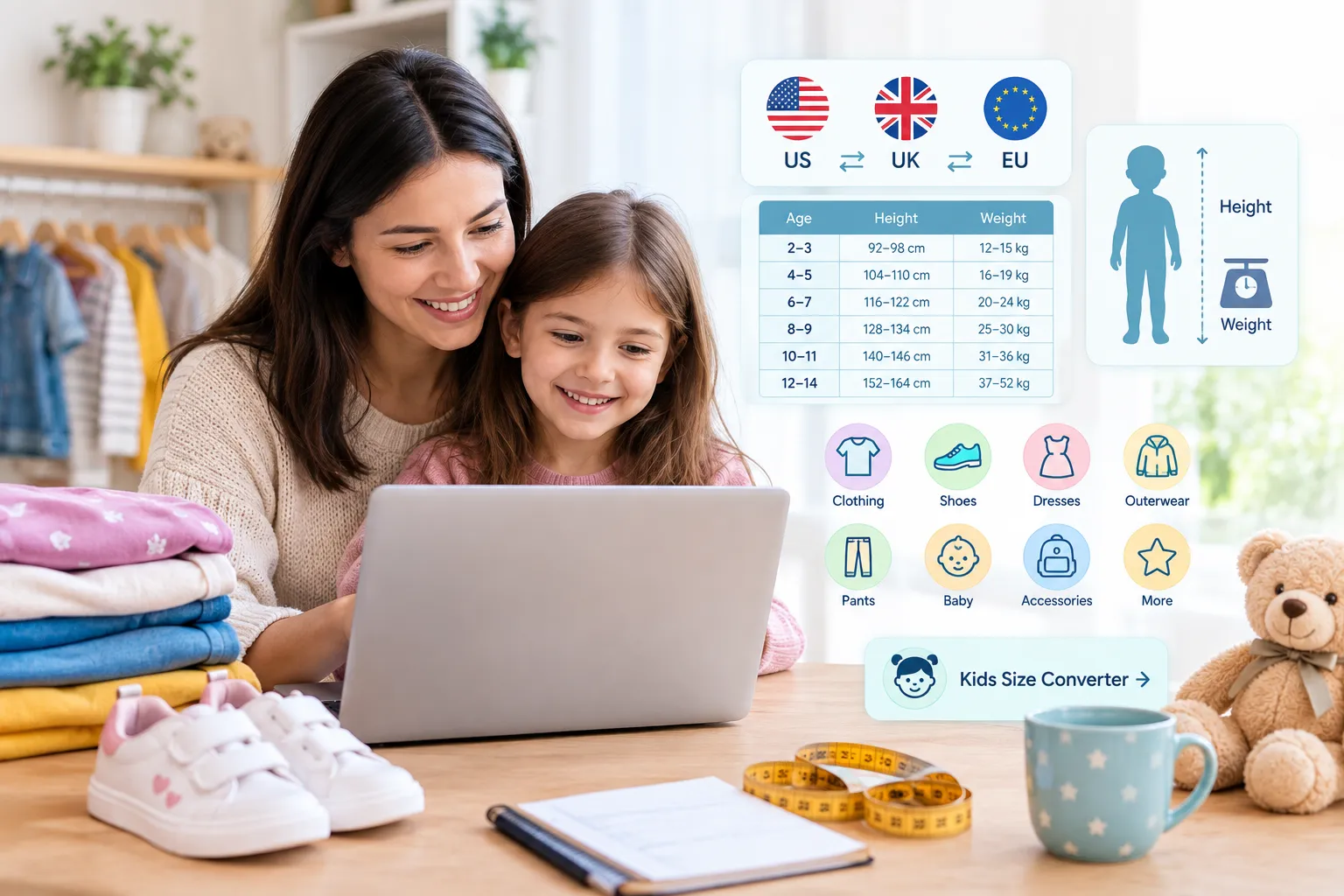
A children's size conversion tool can provide a convenient starting point by connecting age ranges with common US, UK, and EU sizing systems.
For example, the kids size converter on Size Convertly provides clothing and shoe conversions for children from newborn through approximately 14 years. It also presents size information alongside height and weight ranges.
Why International Sizing Creates Confusion
International shopping gives families access to a much wider selection of clothing and footwear. However, different countries can use different sizing conventions.
A parent who normally shops using US sizes may encounter UK or EU sizes when ordering from an overseas retailer. Without a conversion reference, it can be difficult to understand whether the selected product is likely to be appropriate.
This is especially important with children's shoes. A numerical shoe size can mean something different depending on the sizing system being used.
A conversion chart can help parents compare the systems before placing an order instead of relying on guesswork.
Measuring Your Child's Height and Weight
For children's clothing, taking two simple measurements can make online shopping more reliable.
First, measure the child's height while standing against a wall. Make sure the child is standing naturally and that the measurement is taken from the floor to the top of the head.
Next, check the child's current weight.
These measurements can then be compared with the retailer's size chart or a conversion reference. Size Convertly's children's sizing information includes age, height, weight, and corresponding US, UK, and EU clothing sizes.
This approach is generally more useful than choosing a size based only on a child's birthday.
Don't Forget About Growing Room
Children can outgrow clothing and shoes surprisingly quickly. However, buying excessively large items is not always the best solution.
For clothing, a little extra room may be practical, particularly for items such as jackets, sweaters, and everyday trousers. But an excessively large garment can be uncomfortable and may not fit correctly.
Shoes require even more attention. A shoe that is too large can be uncomfortable and may affect how a child walks. Parents should therefore consider the manufacturer's fitting guidance instead of simply choosing several sizes above the child's current size.
Measuring Children's Feet at Home
Parents do not necessarily need professional equipment to get a useful foot measurement.
One simple method is to have the child stand on a piece of paper. Mark the point at the heel and the tip of the longest toe, then measure the distance between those points.
It is useful to measure both feet because they may not be exactly the same length. The larger measurement can then be compared with the retailer's shoe-size chart.
Size Convertly recommends remeasuring children's feet regularly because children's feet can grow quickly.
For international purchases, the children's clothing and shoe size converter can then be used as a reference for comparing US, UK, and EU sizes.
Always Check the Brand's Size Chart
A conversion tool is useful, but it should not replace the manufacturer's measurements.
Brands can use their own patterns, cuts, and fitting standards. A size labeled "8" from one company may not fit exactly like a size "8" from another company.
Before buying, parents should therefore look at the product-specific size chart whenever one is available.
This is particularly important for fitted garments, coats, school uniforms, formal clothing, and footwear.
The best approach is to combine the child's current measurements with the retailer's information and an international size reference.
A Simple Process for Online Shopping
Parents can make children's online shopping much easier by following a simple process:
- Measure the child's current height and weight.
- Measure both feet when purchasing shoes.
- Identify the sizing system used by the retailer.
- Compare the size with an international conversion chart.
- Check the retailer's own measurements.
- Consider the child's growth and the type of garment.
- Review the return or exchange policy before ordering.
This process takes only a few minutes but can reduce the uncertainty involved in buying children's products online.
Making Children's Shopping Easier
Children's sizing does not have to be complicated. The key is to remember that age-based labels are useful references, but they are not perfect measurements.
Height, weight, foot length, and the individual retailer's sizing information can provide a much clearer picture of what is likely to fit.
International shoppers can also benefit from conversion tools when a retailer uses unfamiliar sizing standards. By combining measurements with a reliable reference, parents can shop with greater confidence and avoid making decisions based solely on a number or age label.
As children continue to grow, keeping their measurements up to date is one of the simplest ways to make online clothing and shoe shopping easier.






















Sign in to leave a comment.