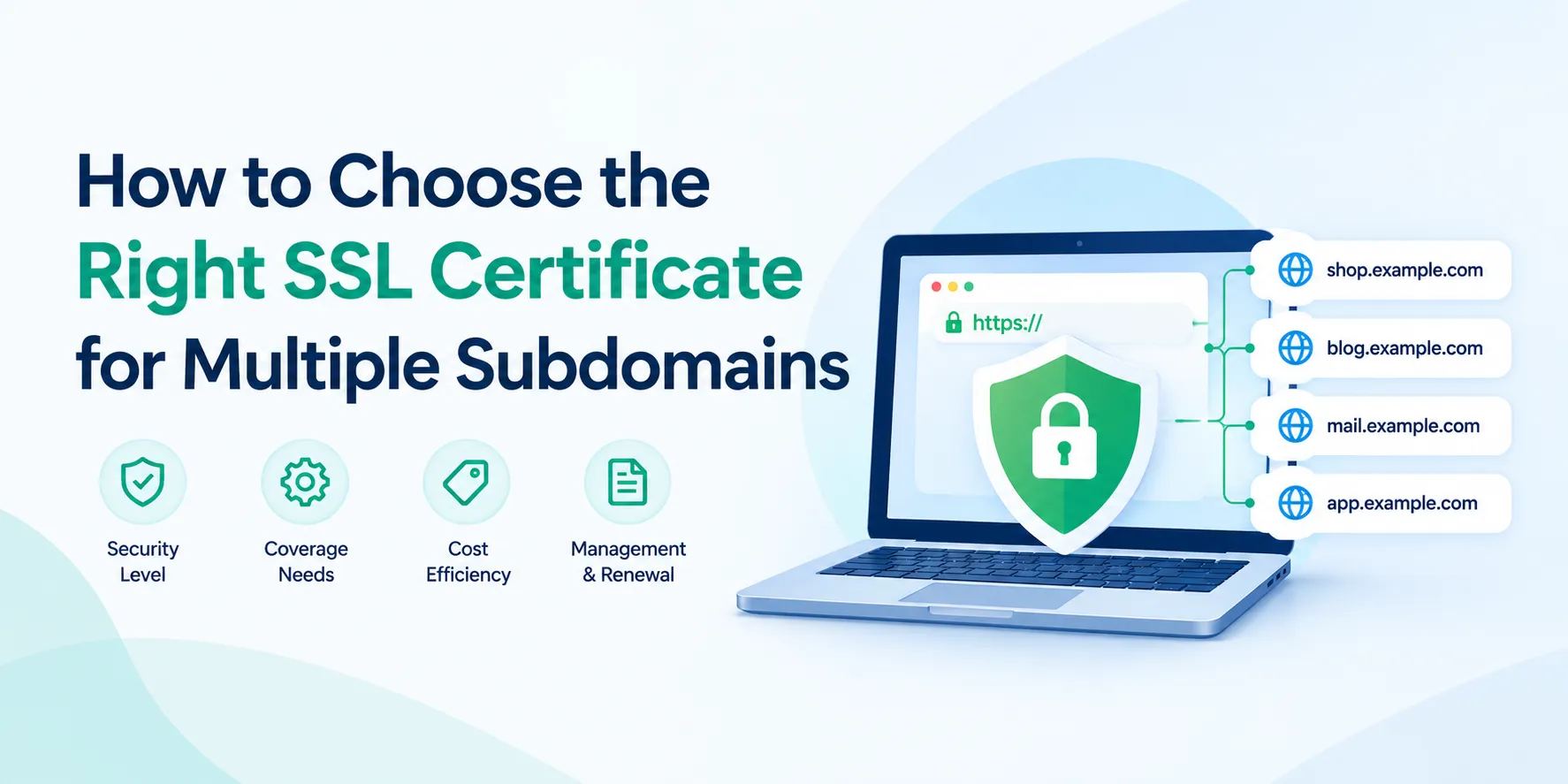

As a website grows, SSL management can become more complicated than it first appears. A business may start with one website and later add a store, customer portal, blog, API, staging environment, or several other subdomains.
At that point, using a separate certificate for every hostname may not always be the most practical approach. Wildcard SSL certificates can simplify this by allowing one certificate to cover a main domain and its first-level subdomains.
When comparing available products, you may come across older references to Comodo wildcard SSL, current DigiCert wildcard SSL products, and different types of GeoTrust SSL certificate. These names are worth understanding, but the certificate's coverage and how it fits into your infrastructure are usually more important than the brand name alone.
What Is a Wildcard SSL Certificate?
A wildcard SSL certificate is designed to secure a domain and multiple first-level subdomains with a single certificate.
For example, a certificate issued for:
*.example.com
can cover:
- www.example.com
- shop.example.com
- login.example.com
- api.example.com
The wildcard does not automatically cover deeper levels such as dev.api.example.com. That distinction is important when planning certificate coverage.
A wildcard certificate also does not automatically install itself on every server. The certificate and private key still have to be deployed wherever TLS terminates.
When Does a Wildcard Certificate Make Sense?
Wildcard certificates are particularly useful when several services belong to the same main domain.
Imagine a company has:
www.example.com
store.example.com
support.example.com
portal.example.com
Instead of managing four separate certificates, a wildcard certificate can cover those first-level subdomains.
This can make certificate management easier, especially when new subdomains are added regularly. However, putting many services behind the same certificate also means the private key needs careful protection. DigiCert specifically notes that distributing the same private key across multiple systems can increase security risk.
What Should You Know About Comodo Wildcard SSL?
The term Comodo wildcard SSL still appears frequently in older articles, product comparisons, and searches.
The reason is largely historical. Comodo CA's certificate business moved under the Sectigo brand, and Sectigo now provides the current certificate offerings that were previously associated with Comodo CA. Sectigo itself explains that ComodoCA is now unified under the Sectigo brand while older Comodo products and references can still be encountered.
So if you find an old article discussing a Comodo wildcard certificate, check the publication date and current product information before relying on it.
The important thing is to look at the certificate's present-day issuer, validation level, coverage, and issuance requirements rather than choosing a product simply because it has a familiar historical name.
What Should You Know About DigiCert Wildcard SSL?
A DigiCert wildcard SSL certificate follows the same basic wildcard concept: one certificate can secure a domain and multiple first-level subdomains.
For example, *.example.com can cover www.example.com, mail.example.com, and support.example.com. DigiCert also explains that wildcard coverage is limited to the same DNS level, so a hostname such as portal.dev.example.com would not be covered by *.example.com.
DigiCert also offers the ability to add SANs to certain wildcard certificates, which can be useful when your environment needs coverage beyond the basic wildcard name.
The main takeaway is that you should map out your actual hostnames before purchasing rather than assuming that every subdomain will automatically be covered.
Where Does a GeoTrust SSL Certificate Fit?
A GeoTrust SSL certificate may be a better fit when you need something other than a standard wildcard setup.
GeoTrust currently offers different certificate coverage types, including single-domain, wildcard, and multi-domain certificates. A multi-domain certificate can cover different domain names, while a wildcard is designed for multiple subdomains under one domain.
For example, a business operating:
example.com
example.net
example.co.uk
may have a different requirement from a business operating ten subdomains under example.com.
This is why it's useful to decide whether you have multiple domains or multiple subdomains before comparing certificates.
Wildcard SSL vs Multi-Domain SSL
These two certificate types are sometimes confused because both can reduce the number of individual certificates you need to manage.
A wildcard certificate is primarily useful when you have many first-level subdomains under the same base domain.
A multi-domain, or SAN, certificate is designed to cover multiple specific domain names or hostnames. GeoTrust, for example, describes multi-domain certificates as a way to secure different domains with one certificate.
Consider this example:
Company A
- shop.example.com
- support.example.com
- login.example.com
A wildcard certificate may be a natural fit.
Company B
- example.com
- example.net
- example.co.uk
A multi-domain certificate may make more sense.
The structure of your websites should therefore come before the brand or price when choosing a certificate.
Don't Choose a Certificate Based Only on Price
Price is important, but it shouldn't be the only deciding factor.
A certificate that appears inexpensive may not provide the coverage you actually need. You should also look at the validation level, renewal process, key protection, supported environments, management tools, and technical support.
For businesses managing many certificates, automation is becoming increasingly relevant. GeoTrust, for example, now includes ACME-based automation with its SSL platform, reflecting the industry's broader move toward automated certificate management.
This matters even more as public TLS certificate lifetimes continue to become shorter. GeoTrust announced that certificates issued from February 24, 2026 would be limited to a maximum of 199 days as part of the industry's broader move toward shorter validity periods.
Think About Private Key Security
One of the biggest advantages of a wildcard certificate is also something that needs careful consideration.
A single private key may be used to secure several subdomains. If that key is copied to numerous servers or environments, the potential impact of a compromise becomes larger.
DigiCert warns that using the same wildcard private key across multiple devices can increase security risks.
For that reason, consider where TLS terminates and how the private key will be stored before deciding to consolidate multiple applications under one certificate.
What Should You Compare Before Buying?
Once you've identified the certificate type you need, compare the products based on your actual environment.
Look at:
- Domain and subdomain coverage
- DV, OV, or EV validation
- Private-key protection
- Certificate lifecycle management
- Renewal and replacement process
- Automation options
- Technical support
- Overall cost
If you purchase through a certificate provider or reseller such as Certera, it can also be useful to compare products from different Certificate Authorities in one place rather than focusing on a single brand.
The goal should be to find a certificate that fits your infrastructure instead of choosing the most recognizable name.
Final Thoughts
Wildcard SSL certificates can make certificate management easier when a business has many subdomains under the same domain. They are not automatically the right choice for every website, though.
Older references to Comodo wildcard SSL may now point toward the Sectigo brand, while a DigiCert wildcard SSL follows the same general wildcard model with its own product and management options. A GeoTrust SSL certificate gives businesses additional choices, including single-domain, wildcard, and multi-domain coverage.
Before choosing one, make a list of the domains and subdomains you need to secure. Once you understand your actual coverage requirements, comparing certificates becomes much simpler.





















Sign in to leave a comment.