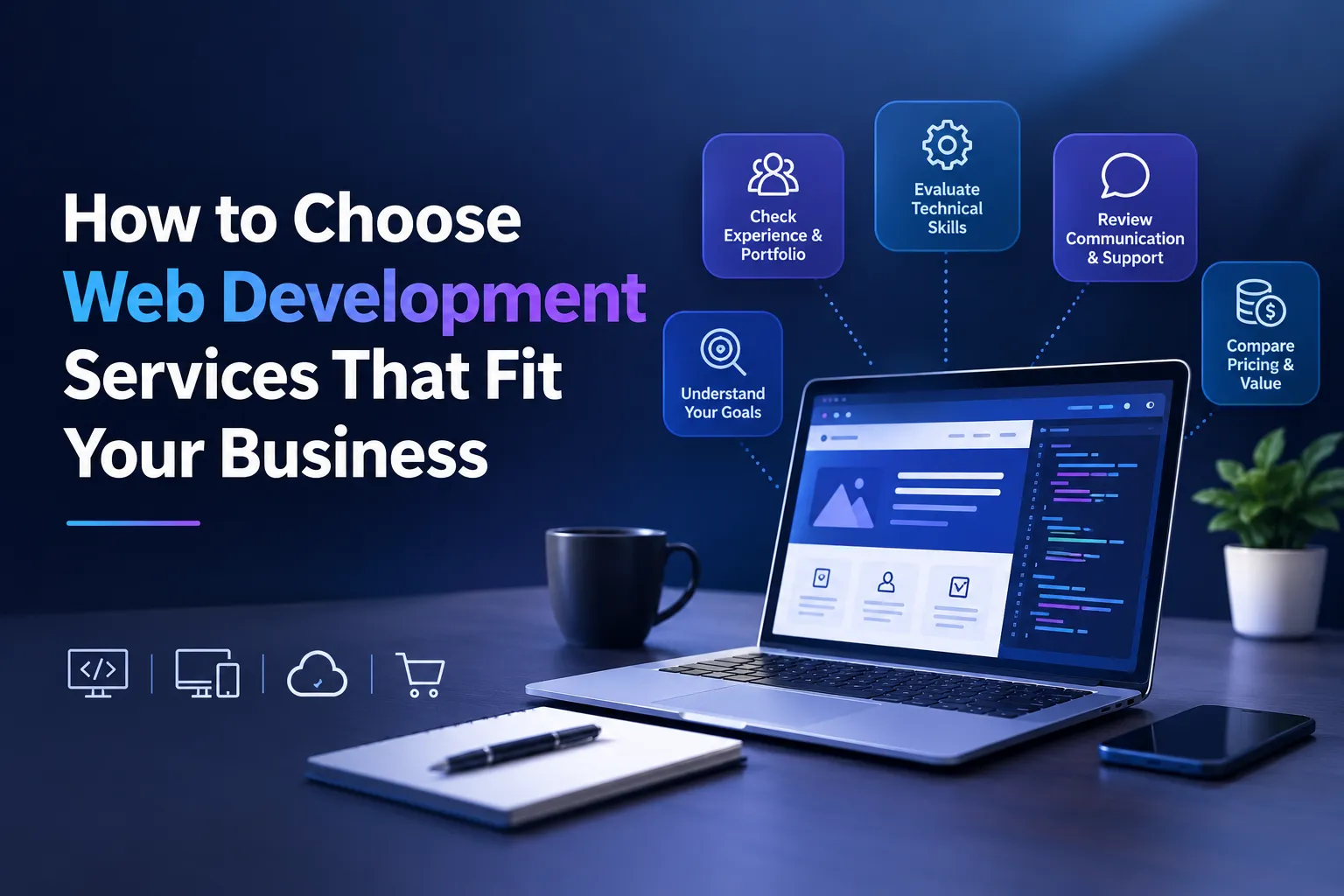

The right web development services should solve a business problem, not just put a website online. Before choosing a developer, decide what the website needs to do, who will use it, how it will be managed, and what happens after launch.
That sounds obvious. Yet many website projects start with the wrong question: “How much will a website cost?”
A better starting point is: “What does my business actually need this website to accomplish?”
That change affects everything—from the technology and number of pages to integrations, SEO, mobile performance and long-term maintenance.
What do web development services actually include?
Web development services cover the technical work involved in creating, launching and maintaining a website or web application.
That might mean a relatively simple business website, an ecommerce store, a content-managed website, a customer portal, or a more complex web application.
A professional project can involve:
- Website planning and information architecture
- UI/UX implementation
- Front-end development
- Back-end development
- CMS integration
- Ecommerce functionality
- API and third-party integrations
- Responsive development
- Performance optimisation
- Technical SEO implementation
- Testing and bug fixing
- Deployment
- Website maintenance and support
The exact mix should follow the project—not a developer's preferred technology stack.
Which type of website do you actually need?
This is where buyers should slow down.
You don't need a complex custom application simply because a developer can build one. And you shouldn't force an important business process into a cheap template just because it has a low starting price.
A business website
Choose this when your main job is to explain who you are, what you offer and how prospects can contact you.
A service company, consultant, manufacturer or local business might need pages such as Home, About, Services, Industries, Contact and individual service pages.
The development priority is clarity.
The visitor should understand what you do and what to do next without hunting through the website.
An ecommerce website
An online store needs more than product pages.
The development scope can include product management, categories, search, filters, cart functionality, checkout, payment integration, order management and other business requirements.
The right architecture depends on the size and needs of the store.
A CMS website
If your team needs to regularly publish or update pages, a content management system can make sense.
WordPress is one possible approach. Custom CMS development is another.
The choice should be based on how the site will actually be managed, rather than on the assumption that one technology is always better.
A web application
This is a different category.
If users need accounts, dashboards, permissions, workflows, calculations, custom business logic or connections with other systems, you're moving beyond a conventional marketing website.
At that point, the development discussion needs to cover architecture, data, authentication, integrations, security and ongoing maintenance.
Why responsive web development services should be the baseline
“Responsive” should not mean simply shrinking the desktop website until it fits on a phone.
Responsive web design is an approach in which the layout adapts to different screen sizes and devices. MDN describes it as a way to make web pages work across different screen sizes and resolutions while maintaining usability.
Google recommends responsive web design as its preferred mobile configuration because the same URL and HTML can serve users across devices while the layout adapts to the screen.
So when evaluating responsive web development services, ask what is actually being tested.
Navigation should remain usable. Text should remain readable. Forms should be practical to complete. Buttons should be easy to interact with. Images should not break the layout. Important content should remain available on mobile.
A site that technically opens on a smartphone isn't automatically a good mobile experience.
What makes affordable web development services genuinely affordable?
Low price and good value are not the same thing.
A cheap quote becomes expensive when important work is excluded and you have to pay for it later. Before comparing prices, compare scope.
Ask whether the proposal clearly explains:
- Number and type of pages
- Design and development responsibilities
- CMS or platform
- Mobile responsiveness
- Forms and lead capture
- Third-party integrations
- Basic technical SEO
- Analytics setup
- Testing
- Hosting and deployment
- Content migration, if required
- Revisions
- Maintenance after launch
- Ownership and access
Two developers can quote very different prices for what appear to be “the same website” because they are not actually delivering the same thing.
That is why I would rather see a slightly higher quote with a clear scope than a very low quote built around vague promises.
Should you choose WordPress or custom development?
There is no prize for choosing the more complicated option.
For a content-heavy business website that needs regular updates, WordPress can be a practical choice.
For a project with unusual workflows, specialised functionality or complex integrations, custom development may make more sense.
The important question is:
Which approach gives the business the functionality it needs without creating unnecessary technical or maintenance work?
Aarav Tech's existing web development offering covers both CMS-based solutions such as WordPress and custom-built web applications, alongside custom website development.
What should SEO have to do with web development?
More than many businesses realise.
SEO should not begin after the website is finished. Google's developer guidance recommends building sites that are secure, fast, accessible and usable across devices. It also recommends practices such as semantic HTML and making content accessible to search engines.
During development, the technical foundation can include:
- Logical URL structures
- Search-friendly page architecture
- Crawlable internal links
- Proper heading structure
- Mobile-friendly layouts
- Descriptive page titles and meta descriptions
- Image optimisation
- Accessible content
- Structured data where appropriate
- HTTPS
- Performance monitoring
None of these guarantees a first-place Google ranking. Google explicitly says that meeting its technical requirements does not guarantee indexing or search visibility.
That distinction matters.
A developer can build an SEO-ready technical foundation. No developer can honestly promise a particular organic ranking simply because the website has been built.
What should you ask a web development company before signing?
Don't limit the conversation to design examples.
Ask practical ownership and delivery questions.
Who owns the website after launch?
You should know who controls the domain, hosting account, source code, database and other important assets.
What exactly is included in the quote?
Ask for the deliverables in writing. “Complete website” is not a useful specification.
How will the website be tested?
Testing should cover functionality and different screen sizes. More complex projects may also require browser, performance and security testing.
Who handles updates after launch?
A website is not necessarily finished just because it has gone live. CMS updates, content changes, bug fixes, security work and feature requests need a defined process.
What happens if I want to move the website later?
This question is particularly useful when comparing hosted platforms, builders and development agencies.
You don't want the answer to be buried in a contract after you've already committed.
What does a sensible web development process look like?
A good project starts before anyone writes code.
1. Requirements
Define the business goal, audience, pages, features, integrations and content requirements.
2. Structure
Plan the navigation, page hierarchy and user journeys.
This is where you decide what information belongs where.
3. Design
Create the visual interface around the approved structure.
4. Development
Build the front end, back end, CMS, integrations and required functionality.
5. Testing
Check forms, links, layouts, functionality, mobile behaviour, browsers and performance according to the project's scope.
6. Launch
Configure hosting, domain settings, HTTPS and other launch requirements, then verify the live website.
7. Maintenance
Handle updates, fixes, security work, content changes and future improvements according to the agreed support arrangement.
Aarav Tech currently describes its web development services around custom development, ecommerce, responsive/mobile-first design, CMS, web applications, and maintenance and support. Its custom development service also describes a process covering planning, design, development, testing, launch and ongoing support.
What are the most common web development mistakes?
The expensive mistakes usually happen before development starts.
Starting with technology instead of requirements
Choosing React, WordPress, Laravel or another technology before defining the actual business problem puts the technical decision ahead of the user requirement.
Technology should serve the project.
Treating mobile responsiveness as a checkbox
A website can technically be responsive while still being awkward to use on a phone.
Test the real experience.
Leaving SEO until launch
Changing URLs, page structures and content architecture after development can create avoidable rework.
Plan search requirements alongside the site structure.
Comparing quotes by price alone
A ₹X quote is meaningless without knowing what X includes.
Compare deliverables, ownership, support and exclusions.
Forgetting what happens after launch
Who updates the CMS? Who fixes bugs? Who manages backups? Who handles changes?
Get these answers before signing.
What should your web development brief contain?
Before requesting quotes, prepare a one-page brief.
Include:
- Business: What the company does.
- Goal: What the website needs to achieve.
- Audience: Who will use it.
- Pages: The main pages you expect.
- Features: Forms, ecommerce, accounts, calculators, booking, dashboards, integrations, etc.
- Content: Who supplies copy, images and product information.
- SEO: Target pages, existing URLs and migration requirements if replacing an old site.
- Management: Who will update the website after launch.
- Support: What assistance you expect after delivery.
This makes quotes easier to compare because developers are responding to the same requirements.
How Aarav Tech Services approaches web development
Aarav Tech Services positions its web development services around business websites and digital experiences rather than a single website type. Its current service page lists custom website development, ecommerce development, responsive/mobile-first design, CMS development, web application development, and website maintenance and support.
The broader we also describes web development as part of its wider digital services offering.
If your project needs both website development and search visibility, that combination is worth discussing at the planning stage rather than treating SEO as a separate task after launch.
The right website is the one your business can actually use
Don't buy a technology stack. Buy a solution to a clearly defined business problem.
If you need a straightforward business website, keep the scope focused. If you need ecommerce, plan the customer and operational workflows. If your business depends on custom processes, invest in the architecture those processes require.
And before accepting any quote, ask one final question:
“What exactly am I getting, what will I own, and what happens after launch?”
The answer will tell you far more about a web development company than a page full of technology logos.
If you're planning a new website or replacing an existing one, start with your requirements rather than a technology choice. Then request a project scope that covers development, responsiveness, SEO foundations, testing, launch and post-launch support.
Contact Aarav Tech Services for web development consultation.
Frequently Asked Questions
What are web development services?
Web development services involve planning, building, testing, deploying and maintaining websites or web applications. Depending on the project, this can include business websites, ecommerce stores, CMS websites, custom applications, integrations and ongoing support.
How much do web development services cost?
There is no useful single price for web development. Cost changes with the number of pages, design requirements, functionality, integrations, ecommerce requirements, CMS choice, custom development and ongoing support.
The safest way to compare prices is to compare the scope behind each quote.
Are affordable web development services suitable for small businesses?
Yes, provided “affordable” does not mean removing requirements the business actually needs. A small business may need a relatively focused website rather than an unnecessarily complex custom application.
Why are responsive web development services important?
Responsive development allows a website's layout to adapt to different screen sizes. Google recommends responsive web design for mobile-friendly websites, and responsive design is intended to support usability across devices.
Should I choose WordPress or custom development?
Choose based on the website's requirements. WordPress can suit businesses that need a manageable content-focused website, while custom development is more appropriate when the project requires specialised functionality, workflows or integrations.
Does web development include SEO?
It can include technical SEO work, but development and ongoing SEO are not the same service. A development project can establish a search-friendly technical foundation, while ongoing SEO typically involves broader work such as content, technical monitoring, internal linking and authority-building activities.
What should I receive after the website is completed?
At minimum, the project handover should clearly define your access to the website and the systems needed to manage it. The exact handover depends on the project, but ownership, hosting, domain access, CMS access and relevant source-code or deployment access should be addressed in the agreement.























Sign in to leave a comment.