
Planning an asphalt paving project can seem straightforward until you need to determine exactly how much material the project will require. Whether you are resurfacing a driveway, preparing a parking area, or estimating materials for a larger road project, getting the quantity right can help you avoid unnecessary expenses, delays, and wasted material.
One of the easiest ways to begin is by understanding the basic measurements involved in an asphalt project. The length and width of the area determine its surface area, while the planned pavement thickness determines the volume of asphalt required. Density can then be used to estimate the approximate weight of the material.
Why Accurate Asphalt Estimates Matter
Ordering too little asphalt can create obvious problems. A project may be delayed while additional material is arranged, and differences between batches can sometimes make completing the surface more difficult.
Ordering too much is not ideal either. Excess material can increase project costs and create unnecessary waste. A reasonable estimate therefore provides a useful starting point before discussing quantities and pricing with a paving contractor or supplier.
For homeowners, contractors, property managers, and business owners, an asphalt calculator can simplify the initial estimation process by handling the basic mathematical calculations.
The Measurements You Need
Before calculating an asphalt requirement, collect several measurements from the project area.
The first is length, usually measured in feet. The second is width, also measured in feet. Multiplying these two values gives the surface area.
The third measurement is thickness. Asphalt thickness is commonly discussed in inches, so it needs to be considered when determining the total volume.
An estimate may also require the approximate density of the asphalt. Density allows the calculated volume to be converted into an estimated weight.
Finally, it can be useful to include a waste percentage. Real construction projects are rarely perfectly efficient, and material requirements can vary because of site conditions, cutting, handling, or changes during installation.
Using an Asphalt Calculator
Instead of performing every conversion manually, you can use an online asphalt volume and cost calculator to simplify the process.
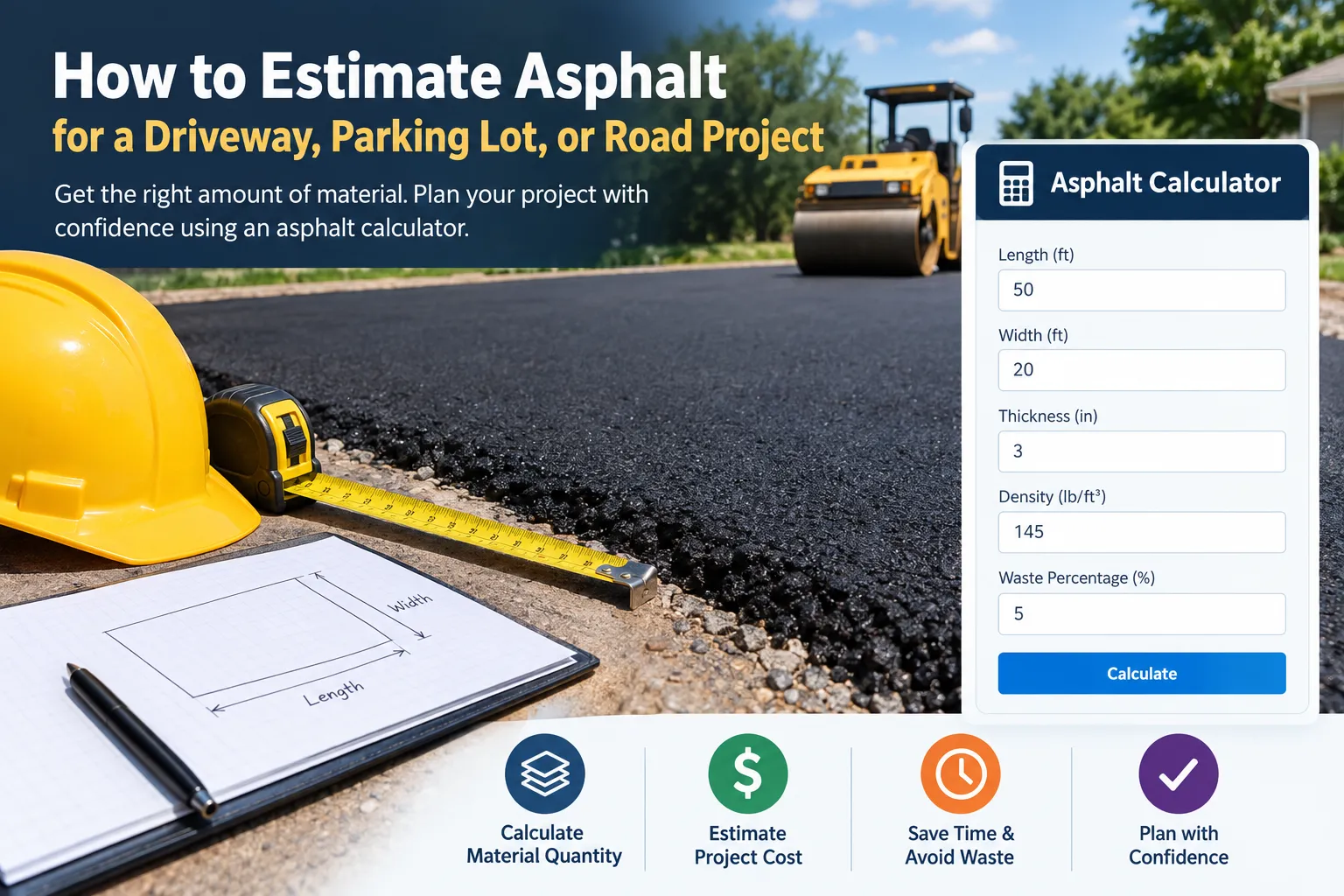
For example, the asphalt calculator from Easy Calculator Nex allows users to enter length, width, thickness, density, and waste percentage. The tool is designed to estimate asphalt volume, weight, and cost for applications such as driveways, parking lots, and roads.
The process is simple: enter the dimensions of the area, provide the planned thickness, adjust the density if necessary, and add an appropriate waste percentage. The calculator then provides an estimate that can be used as a starting point for project planning.
This can be particularly useful when comparing different project dimensions or considering how changes in pavement thickness affect the amount of material required.
Estimating a Driveway
Driveways are one of the most common residential asphalt projects. Before requesting an estimate from a contractor, homeowners can measure the driveway's approximate length and width and determine the intended pavement thickness.
For example, a rectangular driveway can be measured from one end to the other and across its widest section. If the driveway has an irregular shape, dividing it into smaller rectangles or sections can make the estimation easier.
The calculator can then provide an approximate material requirement. However, the calculated figure should not be treated as a final purchasing quantity because actual site conditions may affect the amount of material needed.
Planning a Parking Lot
Parking lots introduce additional considerations because they generally experience more vehicle traffic than residential driveways.
The required pavement structure depends on factors such as vehicle loads, soil conditions, drainage, climate, and the base beneath the asphalt. A simple calculator can help with the initial material estimate, but it cannot replace an engineering assessment or professional paving recommendation.
For preliminary planning, however, calculating the approximate volume and weight can make it easier to establish a project budget and discuss requirements with a contractor.
Considering Waste and Site Conditions
No material estimate is perfectly precise. Measurements can be rounded, surfaces can be irregular, and construction conditions can change.
That is why adding a reasonable waste allowance can be helpful. The appropriate percentage depends on the project, its shape, site conditions, and the methods being used.
An online calculator can provide an approximate result, but the final quantity should be verified before purchasing a significant amount of asphalt. Easy Calculator Nex itself notes that its material estimates are approximate and recommends verification with a qualified contractor or supplier.
Calculator vs. Professional Estimate
An online calculator is best viewed as a planning tool. It can help homeowners understand the approximate scale of a project and give contractors or suppliers useful preliminary information.
A professional estimate goes further. A qualified contractor can evaluate the existing surface, drainage, soil, base material, traffic requirements, accessibility, and other conditions that cannot be determined from dimensions alone.
Using both approaches can therefore be practical: start with measurements and an online calculator, then have the results reviewed by a professional before making major purchasing or construction decisions.
Final Thoughts
Estimating asphalt does not have to begin with complicated calculations. By measuring the project's length, width, and thickness and considering material density and waste, property owners can develop a useful preliminary estimate.
An online asphalt volume calculator can make these calculations faster and easier, particularly when comparing different project sizes or thicknesses.
For larger or more complex projects, the calculator should remain a planning aid rather than the final authority. Site conditions, engineering requirements, local pricing, and contractor recommendations should all be considered before purchasing materials or starting construction.
A good estimate is ultimately about more than getting a number. It gives you a clearer understanding of the project's material requirements, helps with preliminary budgeting, and provides a better starting point for conversations with paving professionals.
For anyone planning a driveway, parking area, or road resurfacing project, taking a few minutes to measure the area and calculate an approximate asphalt requirement can be a simple but valuable first step.




















Sign in to leave a comment.