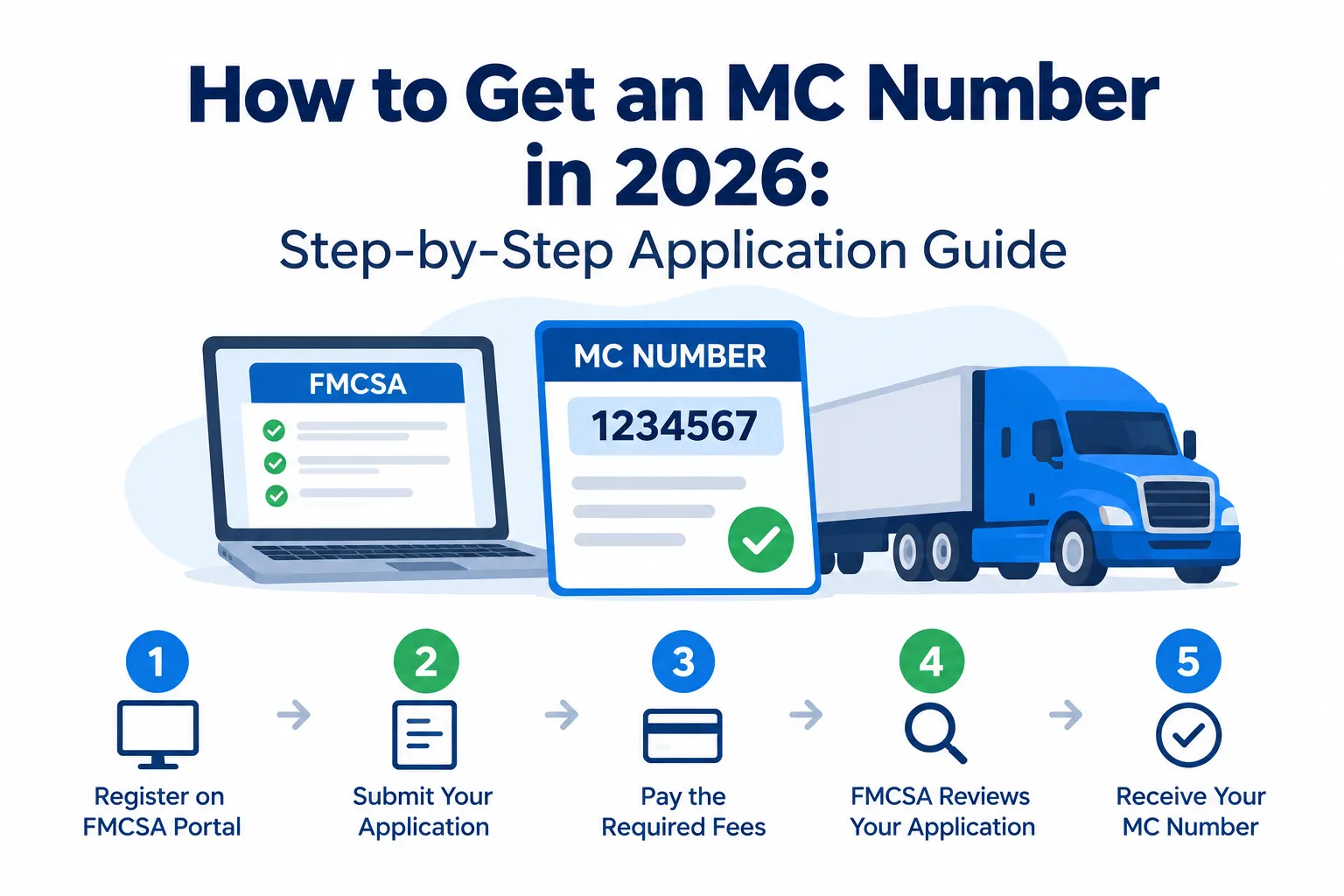

Every year, thousands of new trucking companies reach the same moment. The truck is bought, a customer is interested, and someone asks for an MC number. The path from that request to an active authority runs through several filings that must line up.
Before you file anything, spend ten minutes doing an MC Number Lookup on a few established carriers. Seeing a healthy authority record, with its status, insurance filings and dates, makes the abstract process concrete.

A DOT Number Lookup on the same companies shows the other side of the picture. Whether you use FMCSA's own pages or a tool such as Carrier90, you will see how a legal name, address and operation type appear to every broker who vets you.
The records also differ in maturity. One of the Largest Fleets has years of inspections behind its name, while your new authority starts blank. Over time, your own inspection history will feed the same kind of CSA Score context that shippers and brokers review.
New authorities also get extra scrutiny because of Chameleon Carriers, companies that reappear under new names to escape old problems. Clean, consistent filings from day one are the best way to show you are not one of them.
This guide walks through the full process as it works in 2026. It explains who needs an MC number, how FMCSA's new Motus system changes the workflow, each filing in order, the realistic timeline, and the mistakes that most often delay approval.
Do You Actually Need an MC Number?
Not every commercial operation needs one. FMCSA says entities with USDOT numbers must obtain operating authority when they are for-hire carriers moving passengers or federally regulated property across state lines, or when they are brokers, freight forwarders or certain specialized carriers.
The key phrase is "for hire." If you are paid to haul someone else's regulated freight between states, you almost certainly need authority. If you only move your own goods, you are a private carrier and typically need a USDOT number but not an MC number.
Some for-hire work is exempt. Carriers that operate only within a federally designated commercial zone are one example, and certain unprocessed agricultural commodities are another, which FMCSA lists on its site.
Intrastate operations follow a different track. A company that never leaves one state may answer to state rules rather than federal authority, so check your state's requirements before assuming a federal filing applies.
If you are unsure, describe your real operation on paper. Write down who pays you, what you haul, and where you deliver, then compare that description with FMCSA's guidance before you spend the filing fee.
Choosing the wrong category during registration causes trouble in both directions. Selecting private when you plan to haul for hire means the system will not prompt you for authority, while selecting for-hire unnecessarily creates compliance duties and a fee you did not need to pay.
MC, MX and FF: Choosing the Right Authority Type
An MC number is a docket number tied to operating authority. Docket prefixes describe who holds it: MC for U.S.-based carriers and brokers, FF for freight forwarders, and MX for Mexico-based carriers approved to operate in the United States.
Within the application, you also choose what kind of authority you want. The main choices are authority as a for-hire carrier of property, authority as a broker, and separate categories for household goods and passenger operations.
Each type carries its own fee. FMCSA's OP-1 form states that a separate $300 fee applies for each type of operating authority requested, so a company applying for both carrier and broker authority pays for both.
Pick the type that matches how you will actually earn money. A trucking company that hauls freight needs carrier authority, and a business that only arranges loads for others needs broker authority, with a different bond requirement covered later.
Do not apply for more types than you will use. Extra authority means extra fees and extra filing obligations, and you can add another type later through the same system if your business changes.
If you plan to run trucks and also arrange loads for other carriers, treat those as two distinct businesses with two sets of requirements. Many companies start with carrier authority and add broker authority after they have experience.
How Motus Changed the Process in 2026
FMCSA's new registration system, Motus, is now the home base for applying for a USDOT number, operating authority and related registrations. The agency describes it as a single place to apply, manage registrations, submit biennial updates and reinstate or reapply after revocation.
Access requires identity verification. You create a user profile, complete verification, and sign in through Login.gov, which is part of FMCSA's effort to reduce fraud and unauthorized changes to carrier records.
This affects how you prepare. Use an email address you control and will keep, because your account is tied to a real person and you will need it for every future filing.
You may have read that MC numbers were eliminated. FMCSA has described the idea of ending MC number assignments as a proposal still under consideration, with a rulemaking and public comment required before any change takes effect, so MC numbers remain part of the process today.
New numbers issued through Motus are randomized to reduce fraud, so a new authority may not look like the sequential numbers older carriers hold. Existing identifiers stay unchanged.
Treat any guide, including this one, as a description of the process at a point in time. Screens, labels and timelines can shift, so confirm current details on FMCSA's Motus pages as you go.
Step 1: Set Up Your Business Foundation
Before touching FMCSA's system, form the business you will register. Most new carriers choose an LLC or a corporation, and the choice affects liability, taxes and how brokers view you.
Obtain an Employer Identification Number from the IRS. It is free, and the application must match your legal business information exactly, so use the same name and address everywhere.
Consistency is more important than it sounds. A legal name that differs by a comma, an abbreviation or a spacing choice can cause insurance filing rejections, broker onboarding problems and record-matching failures later.
Check for conflicts early. A quick dot number lookup by name will show whether a similar company name is already registered, which can save you from confusion with an unrelated carrier.
Open a business bank account and, if possible, set up a business phone and email. Brokers verify contact details against federal records, and a professional, stable setup makes your filings easier to confirm.
Finally, decide how you will operate. Note your cargo types, your planned territory and whether you will lease onto another carrier at first, since these choices shape your insurance quotes and your application answers.
Step 2: Create Your Motus Account
Go to FMCSA's Motus portal and create a user profile. The system asks you to verify your identity, and it uses Login.gov to protect your personal data and prevent unauthorized access.
Have your documents ready before you start. Identity verification typically involves a government-issued ID, so set aside uninterrupted time and make sure your device can handle the process.
Decide who will be the company official. That person is tied to the account and is responsible for certifying filings, so it should be someone with real authority over the business.
Keep login details secure and documented. If you hire a filing service or an employee later, use the permission features to grant access rather than sharing one person's credentials.
If you are starting from scratch, you are creating a new record rather than claiming an old one. Existing carriers, by contrast, must claim their USDOT numbers using the same Login.gov email tied to their earlier portal account.
This step feels administrative, but it protects you. A locked or misassigned account can stall every filing that follows, so it is worth getting right the first time.
Step 3: Get Your USDOT Number
Every interstate commercial carrier needs a USDOT number, and it is free. Motus lets you apply for one as part of a new registration, and it is typically assigned once the application is complete.
The USDOT number identifies your company for safety monitoring. Inspections, crashes and compliance reviews attach to it, so it becomes the foundation of your public record.
Be careful with the operation classification. Describe accurately whether you are a for-hire carrier, a private carrier or both, and list your cargo types, power units and drivers honestly.
Third-party guides note that MC authority links to your USDOT record, so the USDOT registration generally comes first or is completed in the same session. Applying for both together can save time.
Once your number is assigned, run a usdot number lookup on yourself. It confirms that your legal name, address and classification appear the way you intended, and it shows you what a broker will see.
Save a dated copy of that record. If something looks wrong, fix it now, because errors in the base record tend to follow you into every later filing.
Step 4: File the Operating Authority Application
Now apply for authority through Motus. The application asks you to declare your authority type, your carrier details and your operation, and it requires the filing fee for each authority type you request.
The fee is $300 per authority type. Third-party guides report that it is paid through Pay.gov inside the Motus dashboard and is non-refundable, so confirm every detail before you submit payment.
Accuracy matters more than speed here. Your business name, EIN and state registration information should match your formation documents exactly, since mismatches are a common source of delays.
After submission, FMCSA publishes the application and opens a protest period. During that time, existing carriers or interested parties can object, although guides consistently describe protests as rare for standard property carrier applications.
Your MC number is assigned in pending status, and pending does not mean approved. FMCSA's OP-1 instructions state that applicants may not begin operations until authority is issued and shows as active in its records.
Treat the application as the start of a parallel process. While the protest period runs, the next two steps, process agents and insurance, need to be completed.
Step 5: File Your BOC-3 Process Agent Designation
The BOC-3 designates a process agent in every state where you operate. A process agent is a representative who can receive court papers if someone brings a legal action against your company.
Most carriers use a blanket process agent service that covers all states. Third-party sources report costs in the range of roughly $20 to $75 for the filing, and cheaper is usually fine as long as the provider files electronically and accurately.
You do not file the BOC-3 yourself in most cases. The service submits it to FMCSA on your behalf, and you should confirm that it appears in your record rather than assuming it went through.
Timing matters. FMCSA's OP-1 instructions state that the form must be filed within 90 days of the application's publication, and missing that deadline results in dismissal of the application and loss of the fee.
Do not wait until after the protest period to file. Filing early avoids the situation where everything else is ready but the authority cannot activate because a required document is missing.
Keep the confirmation. If a broker or auditor asks for proof later, having the filing details in your records saves time.
Step 6: Arrange Insurance and the Required Filings
Federal rules require for-hire carriers to show financial responsibility. For general freight, the minimum liability coverage cited by third-party guides is $750,000, with higher minimums for certain hazardous materials.
Your insurer files the coverage electronically with FMCSA, typically using form BMC-91 or BMC-91X. You cannot file it yourself, so choose an agent who understands trucking and knows how to submit these filings.
Start shopping the day you apply. New carriers often face higher premiums because of limited history, and insurance is frequently the biggest startup cost, so quotes take time.
Expect the filing to be linked to your name and docket number. A mismatch between the name on the policy and the name on your application can cause the filing to be rejected.
Cargo insurance is a separate matter. Federal filing requirements focus on liability, but shippers and brokers often require cargo coverage as a contract term, so ask your agent about it.
Once the insurer confirms the filing, verify it yourself. FMCSA insurance and licensing records in the current registration system should show the filing, and if they do not, ask your agent to follow up immediately.
Step 7: Wait Out the Protest Period and Plan the Timeline
After the application is published, a protest window opens. Guides describe it differently, with some citing 10 days and others citing 21, so check the current requirement in Motus rather than relying on any single description.
The protest period is only part of the timeline. Several third-party guides estimate about four to six weeks from application to active authority, and one puts the range at 25 to 35 business days when everything is complete.
Missing filings are the most common cause of delay. If insurance or the BOC-3 is not on record when the protest period ends, authority stays pending until they arrive.
Use the waiting time productively. You can line up equipment, register for required state and federal programs, arrange a drug and alcohol testing program, and talk to brokers about how you will work with them once you are active.
Do not haul for hire yet. Operating before authority is active can lead to fines and out-of-service orders, and it can complicate your relationship with insurers.
Check your status regularly in Motus. Changes can take a day or two to appear, so avoid panic if a filing does not show immediately.
Step 8: Confirm Your Authority Is Active
When FMCSA grants authority, your status changes to active. Do not rely on an email alone, and verify it in the public record.
Search your MC number or USDOT number in FMCSA's public tools. A quick mc number lookup should show an active status for the authority type you requested, along with the insurance filing.
Licensing and insurance FMCSA records are the details brokers will check, so make sure the name, address and filings all match your paperwork. If anything is off, correct it before you start seeking loads.
You can also review your record through third-party tools. A tool such as Carrier90 offers a DOT and MC lookup view that reads well for a quick check, though FMCSA's own record remains the official reference.
Save a dated copy of your active record. It is useful for onboarding packets and for proving when your authority became effective.
Only after you have seen active status with your own eyes should you accept a load. That single habit prevents the most expensive early mistake.
What to Do After Your Authority Goes Active
Authority is the start of your compliance life, not the end. Several obligations follow, and the details depend on your operation.
Register with the Unified Carrier Registration program each year if you are required to. Fees vary by fleet size, and the registration is separate from your FMCSA filings.
Expect a new entrant safety audit. FMCSA monitors new carriers during their first months, and passing it is part of keeping your authority.
Maintain your registration data. Biennial updates keep your records current, and FMCSA has temporarily paused enforcement of some update deadlines during the Motus transition, so confirm the current rules rather than assuming the pause continues.
Keep insurance continuous. A lapse or cancellation can trigger a revocation process, and reinstating authority can mean new filings, new fees and more waiting.
Monitor your own record. Checking your public listing regularly shows what brokers see and lets you correct outdated contact details before they cost you a load.
What It Costs in Practice
The government filing fee is $300 per authority type. Third-party guides estimate that the other required items, such as a process agent filing, UCR and a drug testing program, add a few hundred dollars more.
Insurance is the largest variable. Premiums depend on experience, cargo, location and equipment, and new carriers typically pay more, so get several quotes before you decide.
Beware of overpriced services. Some companies charge much more than the underlying costs to file paperwork, and while help can be valuable, you should understand what each fee covers.
Budget beyond the filings. Trucks, plates, fuel, maintenance and working capital between delivery and payment are the real cost of getting started.
Plan for cash flow gaps. Brokers and shippers commonly pay weeks after delivery, so a new carrier needs reserves or a financing arrangement to cover expenses in the meantime.
Write a simple startup budget before you apply. Knowing your numbers helps you decide whether to file now or wait until your finances are ready.
Common Mistakes That Delay Approval
Name mismatches are the most frequent problem. The legal name on your application, insurance policy, BOC-3 and state registration must match, down to punctuation.
Waiting on insurance is the second. Because the insurer must file directly, any delay in binding the policy delays your authority.
Forgetting the process agent is another. Without a valid BOC-3, authority cannot activate, and the 90-day deadline can end an application if ignored.
Choosing the wrong classification causes quieter trouble. A carrier who selects private when planning to haul for hire will not be prompted to apply for authority, which can cost weeks.
Hauling before authority is active is the most serious. It exposes you to penalties and can create problems with your insurer and with brokers who see the record.
Finally, avoid assuming approval is automatic. Check your record, respond to any requests from FMCSA promptly, and keep your contact details current so you receive notices.
If You Plan to Become a Broker
Broker authority follows a similar path with different financial requirements. Instead of liability insurance filings, brokers and freight forwarders must maintain a $75,000 surety bond or trust fund, filed by the surety provider.
The application still requires a fee for the authority type and a BOC-3 process agent designation. Brokers also register annually with the UCR program, typically in the lowest fleet-size bracket since they do not own trucks.
Brokers face heavier scrutiny in some ways. Because they handle other people's freight and money, shippers and carriers check their authority, bond status and history carefully.
If you are considering both carrier and broker authority, start with the one that matches your immediate business. You can add the other later through the same system.
Conclusion
Getting an MC number in 2026 means setting up your business, creating a verified Motus account, obtaining a USDOT number, applying for the right authority type, and making sure your process agent and insurance filings are on record. Plan for roughly four to six weeks and confirm every detail before you pay the $300 fee.
The most practical takeaway is to keep names and details identical across every filing and to verify your active status in the public record before you haul a single load. Do that, and the process is far more predictable than it first appears.



























Sign in to leave a comment.