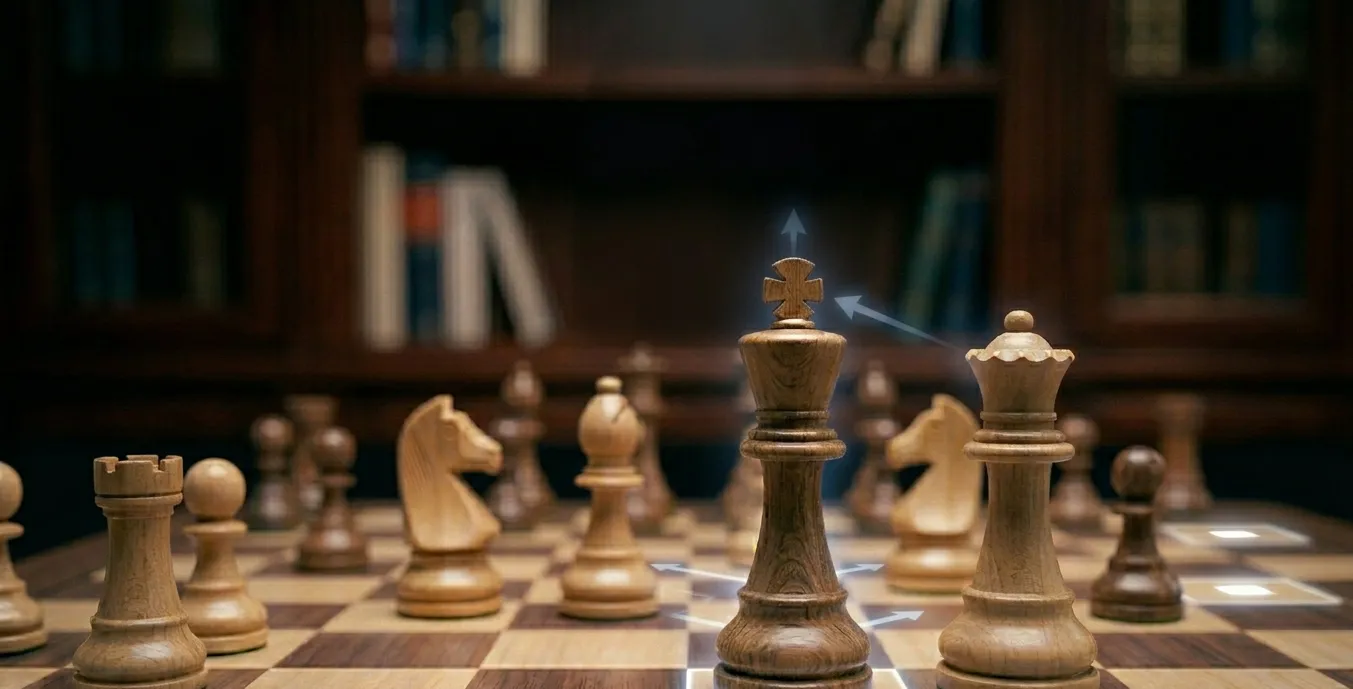

A chess position can become frustrating even when there’s no immediate tactical danger. You may not have a useful check, capture, or direct attack, and every move can seem to lead to another quiet position.
This is where one of the most useful positional ideas in chess comes in: improve your worst-placed piece.
GM Illingworth describes improving the worst-placed piece as part of good piece coordination, particularly when there are no direct moves available. Chess.com also recommends finding the best possible square for each piece and working out a practical way to reach it.
What is your worst-placed piece?
Your worst piece is generally the one making the smallest contribution to your position.
It might be a knight with very few useful squares, a bishop restricted by your own pawns, or a rook placed on a file where it has little influence. The piece doesn't need to be attacked. Its main problem is that it has limited activity or lacks a useful purpose.
Chess.com gives examples including blocked bishops, inactive rooks, and poorly positioned knights when discussing piece improvement.
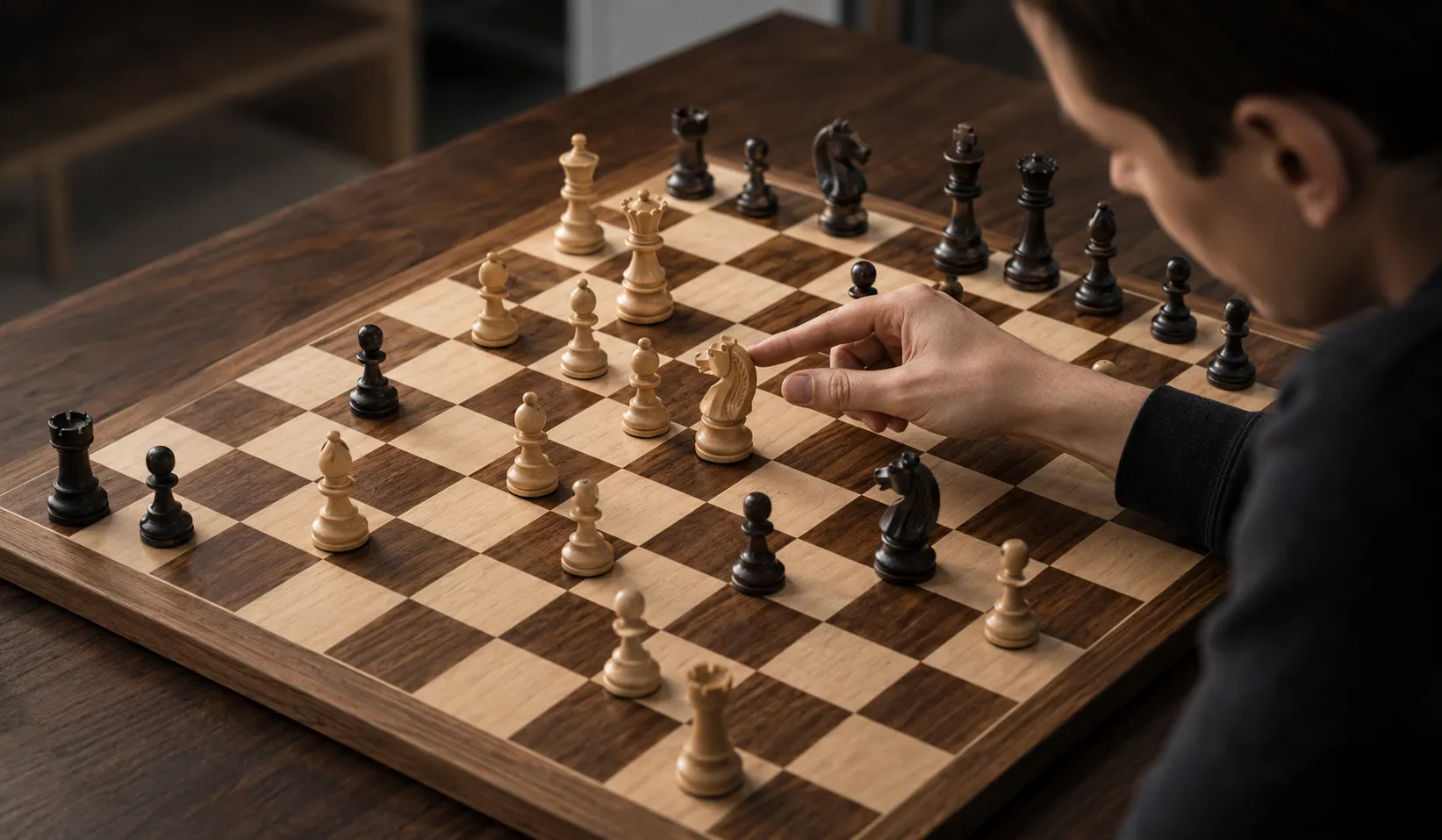
So when you're unsure about your next move, take a moment to examine your pieces before automatically making another pawn move.
Ask yourself: Which of my pieces is currently doing the least useful work?
How to identify your worst piece
Begin by examining the mobility of every piece on the board.
A knight with few useful squares is an obvious candidate. A bishop restricted by its own pawn structure may also need attention. A rook that hasn't found a useful open or semi-open file can have a similar problem.
Then consider what each piece is actually doing.
Is it attacking a target? Is it protecting an important weakness? Is it controlling a valuable square? Does it have a role in your current plan?
Chess.com recommends identifying a strong potential square for your pieces and thinking about how you can reach that square efficiently.
That gives you a practical answer to the question: How to Improve Your Worst Placed Piece in Chess?
Find a better square before moving
Don't move an inactive piece simply because it looks badly placed.
First, work out where you want the piece to go.
For example, if your knight is sitting near the edge of the board, search for a central square or an outpost where it can become more active. Chess.com explains that knights generally benefit from central squares and outposts, while rooks can benefit from open files and bishops from open diagonals.
The route to the better square can sometimes require several moves.
Knight maneuvering is a good example. Chess.com explains that slow knight maneuvers can work in strategic positions when the opponent doesn't have enough counterplay. One useful approach is to identify the worst-placed piece, picture its ideal destination, and then work backward to find a practical route.
Improve knights by giving them useful squares
Knights can become difficult pieces to handle because their mobility is strongly affected by the pawn structure.
A knight placed on the rim can have fewer useful options, while a well-supported knight in the center can control several important squares. An outpost can be especially useful because it can provide the knight with a stable and active location.
Still, don't treat this as an automatic rule.
Chess.com points out that a knight can sometimes move toward the edge or even retreat when doing so creates a better route to a useful square. The position must give you enough time to complete the maneuver.
So don't ask only, "Is my knight on the edge?"
Ask instead, "Does my knight have a useful job from this square?"
Improve bishops by changing their lines
Bishops rely heavily on the diagonals available to them.
A bishop blocked by its own pawns can become restricted, while opening a diagonal can give it access to important squares and potential targets. Chess.com specifically uses blocked bishops as an example when discussing poorly placed pieces.
Sometimes a pawn move is enough to open the bishop's diagonal.
Sometimes the bishop needs to be rerouted.
And in some positions, exchanging a poorly placed bishop can be a sensible practical choice, depending on the role that bishop has in the position.
The key is to judge the bishop according to the actual pawn structure instead of assuming that every bishop should always remain on the board.
Improve rooks by finding useful files
Rooks need open lines through which they can influence the position.
Chess.com's guide to improving pieces specifically identifies open files as useful locations for rooks.
If your rook sits on a square where it attacks nothing and has no important defensive responsibility, search for a file, rank, or target where it can become more useful.
A rook might move onto an open file.
It might support a pawn break or place pressure on a weakness.
The best square depends on the position, so decide what job the rook should perform before choosing where to move it.
Don't improve your worst piece automatically
There is an important condition to remember.
Before spending time on a slow improvement, check what your opponent is threatening.
GM Illingworth's guide explains that positional chess involves improving your pieces while dealing with the opponent's threats and coordinating your forces toward shared goals.
A knight maneuver may look attractive, but if your opponent has a dangerous attack developing, you might not have enough time to carry it out.
The same applies when a tactical opportunity is available. A forcing move can take priority over a quiet positional improvement.
Before making your improvement move, check your opponent's checks, captures, and threats.
A simple routine for your next game
When you reach a quiet position, follow this short process:
- Examine all your pieces.
- Identify the piece doing the least useful work.
- Find its ideal or more useful square.
- Work out a realistic route to that square.
- Check whether your opponent has an immediate threat or stronger idea.
- Play the improvement move when the position gives you enough time.
This changes "I don't know what to play" into a specific decision-making process.
The same idea can help when you study your own games. After reviewing a position, ask which piece was least active and whether you could have found a better route for it. Chess.com recommends reviewing your games as part of chess improvement instead of relying only on playing more games.
Book your first trial lesson for just $9.99 and learn how to make your pieces work together instead of treating them as separate units.
Visit MMChess.org today and reserve your trial lesson for only $9.99.
Frequently asked questions
Q1. What does How to Improve Your Worst Placed Piece in Chess mean?
It means finding the piece that contributes the least to your position and looking for a better square, route, or role for that piece. The concept is closely connected with harmonious piece coordination in positional chess.
Q2. How do I find my worst piece in chess?
Compare your pieces and identify the one with the least useful activity, the fewest useful squares, or the weakest connection to your current plan. A blocked bishop, inactive rook, or poorly positioned knight can all be candidates.
Q3. Should I always improve my worst piece?
No. First examine your opponent's threats and available tactical opportunities. A slow improvement works best when the position gives you enough time to maneuver your piece.
Q4. How can I improve a bad knight?
Look for a useful central square or outpost and calculate a practical route to reach it. Sometimes the knight needs to move away from the center before it can reach its strongest destination.
Q5. Can improving the worst piece help with chess planning?
Yes. When there is no forcing continuation, identifying your least useful piece gives you a concrete positional task. GM Illingworth specifically recommends improving the worst-placed piece when direct moves aren't working.

























Sign in to leave a comment.