How to Make a Website in 2026: A Comprehensive Beginner's Guide

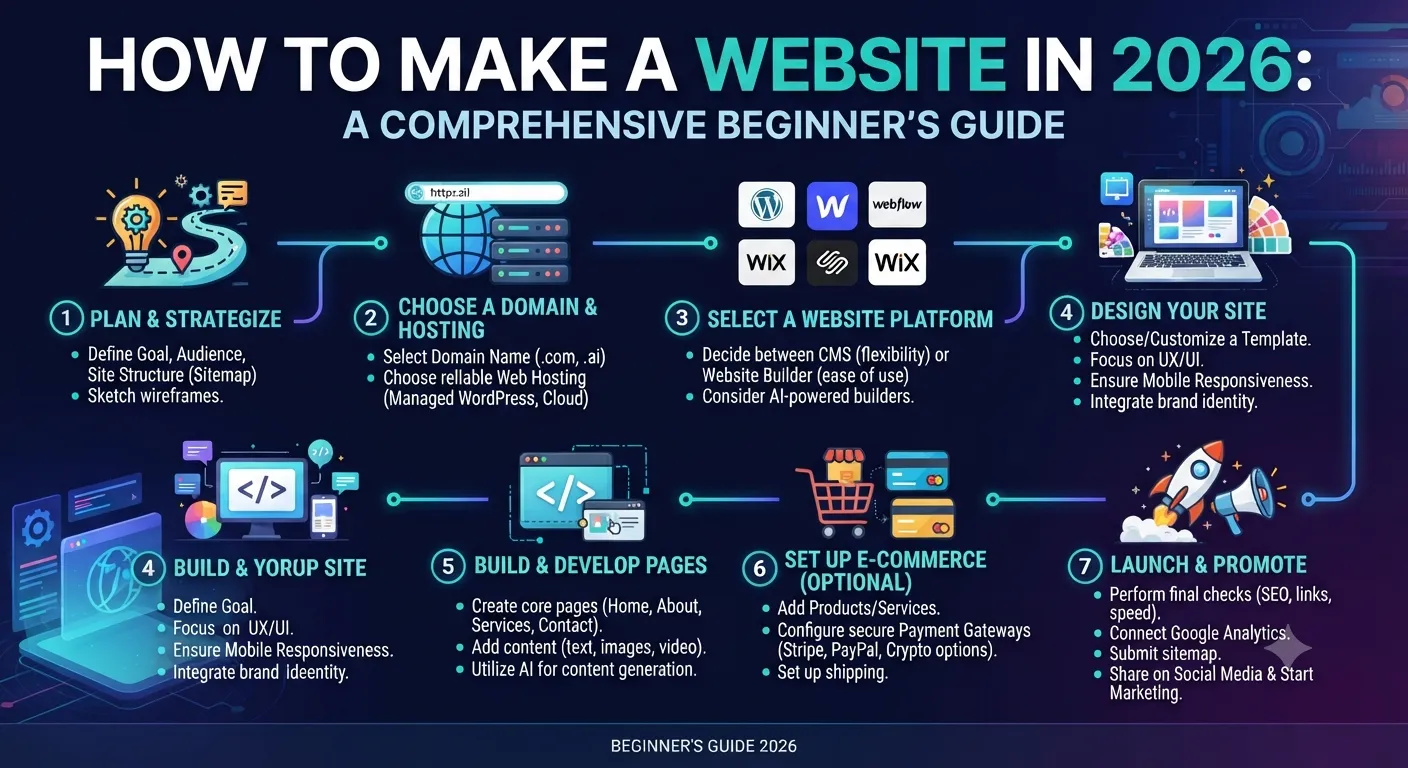
Strategic Blueprints for Launching High-Impact Virtual Infrastructures
In contemporary enterprise networks, constructing an independent online presence has evolved beyond simple technical capability into a definitive operational asset. Whether a professional building a distinct portfolio, an organization driving online client acquisition, or a creator establishing a centralized publishing hub, owning a dedicated web space provides structural authority, personal credibility, and long-term commercial opportunity.
Historically, compiling functional digital properties demanded specialized programming knowledge and comprehensive engineering background. However, modern technological advancements have fundamentally democratized this landscape. Today, any individual can manage public cloud infrastructure by leveraging structured deployment steps and visual creation mechanisms. This analysis serves as an informative roadmap for building solid digital foundations, parsing critical hosting layers, evaluating popular script engines, and illuminating why adaptive content management software remains the gold standard for accelerating organic visibility.
Understanding Foundational Site Infrastructure
Prior to executing live application files, administrators must comprehend the core parameters governing modern website development for beginners.
1. Network Location Vectors (Domains)
A domain operates as the outward routing locator that connects public browsers to active web files. High-performing business entities utilize short, easily articulated, and textually accurate web addresses that pair seamlessly with existing social profiles without awkward internal formatting symbols.
2. Decentralized Host Storage (Hosting)
Web hosting functions as the dedicated physical hardware space that stores compiled site repositories. Whenever an external client requests access, cloud node distributions deliver media elements and script tables to the browser. The baseline reliability of any modern website creation guide depends inherently on these server response loops.
3. Essential Assembly Segments
• Structural Nodes: The primary page assembly composed of target index pages, company profiles, list layouts, and contact endpoints.
• Asset Inventories: Original text documentation, graphic illustrations, and streaming files formatted to satisfy both human users and search crawlers.
• User Interface (UI): Fluid, ultra-responsive visual frameworks designed to mitigate navigation drop-offs and optimize interactive engagement.
Step-by-Step System Deployment Lifecycle
Stage 1: Define Core Functional Targets
Establish distinct system objectives—determining if the target node requires an editorial resource grid, a static business showcase, an academic record vault, or a transactional cart system.
Stage 2: Finalize Brand Positioning
Acquire concise virtual addresses while ignoring unnecessary numerical variations, immediately binding the framework to a high-uptime hosting provider equipped with direct core installation pipelines.
Stage 3: Isolate Application Architectures
Assess structural frameworks based on forward-looking adaptability requirements, balancing direct ease-of-use variables against long-term development autonomy.
[Isolate Core Targets] ➔ [Secure Hosting/Domain] ➔ [Assess Core Architecture] ➔ [Publish Live Assets]
Stage 4: Assemble and Optimize
Inject original, value-driven text components, install solid security filters, perform rigorous performance loading speed checks, and execute organic public notifications to collect primary visitor input.
Comprehensive Framework Comparison
Framework Base Ideal Operational Core Primary Strategic Advantage Primary Structural Limit
WordPress Multi-purpose Scale Full Data Ownership & Unmatched Modular Freedom Demands Occasional Maintenance
Wix Simple Brochure Pages Instant Visual Manipulation Restricted Architectural Scale
Shopify Transactional Retail Unified Commerce Layouts Rigid Framework Inflexibility
Squarespace Visual Lookbooks Elegant Aesthetic Templates High Recurring Licensing Costs
Why Open-Source Platforms Dominate Digital Strategy
Deploying an enterprise-grade framework like WordPress offers massive performance advantages for growing operations. It completely bypasses historical database programming burdens by offering straightforward administrative control boards and layout configuration tools. Crucially, it provides total sovereignty over proprietary database silos, protecting creators from arbitrary shifts in third-party licensing fees or unexpected terms revisions.
Through extensive visual template hubs and modular expansion components, operators can quickly deploy technical search modifications, database firewall rules, and high-velocity server-side caching systems with absolute ease. This setup is intrinsically optimized for automated search crawl scripts. When paired with intelligent indexing tools, it accelerates search placement performance, allowing a simple platform to expand into an enterprise network cleanly.
┌── Total Core Data Ownership & Independence
│
[Enterprise Framework] ├── Thousands of Modular Customization Plugins
│
└── Advanced Search Engine Optimization (SEO) Baselines
Destructive Mistakes New Site Administrators Make
• Leveraging slow, unverified shared hosting space that damages page loading velocities.
• Ignoring interface responsiveness across mobile network connections.
• Overloading the application stack with non-essential tools, which causes script conflicts.
Conclusion
Navigating initial system deployments can introduce minor administrative complexities, but mastering core architectural workflows transforms raw execution into a permanent professional edge. Unifying secure data hosting, rapid execution speeds, and disciplined search optimization forms a resilient storefront engineered for long-term growth.





Sign in to leave a comment.