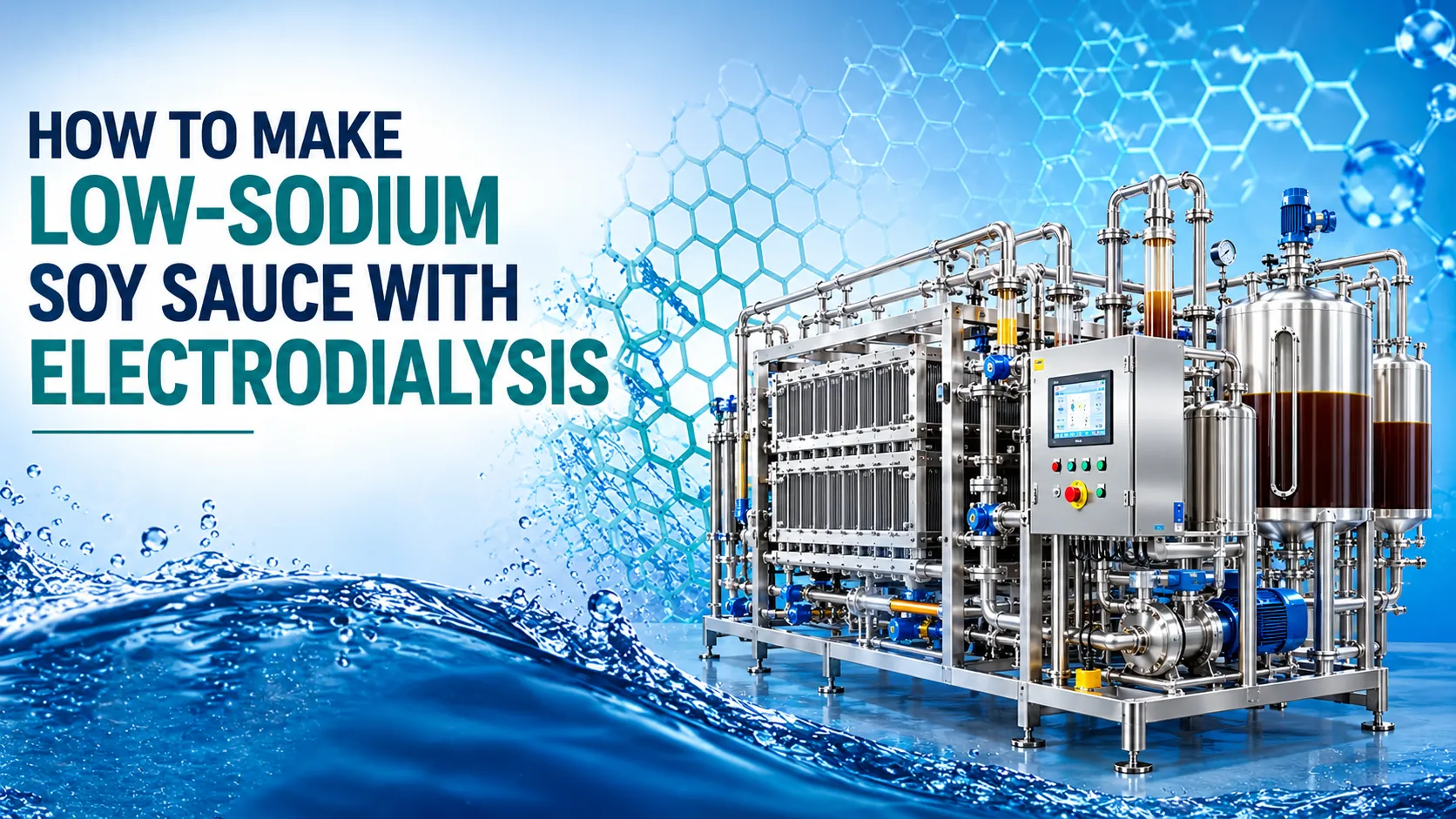

Quick Answer: You make low sodium soy sauce with electrodialysis by passing fermented soy sauce through an ion-exchange membrane stack that pulls sodium and chloride ions out under a DC field. Salt drops. Aroma, amino acids, and color stay. That's the whole trick.

Introduction
Cut the salt by 40 to 60 percent and keep the umami. That's the ask every soy sauce plant brings to us. Learning how to make low sodium soy sauce with electrodialysis solves a stubborn problem: consumers want less sodium, but heat, dilution, and blending flatten the flavor you spent months fermenting. At Laxminarayan Technologies, we build modular electrodialysis (ED) systems that lower sodium at ambient temperature, so the sauce still tastes like sauce. This article walks through the method, compares ED with reverse osmosis, and covers the real headaches, fouling, scaling, current efficiency, that show up on the plant floor.
What is electrodialysis?
Electrodialysis is a membrane separation process. A stack of alternating cation and anion ion-exchange membranes sits between two electrodes. Apply direct current, and charged ions migrate toward the opposite electrode, splitting one stream into a diluate (low salt) and a concentrate (brine). No phase change. No heat.
That last part matters for soy sauce. You're moving ions, not boiling liquid.
How to make low sodium soy sauce with electrodialysis: step by step
Here's the thing. The sequence is simple, but each step has a catch. Follow it in order.
Pre-filter the feed. Fermented soy sauce is loaded with suspended solids, proteins, and colloids. Filter it first. Skip this and your membranes clog like a lint-choked dryer vent.
Set your target. Decide the final sodium spec, say 50 percent reduction. That number sets your run time and current.
Load the diluate loop. The pre-treated sauce circulates through the diluate channels. This is what you're desalting.
Energize the stack. DC voltage drives sodium (Na+) through cation membranes and chloride (Cl-) through anion membranes, into the concentrate.
Watch conductivity. As salt leaves, conductivity falls. That's your live progress bar.
Stop at target. Pull the diluate when it hits spec. Send the brine concentrate to recovery or disposal.
Clean in place. Run a CIP cycle before the next batch. Discipline here buys you membrane years.
Amino acids and flavor peptides are large and mostly uncharged at fermentation pH, so they stay put in the diluate. Small salt ions leave. That selectivity is the reason ED beats blunt-force dilution.
Electrodialysis vs reverse osmosis for soy sauce
Both are membranes. They do very different jobs. Reverse osmosis (RO) pushes water through a semipermeable membrane under high pressure, so it separates by size and rejects most everything, water included. Electrodialysis moves ions selectively and leaves the water and the big flavor molecules behind.
For low sodium soy sauce production, that difference decides the outcome:
Selectivity: ED targets ions. It removes sodium and chloride while sparing amino acids and color. RO rejects broadly, so you lose flavor compounds along with salt, then you're stuck adding them back.
Concentration: RO strips water and concentrates the product, which thickens and darkens the sauce. ED holds volume roughly steady.
Energy: ED energy tracks the salt you remove, so a lightly salted feed costs less. RO energy tracks pressure and viscosity, and soy sauce is viscous.
Fouling behavior: RO membranes foul under pressure with a sticky feed. ED handles high-solids streams better after proper pre-filtration and tolerates polarity-reversal cleaning.
Product integrity: ED keeps the sensory profile closer to the original. For a premium sauce, that's the ballgame.
According to studies in the Journal of Membrane Science, ion-exchange membrane processes achieve selective monovalent ion removal that pressure-driven membranes can't match on complex food streams. For salt reduction with flavor retention, ED is usually the honest answer. RO earns its place in straight water recovery, not selective deacidification of a fermented product.
Where ED and EDBM actually earn their keep
Soy sauce is one job. The same electrochemistry runs a much wider shop, and this is where topical breadth matters. We've commissioned stacks across food, chemicals, and waste recovery.
Soy sauce and food desalination. Selective sodium removal without heat. See our approach on the desalination of soy sauce application page. Same logic extends to dairy whey, wine tartrate, and fruit-juice deacidification.
Organic acid recovery. Bipolar electrodialysis (EDBM) converts an organic acid salt back into the free acid plus a base. We cover this in production of organic acid from organic acid salt. Citric, lactic, gluconic, all fair game.
Acid and alkali from waste streams. EDBM splits inorganic salts in industrial effluent into usable acid and alkali. Details on acid and alkali from inorganic salts. This is where ZLD ambitions get real.
Amino acid purification. Free your amino acids from their salt form with a bipolar membrane stack, as in amino acids from amino acid salts.
Specialty chemicals. Ion removal and purification for products like colloidal silica manufacture, where trace ionic contaminants ruin a spec.
One process, many feed streams. That's the point.
Challenges and solutions
No sugarcoating. ED has failure modes. We design around them.
Membrane fouling. Proteins and colloids in soy sauce coat the membrane surface, and current efficiency slides, the way stack voltage creeps up like a tired pump working harder for the same flow. Our fix: proper pre-filtration, periodic polarity reversal, and scheduled CIP built into the automation. Fouling isn't a mystery. It's a maintenance calendar you actually keep.
Scaling. Calcium and magnesium precipitate in the concentrate compartment and crust the anion side. We control it with feed conditioning, current-density limits below the polarization threshold, and reversal cycles that flush deposits before they set.
Current efficiency and energy. Push current too hard and you waste kilowatt-hours and cook the membrane. We keep current density inside the safe operating window and let the touch-operated controls hold it there batch after batch, so operators aren't guessing.
Our systems are modular, fully automated, and touch-operated, sized for both pilot trials and commercial-scale runs. You test at pilot scale, prove the numbers, then scale the same architecture. No surprises on the way up.
Conclusion
Low sodium soy sauce doesn't have to mean weak soy sauce. Electrodialysis removes the salt your customers don't want and leaves the umami they do, all at ambient temperature. Get the pre-treatment right, respect the CIP schedule, and the economics hold up at commercial scale. If you're weighing a sodium-reduction line, talk to Laxminarayan Technologies. We'll run your feed at pilot scale first, then build the modular system that fits your plant, your spec, and your throughput.
FAQs
Does electrodialysis change the taste of soy sauce?
Barely, and that's the point. ED removes small salt ions while leaving larger amino acids, peptides, and color compounds in the product. Because there's no heat and no water stripping, the sensory profile stays close to the original fermented sauce, just with less sodium.
How much sodium can electrodialysis remove?
Typical low sodium soy sauce production with ED targets a 40 to 60 percent sodium reduction, though the achievable range depends on your feed, run time, and final spec. Reduction is controllable: you stop the run when diluate conductivity hits your target number.
Is electrodialysis better than reverse osmosis for soy sauce?
For selective salt removal, usually yes. ED separates ions and spares flavor molecules, while RO rejects broadly and concentrates the product. RO still wins for plain water recovery, but for keeping a fermented sauce intact, electrodialysis is the cleaner tool.
What is EDBM and how does it split salt into acid and base?
EDBM, bipolar electrodialysis, adds a bipolar membrane that splits water into H+ and OH- ions. Combined with cation and anion membranes, it turns a salt into its corresponding acid and base, useful for organic acid recovery and acid/alkali generation from waste.




















Sign in to leave a comment.