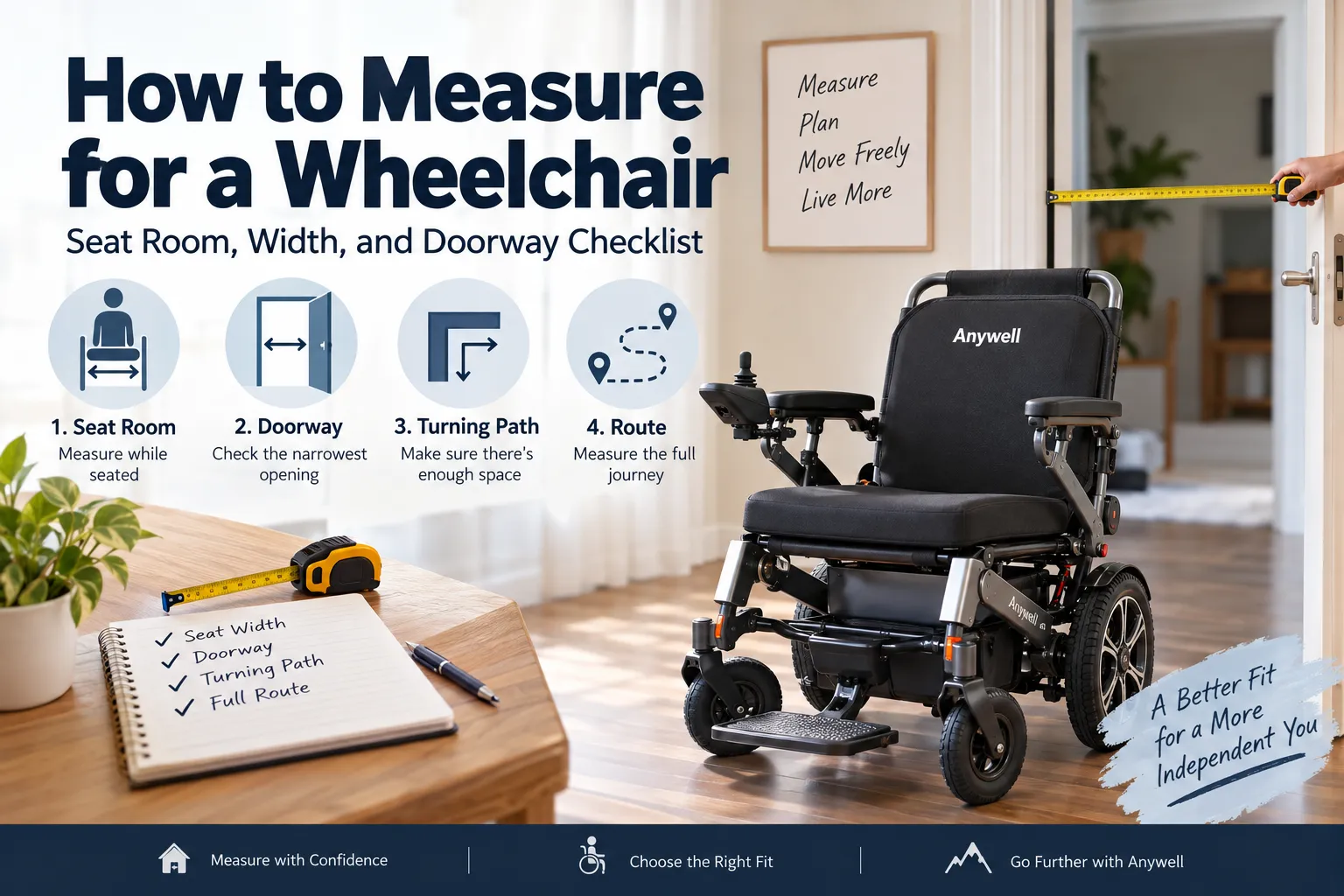

Choosing an Anywell heavy-duty power chair starts with measuring the person, the chair space, and the actual route the wheelchair needs to travel.
Learning how to measure for a wheelchair is not just about finding a seat that looks wide enough. A chair can feel roomy when you read the specifications but still be awkward at home if it cannot clear a narrow doorway, make a hallway turn, or reach the place where it will normally be stored and charged.
A practical wheelchair measurement guide therefore needs to answer several separate questions: How much seated room does the rider need? How wide is the wheelchair itself? What is the narrowest usable opening along the route? Is there enough space to turn? And will the chair work with the way it is actually used every day?
Here is a straightforward way to check those things before buying.
How to Measure for a Wheelchair: Start With the Person
The most useful measurements begin with the rider sitting naturally rather than standing.
Wheelchair guidance from NHS sources recommends taking key measurements while the person is seated. Hip width is measured straight across the widest area, while upper-leg measurements can be used when assessing seat depth.
For a basic home measurement, use a firm, flat seat if possible and have the person sit in their normal position wearing typical clothing.
1. Measure seated hip width
Measure straight across the widest outside points of the hips or thighs.
Do not wrap the tape around the body. You are trying to find the straight-line width the person occupies while seated.
This number gives you a starting point for comparing the rider with the usable seat width of a wheelchair.
The important distinction is this:
Body width and wheelchair seat width are not automatically the same measurement.
A seat should provide usable room rather than forcing the rider tightly between the sides. At the same time, simply buying the widest chair available is not always the answer because a wider wheelchair can create problems elsewhere in the home.
The Anywell fit guidance, for example, recommends measuring across the widest outside points of the hips or thighs while seated naturally, then comparing that result with the clear seat opening.
2. Check upper-leg and seat-depth needs
Width gets most of the attention, but seat depth also affects how someone sits in a chair.
A common measurement is from the back of the seated position along the thigh toward the back of the knee. Professional wheelchair fitting may adjust this measurement depending on the seating system, cushion, posture, foot support, and individual needs.
For everyday shopping, the key lesson is simple: do not judge wheelchair fit from seat width alone.
If the rider has specific positioning, pressure-management, posture, transfer, or clinical needs, those should be assessed by a qualified mobility or healthcare professional rather than relying only on an online measurement guide.
Seat Width Is Not the Same as Electric Wheelchair Width
This is one of the easiest mistakes to make.
A product may list a 20-inch or 22-inch seat, but that does not mean the entire wheelchair is only 20 or 22 inches wide.
There are usually several different measurements involved:
- usable seating space
- width across the armrests
- overall frame or wheel width
- the widest point of the complete chair
When planning a route through the home, electric wheelchair width at the widest point is usually more important than seat width.
Consider the Anywell YS16-1 MAX 20Ah as an example. Its current product specifications list a 22.05-inch usable seat width, while the width including the armrests is listed as 25.6 inches and the maximum overall width is 27.5 inches.
That difference matters.
A person might look only at the 22.05-inch seat specification and assume a roughly 23-inch doorway is sufficient. In reality, the complete chair is substantially wider.
Whenever you compare chairs, find the specification that represents the maximum overall width, not only the sitting area.
Measure the Narrowest Doorway the Chair Will Actually Use
Once you know the wheelchair's overall width, walk through the real route it will travel.
Do not measure only the front door.
Think about the full journey:
Bedroom → hallway → bathroom → living room → kitchen → exterior door → ramp → vehicle or garage.
The narrowest point anywhere on that route may determine whether the chair works comfortably.
Measure the usable opening, not the door label
A door advertised as a certain width does not necessarily provide that full amount of clear space after it is installed and opened.
Measure from the point that actually limits passage to the opposite usable edge while the door is open.
Watch for:
- the door itself
- hinges
- handles or knobs
- thick trim
- baseboards
- radiator covers
- furniture near the opening
- changes in floor level
- thresholds
The YS16-1 MAX guidance makes the same point: users should measure the narrowest usable opening along the full route rather than relying on the nominal door size.
And avoid planning around an exact mathematical match. A 27.5-inch chair and a 27.5-inch clear opening do not create a realistically usable passage.
There needs to be practical clearance for steering, hands, the joystick, and small variations in approach angle.
Straight-Line Clearance Is Only Half the Problem
Imagine a wheelchair has enough room to pass through a doorway.
That still does not mean the route works.
The chair may need to:
- travel down a narrow hallway,
- turn 90 degrees,
- line up with a doorway,
- pass through it,
- turn again immediately afterward.
This is why the turning path deserves its own measurement.
A doorway approached directly from a large room is very different from the same doorway positioned at the end of a tight corridor.
Before buying, physically inspect places where the user will need to change direction.
Look especially at:
- L-shaped hallways
- bathroom entrances
- bedroom doors near walls
- kitchen islands
- furniture corners
- elevators
- ramps
- entrances with a landing immediately outside
- areas where the chair must reverse
You do not necessarily need a complicated technical drawing. A tape measure and a simple sketch of the route can reveal a lot.
Create a Simple Home Route Checklist
One practical method is to write down every important point along the daily route.
For example:
| Location | Measurement to Check |
|---|---|
| Bedroom | space beside the bed and exit path |
| Bedroom door | clear open width |
| Hallway | narrowest usable width |
| Hallway turn | room available to change direction |
| Bathroom | doorway plus interior maneuvering space |
| Front door | clear open width and threshold |
| Ramp | usable width and surface |
| Storage area | parking and charging space |
| Vehicle | cargo opening and loading plan |
Measure the difficult places first.
If the chair cannot negotiate the narrowest hallway or essential doorway, measurements in larger rooms will not solve the problem.
Do a “Paper Wheelchair” Test
If you are uncertain about a larger electric wheelchair, a simple floor test can make the dimensions easier to understand.
Find the manufacturer's listed overall width and length. Then mark a rectangle of roughly that footprint on the floor using removable painter's tape.
You can use the outline to visualize:
- how much room the wheelchair occupies beside furniture
- whether a hallway feels crowded
- where turning becomes difficult
- whether the chair blocks another person walking past
- how much storage space is required
This does not reproduce the wheelchair's real steering geometry, wheel position, or turning behaviour, so it should not be treated as a precise mobility test.
But it is much more informative than trying to imagine what “27.5 inches wide” looks like from a product page.
Think Beyond the Doorway: Storage, Charging, and Transport
A wheelchair has to work when it is not moving too.
Ask where it will normally be parked.
Is there enough room to approach that location without repeatedly moving furniture? Is charging available nearby? Can the chair remain somewhere dry without blocking a walkway?
Transport is another major consideration.
A folding electric wheelchair may become more compact, but folding does not necessarily make a heavy chair easy to lift.
For example, the YS16-1 MAX 20Ah is listed at approximately 114 lb fully assembled. Anywell recommends planning vehicle loading around the cargo opening and using appropriate loading assistance rather than assuming it is suitable for frequent solo lifting.
So add three more measurements to your checklist:
Cargo opening width × cargo opening height × available storage depth.
Then consider who will actually load the chair.
A Realistic Example
Suppose someone measures 20.5 inches across the hips while seated and is considering a wider power wheelchair.
They find a model with approximately 22 inches of usable seat room.
So far, that looks promising.
But the measurement process should continue.
They then check the chair's maximum overall width and discover it is 27.5 inches.
Next they measure their route:
- front entrance: 34 inches clear
- living-room opening: 35 inches
- hallway: 38 inches
- bedroom door: 30 inches
- bathroom door: 28 inches
The bathroom entrance immediately becomes the point requiring the closest review.
Even though 28 inches is technically larger than 27.5 inches, half an inch of total difference leaves almost no practical maneuvering room. The approach angle, door hardware, controller position, and ability to line the chair up matter.
That is why how to measure for a wheelchair cannot be answered with one body measurement.
You are matching a person, a machine, and a physical environment.
Where a Wide-Seat Power Chair May Fit
A wider chair can be worth considering when usable seat room and rated support are priorities and the home route can accommodate the larger footprint.
The current Anywell YS16-1 MAX 20Ah specifications list:
- 22.05-inch usable seat width
- 400 lb rated support
- 25.6-inch width including armrests
- 27.5-inch maximum overall width
- 20Ah battery
- up to 20 miles of rated range under suitable conditions
Anywell also notes that actual range can vary with factors including load, terrain, slopes, temperature, battery condition, and driving behaviour.
Those numbers make the chair a useful example of why both seat measurements and route measurements belong in the same buying process.
A wide seat may solve one problem while a wide overall frame creates another. Neither specification should be considered in isolation.
Common Wheelchair Measurement Mistakes
The first is measuring the rider while standing instead of seated. Your body dimensions and posture change when you sit.
The second is confusing seat width with overall chair width.
The third is measuring the largest doorway rather than the smallest one.
Another common mistake is checking the doorway but ignoring the approach. A chair may physically fit through an opening and still be unable to line up with it from a narrow hall.
People also forget the controller and their hands. Practical clearance matters even when the chair dimensions technically fit.
Finally, avoid choosing a wheelchair using measurements alone when the rider has complex seating, posture, balance, pressure-management, or transfer requirements. Those situations may require individual professional assessment.
FAQ
How do I measure myself for a wheelchair?
Sit naturally on a firm surface and measure straight across the widest points of the hips or thighs. For a more complete fit assessment, measurements such as upper-leg length, lower-leg position, seat depth, and foot support may also be relevant.
How much wider should a wheelchair seat be than the person?
There is no single extra-width rule that is appropriate for every person and every wheelchair. Start with an accurate seated measurement and compare it with the manufacturer's usable seat dimensions. For individual positioning or clinical requirements, consult a qualified professional.
Should I use seat width or total wheelchair width to measure a doorway?
Use the wheelchair's maximum overall width for doorway planning. Seat width describes the rider's sitting space, not the complete footprint of the chair.
What is the most important doorway to measure?
The narrowest essential opening on the person's normal route. That might be a bathroom door, bedroom entrance, hallway transition, lift door, or exterior doorway.
Should I measure turning space too?
Yes. Straight-line width only tells you whether the chair can potentially pass through an opening. Hallway corners, door approaches, furniture placement, and the space immediately before and after a doorway can determine whether the route is realistically usable.
Final Takeaway
A useful wheelchair measurement guide should connect three things: the rider's seated measurements, the wheelchair's actual dimensions, and the environment where it will be used.
Start by measuring seated hip width. Compare it with the usable seat space. Then check the chair's maximum overall width and walk through every important part of the daily route, measuring the narrowest doorway, hallway, and turning area.
After that, check storage, charging, transport, and loading.
That process takes a little longer than choosing a chair from seat width alone, but it gives you a much clearer answer to the question that really matters: not simply “Will this wheelchair fit?” but “Will this wheelchair fit the person and the places they need to use it every day?”



























Sign in to leave a comment.