
You've measured the wall once, typed the number into the order form, and hit submit. Two weeks later the poster arrives and it's a good 15cm short on one side.
That's a measuring mistake, and it's the single most common reason custom size printing services end up producing something that doesn't fit.
Here's how to actually get it right before you order.

Measure more than once, with more than one tool
"Measure twice, cut once" sounds like something stitched onto a tea towel, but it exists because it works.
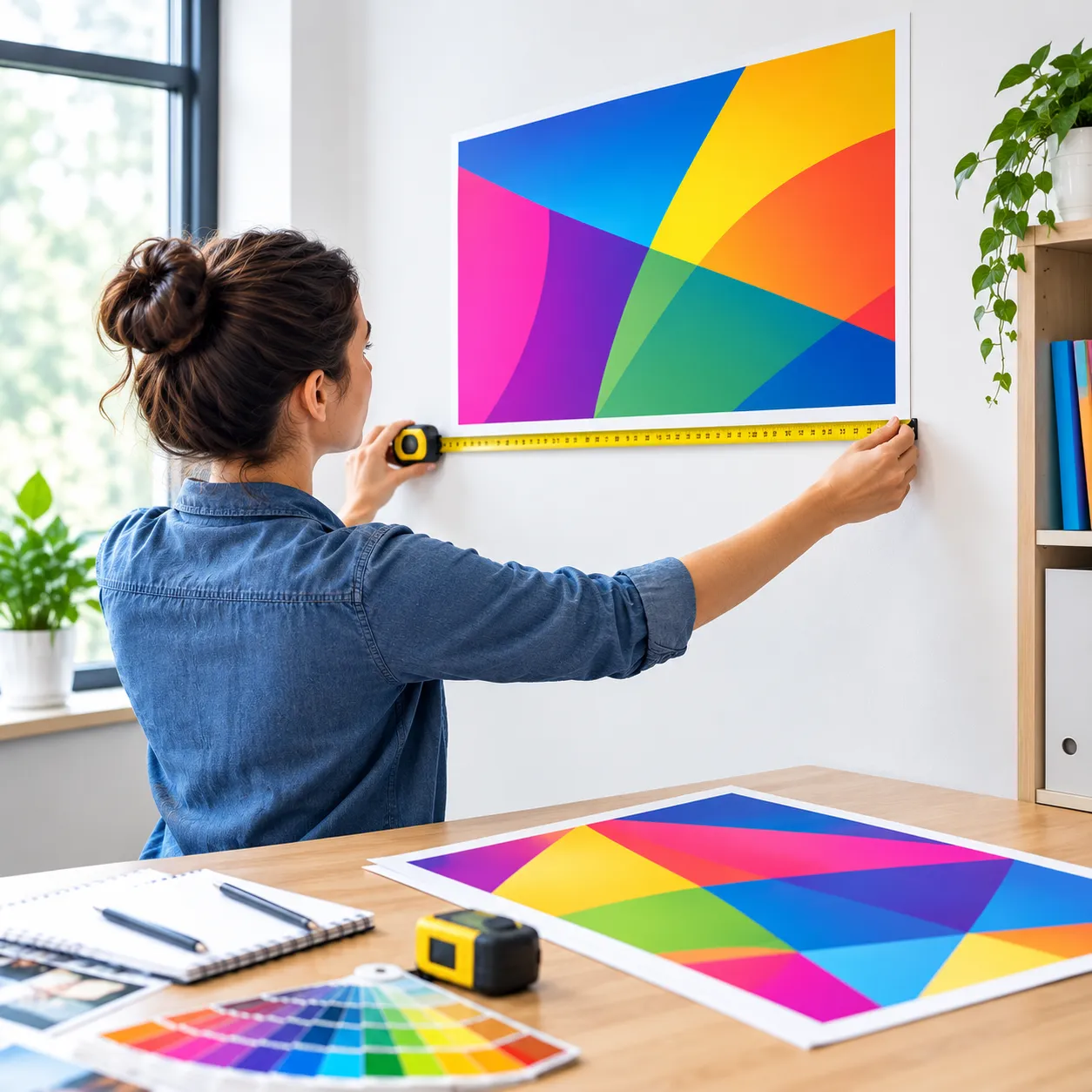
Check your width and height more than once, using a metal tape measure from a few different angles, and cross-reference the reading with a laser distance measurer if you have access to one. Two tools rarely agree on the exact millimetre, but they'll catch a genuine mistake, like reading 1.5m instead of 1.05m because the tape twisted.
If you only measure once, you've got no way of knowing whether that one number is right or just confidently wrong.
Account for how far away people will actually stand
Size on its own doesn't tell the whole story. Where the print gets viewed from changes what size actually works.
A rough rule used across the signage trade is about 1 inch of letter height for every 10 feet of viewing distance, so text meant to be read from 100 feet away needs to be at least 10 inches tall. A banner sized perfectly for the wall it's hanging on can still fail completely if no one can read the text from where they're actually standing.
So measure the space, then measure the distance people will be from it. Both numbers matter, and they're not the same measurement.
Test with a paper mock-up before committing
This one sounds almost too simple to work, and yet it catches more mistakes than any amount of careful tape-measure work.
Print a paper version of your design at 100% scale and hold it against the actual surface before finalising your order It takes five minutes. What looked like a sensible size on a laptop screen can suddenly look enormous, or oddly small, the second it's held up against the real wall, window, or counter it's meant to fill.
Skipping this step to save five minutes is how people end up paying for a reprint that costs considerably more than five minutes of their afternoon.
Don't forget what's hidden or in the way
A tape measure gives you a number. It doesn't tell you about the door handle sitting exactly where your poster was meant to go.
Check for anything that eats into your usable space before you commit to a size: light switches, window latches, mounting brackets, hinges. For a pull up banner, remember the bottom section rolls into the base and disappears from view, so that part shouldn't carry anything important. The same logic applies anywhere a frame, stand, or fixing covers part of what you're printing.
Getting the numbers into the right hands
Once you've got a measurement you actually trust, the print side is the easy part. Send the real dimensions, not a rounded guess, and confirm whether the number you're giving is the finished size or the size including any bleed or overlap.
Chelmer Print offers printing services in Essex built around exactly this kind of custom sizing, checking your measurements against the finished product before anything goes to print, rather than after it turns up too small.
Measure twice, test with paper if you can, and account for what's hidden. The rest of the order tends to sort itself out.
FAQs
What's the best way to measure an odd-shaped space for printing?
Use a metal tape measure from a few different angles, and cross-check with a laser measurer if you have one. Two tools catch mistakes that one measurement alone can miss.
How do I know what size text I need for a banner people will see from a distance?
A common rule is roughly 1 inch of letter height for every 10 feet of viewing distance. Measure how far people will actually be standing as well as the size of the space itself, both numbers matter.
Is it worth printing a paper mock-up before ordering a full-size print?
Yes. Holding a full-scale paper version against the real surface takes a few minutes and catches sizing problems a screen simply won't show you.
What should I check for before measuring a wall or window for a custom print?
Look for anything that could interrupt the space, light switches, handles, hinges, or mounting hardware, and measure around them rather than finding out after the print arrives.


















Sign in to leave a comment.