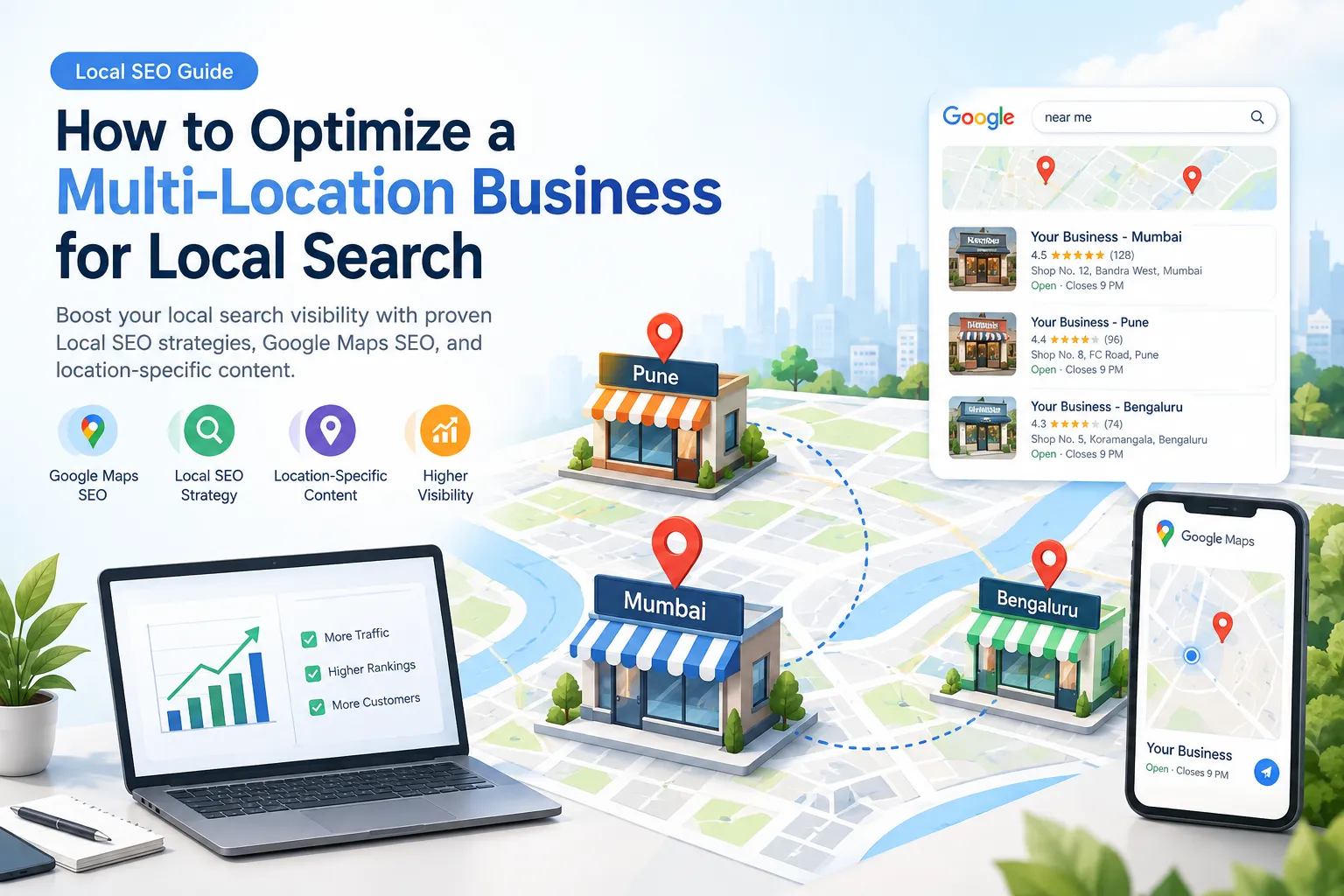

Managing a business across multiple locations creates exciting opportunities for growth, but it also introduces unique challenges in online visibility. Customers searching for your services expect to find accurate business information, relevant local pages, nearby branches, and clear directions. Without a coordinated approach, even established businesses can struggle to appear consistently in local search results.
Local SEO helps multi-location businesses connect with customers in specific geographic areas by improving their visibility across Google Search, Google Maps, and other relevant discovery platforms. However, optimizing multiple branches requires more than creating separate business listings. Each location needs accurate information, relevant content, a strong local presence, and a consistent optimization strategy.
In this guide, we explain how to optimize a multi-location business for local search, strengthen Local Search Visibility, and build a scalable Local SEO Strategy that supports sustainable business growth.
What Is Multi-Location Local SEO?
Multi-Location SEO is the process of optimizing a business's online presence across several physical locations so customers can discover the most relevant branch when searching locally.
For example, a healthcare group with clinics in Mumbai, Pune, and Nashik needs its online presence to help customers find the correct clinic based on their location and requirements.
An effective approach combines website optimization, Google Business Profile management, location-specific content, customer reviews, and accurate business information.
Businesses can use Local SEO to:
- Improve visibility for relevant geographic searches.
- Help customers discover nearby branches.
- Provide accurate addresses, opening hours, and contact details.
- Strengthen local relevance and customer trust.
- Create a consistent experience across different locations.
1. Create a Dedicated Website Page for Every Business Location
One of the most important steps in multi-location Local Search Optimization is creating a dedicated, useful landing page for each physical branch.
A single contact page listing every address may not provide enough information for customers searching for a specific location.
What Should Each Location Page Include?
Every location page should provide information that is genuinely relevant to that branch, such as:
- Business name, address, and local phone number.
- Opening hours and holiday schedules.
- Services or products available at that location.
- Directions, parking details, and nearby landmarks where useful.
- Location-specific photographs.
- Customer reviews or testimonials, where appropriate.
- A clear enquiry, appointment, or contact option.
For example, a business operating in Mumbai and Pune should create separate pages describing the services, contact information, and customer requirements relevant to each city.
Avoid creating multiple nearly identical pages that differ only by city name. Each page should offer meaningful information and serve a distinct local search intent.
2. Optimize Google Business Profiles for Every Eligible Location
Google Business Profile is an important part of local discovery, particularly for businesses that serve customers at physical locations.
For eligible businesses, maintaining accurate individual profiles helps customers find branch-specific information through Google Search and Google Maps.
Essential Google Business Profile Optimization Steps
For each eligible location:
- Use the real-world business name consistently and avoid adding unnecessary keywords.
- Select the most accurate primary and additional business categories.
- Verify the address, phone number, opening hours, and website link.
- Link to the corresponding location page rather than sending every visitor to the homepage.
- Add relevant, genuine photographs of the branch.
- Keep services, products, and other available profile information accurate.
- Monitor customer questions, reviews, and suggested edits.
Businesses should follow Google's eligibility and representation guidelines when creating and managing profiles.
Do not create multiple profiles for the same location simply to target additional keywords. Each profile should represent a legitimate, eligible business location.
3. Develop a Location-Specific Local SEO Strategy
A successful Local SEO Strategy should account for differences between locations rather than applying exactly the same approach everywhere.
Customers in different areas may use different search terms, have different needs, or look for different services.
Conduct Local Keyword Research
Identify the search terms customers use when looking for your business in each service area.
For example, a company offering digital marketing services might research phrases such as:
- Digital marketing agency in Mumbai.
- Digital marketing agency in Pune.
- SEO consultant in Andheri.
- Digital marketing company in Navi Mumbai.
These examples illustrate how geographic modifiers can help identify local search intent.
Use keyword research tools, Google Search Console data, and relevant search results to understand which terms are appropriate for each location.
Match Keywords to the Right Pages
Map relevant search terms to the most useful pages on your website.
For example:
| Page Type | Content Focus |
|---|---|
| Main service page | Core services offered by the business |
| Mumbai location page | Services, information, and customer needs relevant to Mumbai |
| Pune location page | Branch-specific information relevant to Pune |
| Individual service page | Details about a particular service |
| Contact page | Business contact information and available locations |
This structure helps search engines understand the relationship between your business, its services, and its locations.
4. Strengthen Local Search Visibility Through Consistent Business Information
Inaccurate business information can confuse customers and create difficulties when they try to contact or visit a branch.
Maintain consistent business details across your website, Google Business Profiles, and relevant business directories.
Review Your NAP Information
NAP stands for Name, Address, and Phone Number.
Check that each location's details are accurate and reflect its actual business information.
Pay particular attention to:
- Old addresses that remain online after a branch relocation.
- Incorrect phone numbers.
- Duplicate business listings.
- Inconsistent opening hours.
- Incorrect website links.
- Branch names that do not match the business's real-world identity.
Relevant local citations can support business discovery, but prioritize accurate information on trustworthy platforms instead of pursuing large quantities of low-quality directory listings.
5. Use Google Maps SEO to Help Customers Find Nearby Branches
Google Maps SEO focuses on improving a business's presence in Google Maps and related local search experiences.
For multi-location businesses, the goal is to help customers discover the branch that is most relevant to their search.
Google explains that local results are primarily influenced by relevance, distance, and prominence. Businesses cannot directly control every factor, particularly a searcher's distance from a location.
Practical Google Maps SEO Improvements
- Maintain complete and accurate business profiles.
- Choose appropriate business categories.
- Keep location pages informative and accessible.
- Encourage genuine customer reviews without offering prohibited incentives.
- Respond professionally to customer feedback.
- Ensure map pins and addresses accurately represent each branch.
- Maintain accurate opening hours and contact information.
These actions help create a reliable local presence, although they cannot guarantee a particular ranking or placement.
6. Build Location-Specific Content That Demonstrates Local Relevance
Content should answer the questions customers actually have about a particular branch.
Instead of publishing repetitive city pages, develop useful information that reflects the services, expertise, and customer needs associated with each location.
Examples of Useful Local Content
Depending on the business, consider creating:
- Guides explaining how customers can access a particular branch.
- Location-specific service information.
- Local project or customer case studies, with permission.
- Frequently asked questions about appointments, availability, and services.
- Information about the facilities or accessibility features available at a branch.
For example, a healthcare organization could explain the specialties available at each clinic, while a retail business could provide branch-specific information about products, parking, and store hours.
Authentic, location-specific information gives customers a reason to visit the page and helps distinguish one branch from another.
7. Optimize Your Website for AI-Powered Search Experiences
Customers increasingly encounter business information through a variety of search interfaces, including AI-powered experiences.
For multi-location businesses, the underlying requirement remains clear: provide accurate, accessible, consistent, and useful information about every branch.
AI Search Optimization can complement traditional Local SEO by making business information easier for search systems to understand.
Make Your Location Information Clear and Structured
Consider the following practices:
- Use descriptive headings that identify the location and its services.
- Clearly state each branch's address, contact information, and operating hours.
- Keep location pages accessible to search engines.
- Use appropriate structured data, such as Local Business or a relevant subtype, when it accurately describes the business.
- Ensure structured data matches the visible information on the page.
- Answer common customer questions directly and accurately.
- Maintain consistent information across important business profiles and directories.
Structured data can help search engines interpret information, but it does not guarantee inclusion in AI-generated answers or enhanced search features.
The same principle applies to AI search visibility: useful information and a reliable online presence are more meaningful than attempting to manipulate AI-generated recommendations.
8. Track Local SEO Rankings and Performance for Each Location
Measuring performance separately helps businesses identify which locations need attention and which optimization activities are producing useful results.
Avoid relying on a single ranking measurement. Local search results can vary according to location, query, device, and other contextual factors.
Important Metrics to Monitor
| Metric | What It Helps You Understand |
|---|---|
| Local SEO Rankings | How visibility changes for relevant local search terms |
| Google Business Profile Performance | Customer interactions with eligible business profiles |
| Organic Website Traffic | Visits to individual location pages |
| Calls and Enquiries | Customer interest in contacting a branch |
| Direction Requests | Interest in visiting a physical location |
| Conversion Rate | How effectively location pages generate enquiries, bookings, or purchases |
| Customer Reviews | Customer feedback and recurring service issues |
Use Google Search Console, Google Analytics, Google Business Profile performance data, and suitable rank-tracking tools to evaluate results.
Review performance by location so that you can identify inaccurate listings, underperforming pages, and opportunities for improvement.
How Rajkar Can Help with Multi-Location Local SEO
Managing multiple locations requires a coordinated approach that combines technical accuracy, local relevance, and ongoing performance monitoring.
Rajkar's Local SEO approach can help businesses strengthen their online presence through activities such as:
- Local SEO audits to identify technical and on-page issues.
- Location-page optimization and local keyword research.
- Google Business Profile optimization for eligible locations.
- Google Maps SEO and business information consistency.
- Local citation and reputation management.
- Location-specific content planning.
- Structured data implementation where appropriate.
- Performance tracking and ongoing optimization.
The focus is on building a clear, consistent, and useful online presence that helps customers discover the right business location.
Conclusion
Optimizing a multi-location business for local search requires more than adding city names to website content. Each branch needs accurate business information, a useful location page, an appropriately maintained Google Business Profile, and content that reflects genuine local customer needs.
A structured Local SEO Strategy helps businesses manage these elements consistently while allowing each location to maintain its own relevance and identity.
By combining website optimization, Google Maps SEO, location-specific content, and performance monitoring, businesses can build a stronger foundation for Local Search Visibility across their service areas.
Frequently Asked Questions
1. What is multi-location Local SEO?
Multi-location Local SEO is the process of optimizing a business's website, business profiles, and online information across multiple physical locations to help customers discover the most relevant branch in local search results.
2. Should every business location have a separate website page?
Generally, businesses with multiple physical locations should create dedicated pages when each page can provide useful, distinct information about that branch. Pages should not be created solely to repeat keywords or generate near-identical content.
3. Does every business location need a separate Google Business Profile?
Each eligible location may have its own profile when it meets Google's eligibility and representation guidelines. Businesses should avoid creating duplicate or ineligible profiles.
4. How long does multi-location Local SEO take to show results?
The timeline varies according to factors such as the website's existing condition, competition, location, business category, and optimization work required. Improvements are not guaranteed to produce results within a fixed period.
5. Can Local SEO improve visibility in AI search?
A well-maintained online presence, accurate business information, useful location pages, and accessible content can support discoverability across search experiences. However, Local SEO does not guarantee that a business will be mentioned or recommended by an AI system.






















Sign in to leave a comment.