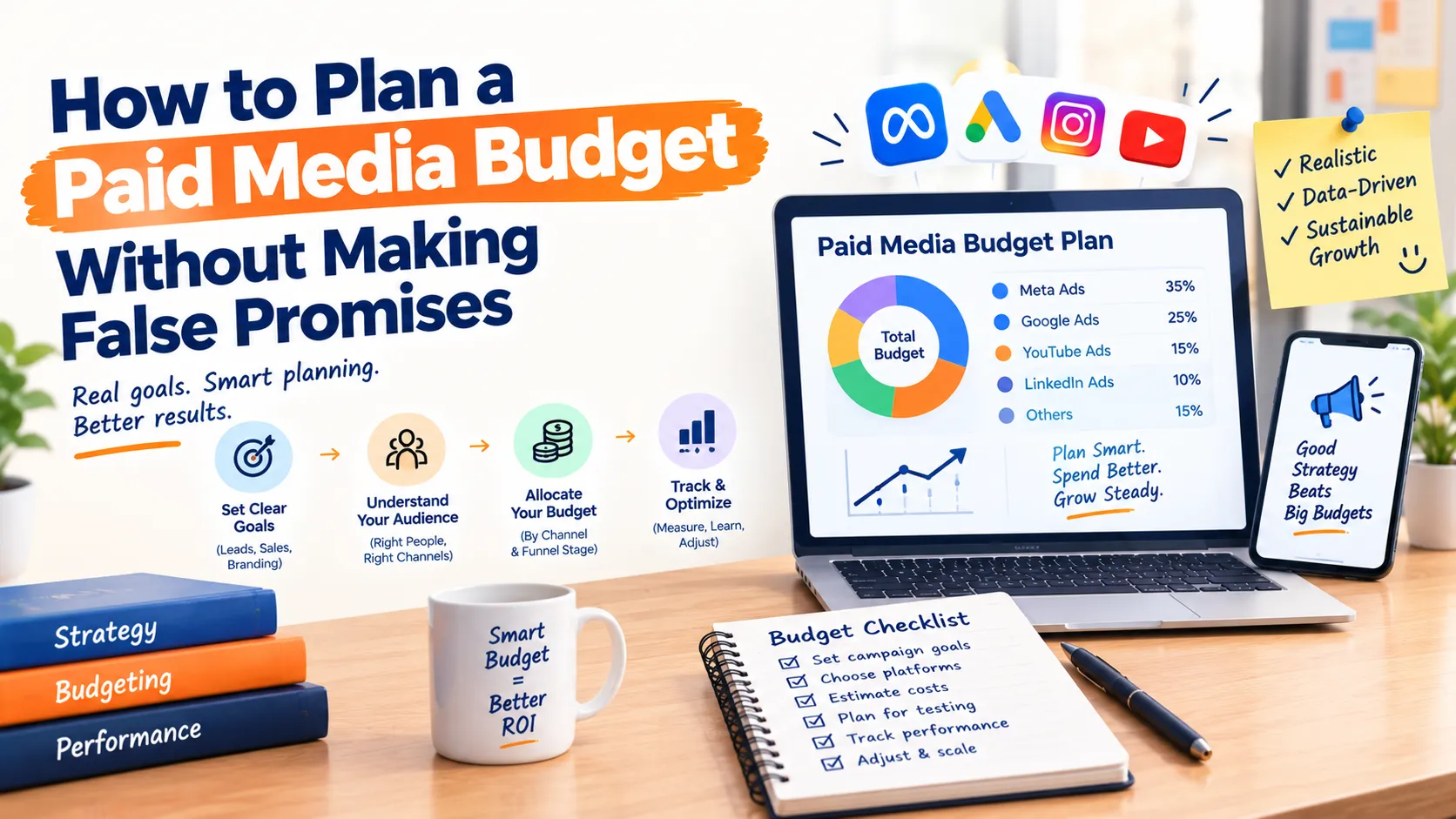

A budget is a learning commitment, not a promise that the market will deliver a fixed number of leads.
A responsible plan states the assumptions, range, break-even question, creative and landing-page work required, and the point at which the team will stop or change direction.
This guide is designed for small businesses deciding what they can responsibly test. It focuses on decisions that can be explained, tested and improved—not on vanity numbers or promises of instant rankings.
The practical framework
Use scenarios rather than a single forecast. Separate media spend from production, tools, taxes and follow-up capacity, then measure the quality of the resulting conversations.
Start with the business constraint
Clarify the monthly amount that can be risked, the capacity to respond to leads and the minimum meaningful result. A campaign that overwhelms a small team is poorly planned.
Use ranges
Estimate a conservative, expected and optimistic scenario. Label each input as observed, borrowed from a source or a hypothesis; do not present a spreadsheet as certainty.
Budget the whole path
Include landing-page work, creative production, tracking, testing and follow-up. Media spend alone cannot repair an unclear offer or a missed phone call.
Set stop rules
Agree on the evidence that triggers a pause, fix or scale decision. Stop rules protect the budget and reduce the temptation to explain away weak results.
Review quality
Sample enquiries, record fit and outcome, and compare the cost of a useful conversation rather than only the cost of a form.
2026 signal to use in this article
A responsible 2026 budget plan is a sequence of learning releases, not a single promise about return. Google and YouTube's wider AI-assisted buying tools make it even more important to define the page, event, audience and stop rule before money is spent. A small business should budget for creative, tracking, landing-page changes and follow-up time as well as media. If those supporting pieces are missing, a larger ad budget mostly buys more uncertainty.
Worked example (illustrative)
Illustrative scenario table: with ₹10,000, spend ₹6,000 on one intent test, ₹2,000 on two creative variants and keep ₹2,000 for fixing tracking or extending the better-qualified segment. With ₹25,000, run two intent groups and hold ₹5,000 for a second iteration. With ₹50,000, add a separate retargeting or video test only after consent, frequency and conversion quality are understood. If the first ₹10,000 produces 50 leads but only 5 qualified conversations, the next budget should improve the offer and qualification; simply doubling spend would scale the wrong denominator.
Learning points
- Budget for the whole system, not only media impressions.
- Release money in stages with a pre-written stop rule.
- Use qualified actions and contribution margin where available.
- Keep a reserve for creative, tracking and landing-page fixes.
- State every scenario as illustrative until real account data exists.
Implementation worksheet
Treat this article as a working brief for small businesses deciding what they can responsibly test, not as a finished claim about every business. Write the decision in one sentence: what should the reader be able to choose, create or improve after reading? Then record the starting situation, the audience, the date and the evidence you are allowed to use. For this topic, begin with **Start with the business constraint** and keep the final review focused on **Review quality**.
Capture a baseline before making changes. Depending on the project, that may be a query list, profile audit, page version, campaign spend, form count, response time, video retention sample or contribution-margin calculation. Store the denominator and the date beside every percentage. If a number is illustrative, label it visibly; if it comes from a real account, obtain permission before publishing it. This makes a small practice project useful without turning it into an invented case study.
Run one controlled iteration at a time. Keep a copy of the original brief, note what changed and assign an owner for the check. Use the most relevant signals—Actual spend versus approved range, Cost per qualified conversation—alongside the reader's questions and the quality of the next action. At the review point, write what happened, what remains uncertain and what you would test next. That short decision record is the part a client, editor or interviewer can actually evaluate.
Questions for a careful reviewer
- What exact reader problem does this draft solve, and is the promised next action visible?
- Which current claim, date, platform rule or local detail needs a source check before publication?
- Are any percentages, outcomes or examples synthetic, clearly labelled and calculated from a visible denominator?
- Does the draft include an original observation, permission-safe example or transparent limitation?
- Could the link, CTA, data collection or automation create a trust, privacy or host-policy problem?
- What single follow-up test would produce better evidence than adding more generic text?
What to measure
Document spend, impressions, clicks, conversion events, qualified rate and follow-up result. Keep forecast and actual columns separate so the learning remains honest.
- Actual spend versus approved range
- Cost per qualified conversation
- Follow-up response time
- Revenue or opportunity quality
A small practice project
Prepare a three-scenario budget for a Jaipur course or local service. Add a paragraph explaining what would invalidate each scenario.
Turn this guide into evidence
Start with the first action in the framework and complete it for one clearly labelled practice brief. Save the brief, working file, review notes and final version together. That folder becomes more useful than a screenshot because another person can see how the decision changed.
For small businesses deciding what they can responsibly test, a good test is small enough to finish and specific enough to discuss. Use the final action—Review quality—as the review point. Write what you expected, what you observed and what you would test next. If you use AI, keep the prompt, source list and human edits with the work.
Editorial checklist
- Replace general examples with an original, permission-safe example.
- Verify dates, platform interfaces, prices and claims immediately before publication.
- Add an original screenshot, diagram or observation where you have the right to use it.
- Keep headings, links and the call to action useful for the reader, not only the keyword.
- Retain one contextual course-page link only when the host permits it.
- Record the publication URL, date, author and any required AI disclosure.
Common mistakes to avoid
- Forecasting from platform averages alone
- Ignoring sales capacity
- Changing the target after seeing results
- Calling every form submission a lead
A useful next step
Good budgeting gives the team permission to learn while protecting the business from wishful thinking. If you want a structured, project-led reference while comparing options, review the digital marketing course project framework page and confirm its current modules, schedule and fees before publishing or enrolling.
Further reading
- Google campaign URL builder
- Google Ads Help























Sign in to leave a comment.