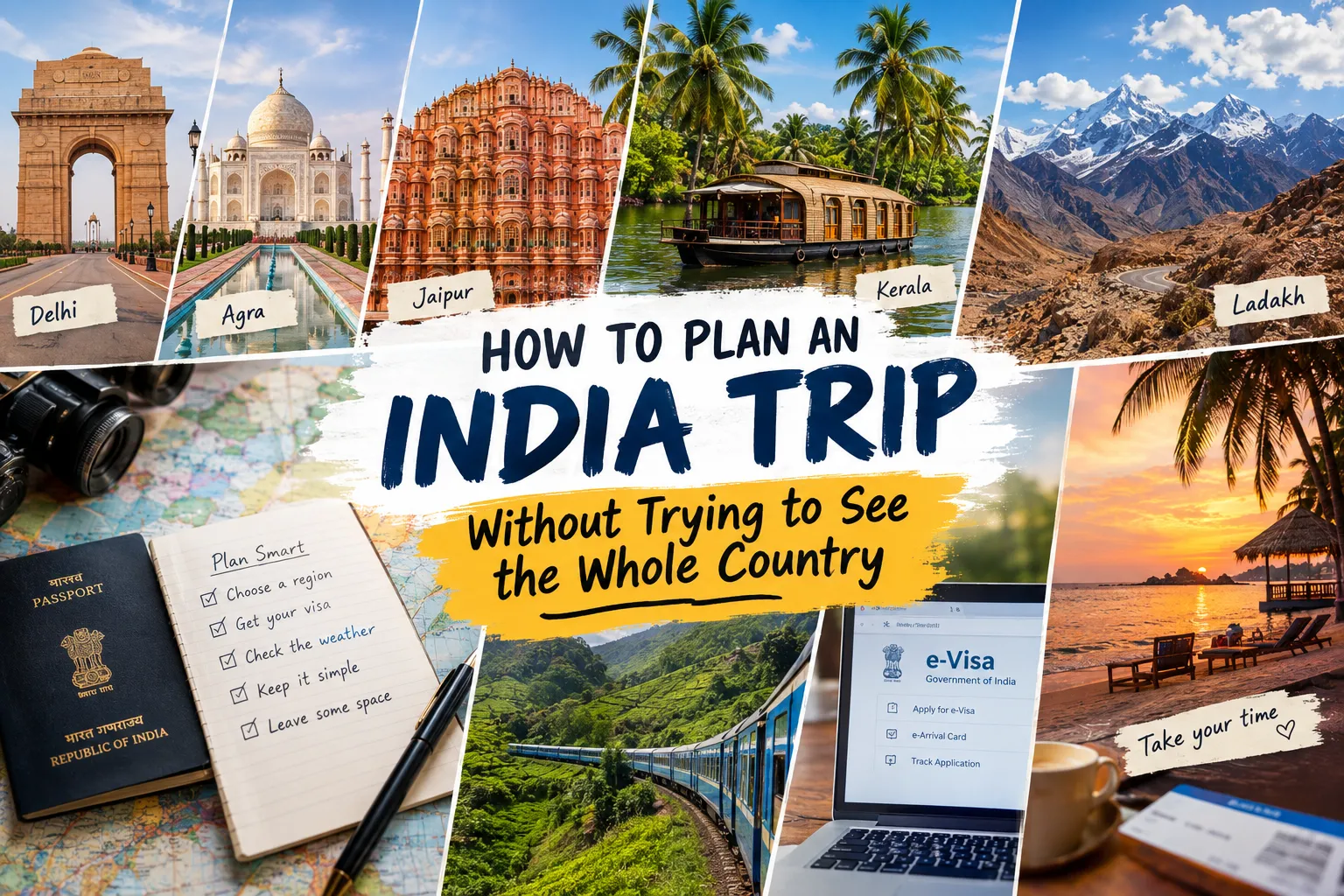

There's a particular temptation that shows up the moment India planning begins, and it usually takes the shape of a very long list. Delhi, Agra, Jaipur, Goa, Kerala, Mumbai, Varanasi, the Himalayas, the Northeast — all stacked into a single two-week window, as if enough determination could make the geography cooperate. That's usually the point where the itinerary quietly takes over and the trip itself gets pushed to the side. A better route through this is to pick a few places and let each one actually breathe, rather than rushing between all of them.
Start With One Region
For a first trip built around history, Delhi, Agra, and Jaipur already form a solid, self-contained route. Delhi carries the layered history of a capital that has changed hands many times over. Agra brings the Taj Mahal along with the wider Mughal architecture surrounding it. Jaipur adds Rajasthan's forts, palaces, and the atmosphere of its old city streets. Put those three together and the trip is already complete on its own — there's no real need to tack on six more states just because they're technically reachable.
Or Build the Whole Trip Around Kerala
A completely different kind of trip can be built around Kerala alone. Kochi offers historic neighbourhoods layered with coastal, seafaring culture. Munnar brings hills covered in tea plantations. Alappuzha introduces backwaters, canals, and the slow rhythm of houseboat life. None of this resembles Delhi, Agra, or Rajasthan in the slightest, which is exactly why trying to squeeze both routes into one short holiday tends to leave a traveller more exhausted than satisfied.
What About the Mountains?
For anyone drawn more to scenery than monuments, a Himalayan route often makes more sense than either of the above. Leh and the surrounding Ladakh region offer high-altitude landscapes that a Rajasthan or Kerala itinerary simply cannot recreate. Here, the trip stops being about collecting famous sights one after another and becomes, instead, about the landscape itself.
Sort Out the Practical Details Early
International travellers should check current visa requirements well before finalising any plans. According to India's visa portal, foreign nationals generally need a valid passport along with an appropriate visa or eligible e-Visa, unless they qualify for an exemption. Anyone applying through the e-Visa route should review every detail carefully before submitting, since the same official guidance states that changes aren't permitted once the application has gone through.
The portal also draws a clear line between the e-Visa and the e-Arrival Card — the two aren't interchangeable. The e-Arrival Card covers arrival information only, and it can be submitted within 72 hours of landing in the country.
Leave the Itinerary a Little Unfinished
A good India itinerary needs some open space built into it on purpose. Room for a meal that wasn't recommended by any website. Room to wander through an old neighbourhood with no particular destination in mind. Room for a long train ride that ends up more memorable than the city on either end of it. Room to simply sit somewhere for a while instead of rushing straight to the next stop.
India is large enough that there will always be somewhere left over for another trip. Seeing the entire country in one go was never really the goal. Seeing three places properly, and actually being present in each of them, tends to leave a far stronger memory than rushing through ten.





























Sign in to leave a comment.