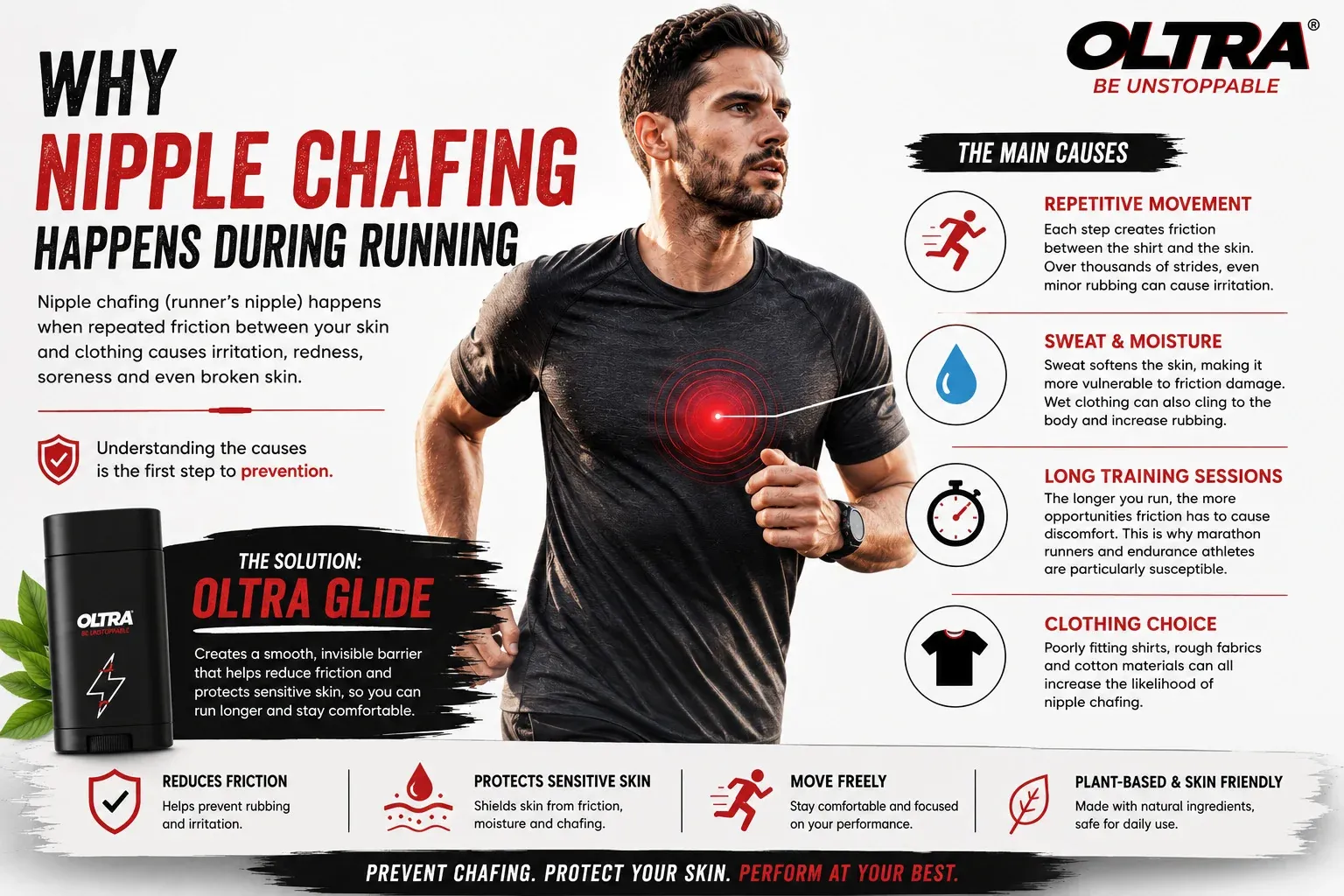

Running should challenge your cardiovascular fitness and muscles, not leave your chest painfully irritated. Yet nipple friction is a familiar problem among runners because a shirt can move across the same small area thousands of times during a training session. Learning how to prevent nipple chafing while running can therefore make long runs, races and everyday training considerably more comfortable.
The problem is usually simple: repeated contact between fabric and skin. Add perspiration, rain, heat or a poorly fitting running top and that rubbing may become increasingly noticeable. Prevention is particularly important because once irritation begins during a long run, there may be little you can do until the session ends.
Why Do Nipples Chafe During Running?
Unlike many forms of sports discomfort, nipple chafing is not primarily related to fitness. It is mechanical friction.
With every stride, your upper body moves slightly and your shirt moves with it. The same section of fabric can brush across the nipple repeatedly.
Moisture Changes the Situation
A dry running top may feel perfectly comfortable during the opening kilometres. Once soaked with perspiration, however, its texture and movement against the skin can feel very different.
Rain can create the same problem.
Longer Distances Mean More Repetition
The longer the run, the more times fabric passes over the same area.
This explains why someone who experiences no difficulty during a 20-minute session may suddenly notice nipple chafing during marathon training.
Recognising Early Warning Signs
Problems often develop gradually.
You may initially notice:
- Slight warmth
- Mild sensitivity
- Tingling or stinging
- Redness
- Discomfort when clothing moves
- Tender skin after showering
Ignoring these early signs and continuing prolonged friction may lead to more substantial irritation.
Start With Your Running Top
Clothing should be your first consideration.
Cotton absorbs moisture and can remain wet for an extended period. Many runners therefore prefer technical exercise fabrics that manage perspiration more effectively.
Fit also matters. An oversized top may shift considerably during each stride, while overly tight clothing can create pressure.
Test Kit During Training
Do not assume an expensive running top will automatically prevent friction.
Different body shapes, fabrics and seams behave differently.
Test your race kit during:
- Tempo runs
- Long training sessions
- Warm-weather runs
- Rainy conditions where practical
This tells you far more than simply trying the shirt on at home.
Create a Barrier Before Running
Reducing contact between fabric and skin is one of the simplest preventative strategies.
Some runners use tape or nipple covers, while others prefer an anti-friction product. The most suitable option depends on personal preference, distance and skin sensitivity.
People researching nipple chafing running solutions should focus primarily on prevention rather than waiting until the skin is already sore.
A barrier product can be applied before dressing so fabric moves more smoothly across the skin.
Build Protection Into Your Routine
Good habits are easier to maintain when they are simple.
Before leaving for a run:
- Check that your chest is dry.
- Apply your preferred friction protection.
- Put on a tested running top.
- Check that seams sit comfortably.
- Take additional protection for very long sessions if needed.
The entire process can take less time than tying your shoes.
Consider Weather Conditions
Weather changes friction risk.
Hot Conditions
More perspiration means your shirt may become saturated sooner.
Rain
A soaked running top can cling to the body and move differently across the skin.
Cold Weather
Layers can create additional seams and contact points. A base layer may reduce movement, but it should be tested beforehand.
Race Conditions
Crowded races, hydration stops and longer-than-normal running times can all change how your clothing behaves.
Adjust your preparation according to conditions rather than relying on exactly the same routine every day.
What Should You Do After a Run?
If your skin is slightly irritated, avoid creating more friction immediately afterwards.
Change out of wet clothing, gently clean the area and pat rather than vigorously rub the skin dry.
Do not apply strong or irritating products to damaged skin.
Allow the area to settle before another long session. If irritation is severe, broken, bleeding or showing signs of infection, professional healthcare guidance may be appropriate.
Prevention Is Better Than Mid-Run Treatment
Trying to solve the problem once a race is underway is much harder.
A runner may have limited access to replacement clothing or skin-care products. More importantly, the skin has already experienced repeated rubbing.
Planning beforehand is therefore more practical.
Experienced runners often create checklists for hydration, fuel, shoes and GPS equipment. Friction protection deserves a place on that checklist as well.
About Oltra
Oltra creates active personal-care products for people whose daily routines involve movement. Rather than looking only at elite sport, its products are relevant to runners, cyclists, walkers, gym users and people who spend long days on the move. This activity-focused approach makes friction management one part of a broader personal-care routine.
Why Runners May Choose Oltra
Running equipment works best when it does not complicate your preparation. Oltra's approach to friction protection is designed around convenient use before activity.
For runners, useful qualities include:
- Straightforward application
- Portability for training or events
- Use across several friction-prone areas
- Suitability for different active routines
- A focus on prevention before discomfort starts
The goal is not to add another complicated step to training. It is to make skin protection simple enough to become automatic.
A nipple chafing cream or anti-friction balm can be incorporated into your preparation alongside suitable clothing, particularly before long-distance sessions when repeated fabric movement is likely to be greatest.
Nipple irritation may seem like a small running issue until it begins halfway through a long event. Fortunately, it is also one of the problems runners can prepare for relatively easily. Test your kit, understand how weather affects your clothing and protect vulnerable skin before setting off. Prevention can help you keep your attention where it belongs: on your pace, surroundings and the run itself.




















Sign in to leave a comment.