

Selecting surgical lighting for an operating theatre involves much more than comparing brightness or choosing a light with the highest lux value. Modern surgical lights are defined by a combination of optical, mechanical, electrical, and ergonomic specifications that collectively determine how the system performs during surgery.
For hospital procurement teams, surgeons, biomedical engineers, and OT planners, these specifications can sometimes be difficult to interpret. Terms such as illuminance, colour rendering index, R9, colour temperature, depth of illumination, field diameter, and shadow dilution all describe different aspects of lighting performance.
Understanding what these values actually mean can help hospitals evaluate products based on clinical requirements rather than relying solely on headline numbers.
This guide explains the major OT light specifications and why they matter when planning a modern operating theatre.
1. Central Illuminance: Understanding Lux
Central illuminance is one of the most commonly highlighted specifications of an operation theatre light led. It indicates the amount of light reaching the centre of the illuminated field and is expressed in lux.
Modern surgical lights can provide high levels of illumination because surgeons need clear visibility of the operative area. However, maximum lux should never be considered in isolation.
A very bright central point does not necessarily mean that the entire surgical field is illuminated uniformly. Two lights with similar maximum illuminance may perform differently because of their optical design, beam distribution, field size, and shadow management.
Hospitals should therefore ask not only:
"What is the maximum lux?"
but also:
"How effectively is that illumination distributed across the surgical field?"
Practical demonstrations can reveal much more about usable illumination than the maximum lux figure alone.
2. Light Field Diameter
The light field diameter describes the size of the illuminated area at a specified working distance.
Different procedures require different field sizes. A broad surgical site may benefit from a wider field, while procedures involving a smaller operative area may require more concentrated illumination.
Some modern surgical lights allow users to adjust the field diameter.
This flexibility can be useful in multi-specialty operating theatres where the same lighting system needs to support different procedures.
When comparing specifications, hospitals should verify the measurement conditions used by the manufacturer because field diameter and illuminance can be influenced by working distance and optical configuration.
3. Depth of Illumination
Surgical procedures do not always take place on a flat surface. Surgeons may need to visualize structures within deep cavities where maintaining useful illumination can become more challenging.
This is where depth of illumination becomes important.
Depth of illumination describes the range over which the lighting system maintains a defined level of useful illuminance as the measurement point moves above or below the reference plane.
For hospitals performing procedures involving deeper surgical fields, this specification can be particularly relevant.
However, a numerical value should be considered together with real-world performance. During a demonstration, clinical teams should evaluate whether adequate visibility can be maintained at different depths without repeatedly repositioning the light.
4. Colour Rendering Index – CRI
Brightness alone does not determine how clearly tissue colours appear.
The Colour Rendering Index, commonly referred to as CRI or Ra, describes how naturally colours appear under an artificial light source compared with a reference source. The scale generally extends to 100, with higher values indicating closer colour reproduction according to the metric.
High-quality lights in operation theatre commonly emphasize strong colour-rendering performance because surgery involves visual differentiation between tissues, blood, vessels, and surrounding structures.
However, CRI should not be interpreted as a direct measure of surgical performance or clinical outcomes. It is a characteristic of the light source.
Hospitals should use CRI as one part of a broader evaluation that includes other colour-rendering measures and direct visual assessment.
5. R9: Why Red Reproduction Matters
CRI alone does not tell the entire colour-rendering story.
Standard Ra is calculated primarily from eight test colour samples and does not include R9 in its average. R9 evaluates the reproduction of a saturated red test colour.
This makes R9 a useful additional specification when evaluating surgical lighting because red reproduction is relevant to how various red and tissue tones appear within the operative field.
A surgical light can theoretically have a high general CRI while showing weaker performance for saturated red.
Hospitals should therefore review both the general CRI and R9 value rather than making decisions based on CRI alone.
Again, these values describe lighting characteristics; they should not be interpreted independently as guarantees of clinical performance.
6. Understanding R13 and Additional Colour Metrics
Some manufacturers also provide R13 and other individual colour-rendering values.
R13 represents the rendering of a light skin-tone test colour and can provide additional information about how naturally certain colour tones appear under the light.
Reviewing CRI together with R9, R13, and other relevant metrics can provide hospitals with a more complete understanding of spectral performance.
However, comparing specifications only works when the values have been measured using comparable methods.
For this reason, technical documentation from the manufacturer should always be reviewed alongside a practical demonstration.
7. Colour Temperature
Colour temperature, measured in Kelvin (K), describes the visual appearance of white light.
Lower colour temperatures generally appear warmer, while higher colour temperatures appear cooler.
Modern best ot lights in india may provide a fixed colour temperature or offer multiple adjustable settings. Adjustable colour temperature allows surgical teams to modify the appearance of the illuminated field according to the procedure, surrounding conditions, or clinician preference.
It is important to distinguish colour temperature from colour rendering.
A light with a higher colour temperature does not automatically provide better colour reproduction. Likewise, changing colour temperature does not necessarily indicate a change in CRI.
Hospitals should evaluate these specifications independently.
8. Shadow Dilution and Shadow Management
One of the greatest challenges in surgical lighting is maintaining illumination when surgeons, assistants, or instruments partially obstruct the light.
Modern LED surgical lights typically use multiple LED modules and optical elements to create overlapping beams. If one part of the light is obstructed, other light paths can continue illuminating the field.
Specifications relating to shadow dilution or residual illumination can help describe this performance.
Hospitals should pay particular attention to how the light behaves when obstructions occur because a completely unobstructed field does not accurately represent real surgery.
During demonstrations, users should deliberately position heads, shoulders, or other representative obstructions between the light and working field and observe how effectively useful illumination is maintained.
9. Working Distance
Working distance refers to the intended distance between the surgical light and the operative field.
This matters because illumination, field diameter, focus, and optical performance can change depending on distance.
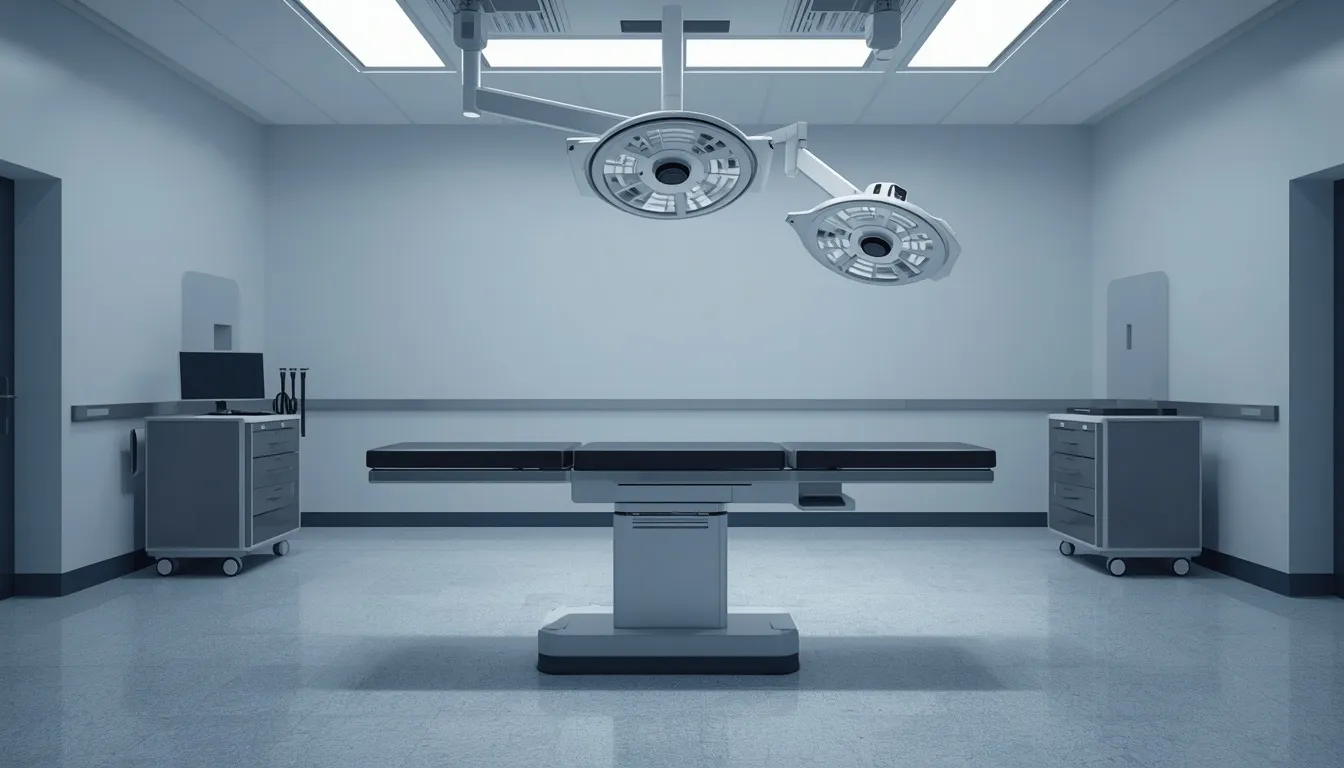
Hospital planners should consider operating table height, ceiling height, suspension-arm configuration, and the types of procedures performed when assessing the required working range.
A lighting system should provide sufficient positioning flexibility without interfering with other ceiling-mounted equipment.
This becomes particularly important in operating rooms containing multiple devices such as pendants, monitors, imaging equipment, or additional light heads.
10. Dimming and Intensity Control
Maximum brightness is not required for every procedure.
A good surgical lighting system should provide controlled intensity adjustment so that clinicians can select an appropriate illumination level for the situation.
The quality of dimming is also worth evaluating. Hospitals should assess how smoothly intensity changes, whether controls are intuitive, and whether frequently used settings can be accessed efficiently.
Some systems may also provide specialized low-intensity or minimally invasive surgery settings designed for procedures where surrounding room illumination needs to be reduced.
Hospitals should evaluate these features according to their actual surgical workflows rather than selecting them simply because they appear technologically advanced.
11. Heat and Thermal Management
LED technology has significantly changed the thermal characteristics of surgical lighting compared with older technologies such as halogen lamps.
LEDs are generally more energy-efficient and can reduce radiant heat directed toward the surgical field. However, LEDs are not heat-free.
The LED modules and electronic components still generate heat, which must be managed through appropriate product design.
Hospitals should therefore examine energy consumption, thermal management, operating conditions, and expected LED service life.
Effective thermal design is particularly important because excessive internal heat can affect electronic components and long-term reliability.
12. LED Service Life and Maintenance
Manufacturers commonly specify expected LED operating life in hours.
While a high number can indicate long expected service duration, hospitals should understand what the figure actually represents. LED lifetime specifications may refer to defined test conditions or lumen-maintenance criteria rather than guaranteeing that the complete surgical light will operate without maintenance for that entire period.
Other components—including power supplies, control electronics, suspension arms, handles, and optional cameras—may require maintenance during the system's lifecycle.
Hospitals should therefore evaluate preventive maintenance requirements, warranty terms, spare-parts availability, technical support, and expected service response.
13. Camera and Digital Integration Specifications
Advanced surgical lights may include HD or 4K cameras for overhead visualization.
If camera integration is required, hospitals should consider more than resolution. Relevant specifications can include optical zoom, digital zoom, focus, colour reproduction, frame rate, latency, output interfaces, and compatibility with surgical monitors or OR integration systems.
A 4K camera also requires compatible infrastructure if the hospital wants to maintain 4K resolution throughout the video chain.
The complete pathway should be considered:
Camera → video processing → routing/recording → surgical monitor
A 4K source alone does not guarantee a complete 4K workflow.
14. Mechanical and Ergonomic Specifications
Technical lighting performance is only useful if clinicians can position the light effectively.
Hospitals should evaluate the suspension system, range of movement, light-head weight and balance, positioning stability, handle design, and ease of adjustment.
The light should move smoothly when required and remain stable once positioned.
Ceiling mounting requirements should also be reviewed before installation to ensure compatibility with the room's structural design and other ceiling-mounted systems.
Look Beyond the Specification Sheet
A specification sheet is essential when comparing surgical lights, but it should be the beginning of the evaluation—not the end.
Hospitals should consider illuminance, field size, depth, CRI, R9, colour temperature, shadow performance, thermal management, ergonomics, camera capabilities, reliability, and service support as interconnected characteristics.
Whenever possible, shortlisted systems should be demonstrated under realistic conditions and assessed by surgeons, OT personnel, biomedical engineers, and procurement teams.
The most suitable surgical light is not necessarily the one with the highest number in every specification. It is the system that provides the right combination of illumination quality, visual performance, positioning, reliability, and functionality for the hospital's clinical requirements.
Understanding OT light specifications enables hospitals to move beyond marketing claims and make procurement decisions based on measurable performance, practical evaluation, and long-term clinical needs.






















Sign in to leave a comment.