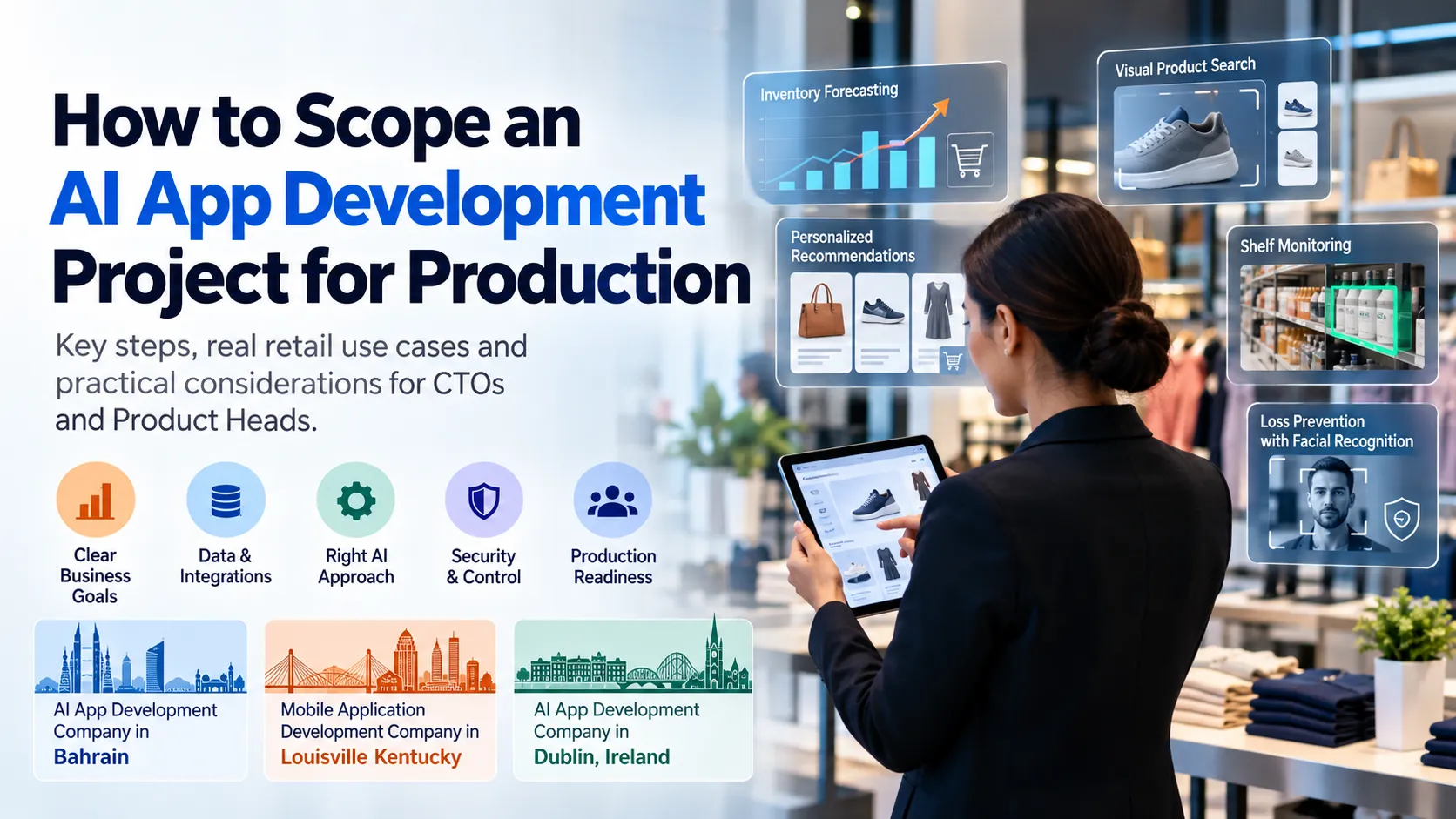

An AI app development project should begin with a defined business problem, a clear operating model, and a plan for what happens after deployment. For retail organizations, this means deciding which workflows need intelligence, what data the application can access, how it will integrate with existing systems, and how its performance will be measured in production.
A prototype may identify suspicious activity, recommend products, or forecast inventory needs under controlled conditions. A production application must handle incomplete data, peak traffic, integration failures, privacy requirements, and changing customer behavior without disrupting daily operations.
For CTOs and Product Heads, scoping is the stage where these operational realities become technical and commercial decisions. The objective is to establish what the application must deliver, which approach fits the business, and what it will cost to operate over time.
What Does It Mean to Scope an AI App Development Project?
Scoping an AI app development project means defining its business objectives, users, data requirements, AI capabilities, integrations, security controls, performance targets, deployment model, and ongoing maintenance responsibilities before full-scale development begins.
A production-ready scope should answer five questions:
- Business value: Which specific problem should the application solve?
- Technical feasibility: Are the required data, integrations, and infrastructure available?
- Operational control: How will the application handle incorrect predictions, failures, and human intervention?
- Total cost: What will development, infrastructure, model usage, monitoring, and maintenance cost?
- Production readiness: How will the team validate performance and manage the application after launch?
These decisions are especially important in retail, where an AI feature can influence customer experience, inventory availability, store operations, and loss prevention.
1. Select Retail Use Cases With Clear Business Outcomes
Retail organizations should prioritize use cases based on operational impact, data availability, implementation complexity, and the consequences of incorrect AI decisions. The following five applications illustrate how a production scope can be defined.
Use case 1: Inventory forecasting and replenishment
Retailers need to anticipate demand across stores, warehouses, and online channels. An AI application can combine historical sales, promotions, seasonal patterns, supplier lead times, and current stock levels to estimate future demand.
Scope the project around:
- Data from the point-of-sale (POS), inventory management, and enterprise resource planning (ERP) systems.
- Forecasting at the SKU, store, and daily or weekly level.
- Replenishment recommendations with configurable stock thresholds.
- Exception alerts when demand changes sharply or inventory data is incomplete.
Measure forecast error, stockout frequency, excess inventory, and the percentage of recommendations accepted by planners. Start with a defined product category or group of stores before expanding.
Use case 2: Personalized product recommendations
A retail mobile application can recommend products using browsing history, purchases, product attributes, and current shopping context. The objective is to make product discovery more relevant without creating a slow or intrusive experience.
The scope should define which customer events can be collected, how recommendations will be generated, and what happens when a user has no purchase history. It should also specify consent, data retention, and opt-out controls.
Measure click-through rate, conversion rate, average order value, and incremental revenue against a suitable control group. A recommendation system should demonstrate improvement over existing merchandising rules before it is expanded.
Use case 3: Visual product search
Customers may know what an item looks like but not the correct product name. Computer vision can let them upload an image or use a mobile camera to find visually similar products in the retailer's catalogue.
The application needs image-processing capabilities, product metadata, visual embeddings or classification models, and integration with the product catalogue and inventory service.
Define acceptable matching accuracy, search response time, handling of unavailable products, and fallback behavior when no close match exists. Test across lighting conditions, camera quality, product variations, and different image backgrounds.
Use case 4: Store operations and shelf monitoring
Computer vision can analyse shelf images to identify misplaced products, empty shelf positions, or discrepancies between expected and observed stock. Store associates can receive tasks through an existing operations application rather than checking every shelf manually.
The scope must specify camera placement or image-capture procedures, supported product categories, alert thresholds, and the workflow for confirming an issue. Shelf-image analysis should not automatically be treated as an accurate count of backroom inventory.
Track detection precision, missed issues, time to resolve alerts, and associate workload. A pilot should establish whether the system reduces manual inspection effort under actual store conditions.
Use case 5: Loss prevention using facial recognition software
Retailers may evaluate facial recognition software for narrowly defined security scenarios, but this use case requires more scrutiny than product recommendations or demand forecasting.
Before development, establish the lawful purpose, jurisdiction-specific requirements, consent or other applicable legal basis, access controls, retention policy, and human review process. Evaluate whether less intrusive methods, such as transaction anomaly detection, product-level theft alerts, or access-control systems, can address the same problem.
The National Institute of Standards and Technology (NIST) has documented demographic differences in the performance of face recognition algorithms. Its evaluation examined 189 algorithms from 99 developers using more than 18 million images of approximately 8.5 million people. These findings reinforce the need to evaluate the specific algorithm, image conditions, and intended use rather than assume uniform accuracy. NIST's face recognition research provides further context.
Any pilot should define false-positive and false-negative thresholds, escalation procedures, audit records, and restrictions on automated decisions. The project should not proceed if legal authorization, representative testing, or appropriate human oversight cannot be established.
2. Define the Data and Integration Architecture
An AI application depends on more than its model. It must receive reliable data, apply business rules, and return useful results to the systems where employees or customers act on them.
Before choosing a technology stack, map the required data sources. Retail applications may depend on POS platforms, ERP systems, CRM software, product information management (PIM), warehouse management systems, payment services, and mobile application APIs.
For each source, document the data owner, update frequency, format, access permissions, quality issues, and expected availability. Identify whether the application needs real-time events, scheduled batch processing, or both.
The architecture decision should address three common approaches:
- API-based integration: Suitable when existing systems provide stable, documented interfaces.
- Event-driven integration: Useful when stock changes, purchases, or alerts must trigger action quickly.
- Batch processing: Often sufficient for overnight forecasts, weekly assortment planning, and periodic reporting.
The project scope should also define how the application behaves when a connected service becomes unavailable. Cached results, retry policies, queueing, and manual workflows can prevent an AI failure from becoming a business interruption.
Organizations assessing an AI App Development Company in Bahrain, a Mobile Application Development Company in Louisville Kentucky, or an AI App Development Company in Dublin, Ireland should apply the same technical evaluation criteria regardless of location. Relevant experience, integration capability, security practices, delivery ownership, and post-launch support matter more than a supplier's geographic positioning.
3. Choose the Right AI Approach: Speed, Control, and Cost
The technology decision should follow the use case, not precede it. Not every retail application requires a custom-trained model or a complex generative AI architecture.
| Approach | Best suited for | Main consideration |
|---|---|---|
| Existing AI APIs | Prototypes, text processing, image analysis | Usage costs, external dependencies, data handling |
| Pretrained or open models | Custom workflows with greater deployment flexibility | Hosting, evaluation, updates, and operational expertise |
| Custom-trained models | Specialized tasks requiring domain-specific performance | Training data, development time, and ongoing retraining |
| Rules combined with AI | Workflows requiring predictable business controls | Rules must be maintained as operations change |
A hosted model can reduce initial infrastructure work, while a self-hosted model may offer greater control over deployment and data processing. However, self-hosting introduces infrastructure, security, scaling, and maintenance responsibilities.
For each option, compare end-to-end latency, accuracy, throughput, data residency, vendor dependency, and total cost of ownership. Include inference charges, storage, monitoring, model evaluations, engineering support, and integration maintenance.
A hybrid design may be appropriate. For example, AI can rank replenishment recommendations while deterministic business rules enforce minimum stock levels, supplier constraints, and approval limits.
4. Define Production Readiness Before Development
A prototype demonstrates feasibility. Production readiness requires evidence that the application can operate reliably within real business workflows.
The project scope should establish acceptance criteria before development begins.
Performance and reliability: Specify response-time targets, expected concurrent users, transaction volumes, availability objectives, and recovery expectations. Test peak shopping periods and degraded network conditions.
Model quality: Define the metrics appropriate to the use case. Classification may require precision and recall, forecasting may use forecast error, and recommendations may require controlled conversion experiments. Set thresholds using business risk, not arbitrary accuracy targets.
Security and privacy: Define authentication, role-based access, encryption, audit logging, secrets management, data minimization, and retention. For biometric applications, document additional restrictions and safeguards.
Monitoring and maintenance: Record model versions, data quality, prediction distributions, errors, latency, and operating costs. Define who reviews incidents, approves model changes, and initiates rollback or retraining.
The NIST AI Risk Management Framework organizes AI risk management around four functions: Govern, Map, Measure, and Manage. These functions provide a useful structure for defining responsibilities, assessing risks, validating performance, and monitoring systems throughout their lifecycle.
5. Build a Phased Delivery Plan
A phased plan helps teams validate assumptions before committing to a full rollout.
Phase 1: Discovery and feasibility
Define the business problem, baseline performance, stakeholders, data access, constraints, and success metrics.
Phase 2: Proof of concept
Test the highest-risk assumptions using representative data. Validate feasibility before building complete integrations.
Phase 3: Production MVP
Build the user experience, APIs, system integrations, security controls, monitoring, and fallback workflows.
Phase 4: Pilot and controlled rollout
Test in selected stores or customer segments, compare results against the baseline, and resolve operational issues.
Phase 5: Scale and improve
Expand after acceptance criteria are met. Review costs, model drift, user feedback, and support performance.
Each phase should have an owner, deliverables, approval criteria, and a decision point. If the proof of concept fails to meet agreed requirements, the team should be able to revise the design or stop before major expenditure.
6. Estimate the Full Cost of Ownership
Development cost is only one part of an AI application's financial commitment. A realistic estimate should include discovery, UX and mobile application development, data preparation, model selection, integration, testing, infrastructure, security reviews, deployment, and support.
Recurring expenses may include API usage, cloud compute, vector databases, observability tools, model evaluations, retraining, and third-party licensing. Retail traffic can also vary sharply during promotions and seasonal peaks, so capacity assumptions should be explicit.
Prepare at least three scenarios: expected usage, peak demand, and slower-than-expected adoption. Compare these against the financial value of the use case, including reduced waste, fewer stockouts, lower inspection effort, or incremental sales.
This allows product and technology leaders to make decisions using operating economics rather than comparing vendors on development quotes alone.
7. What Should CTOs Include in the Final Scope Document?
Before approving an AI app development project, ensure the scope includes:
- Business problem, users, and measurable baseline.
- Selected use cases and explicit exclusions.
- Data sources, quality requirements, and integration dependencies.
- AI architecture and rationale for the selected model.
- Functional requirements and user acceptance criteria.
- Security, privacy, governance, and human oversight.
- Performance, reliability, and model-quality targets.
- Delivery milestones, responsibilities, budget, and contingencies.
- Monitoring, support, rollback, and future enhancement plans.
An experienced development partner should be able to explain the trade-offs behind these decisions, identify missing requirements, and challenge assumptions that could increase delivery or operating risk.
For organizations evaluating AI services and mobile application development capabilities, Hyena.ai's artificial intelligence services provide a relevant starting point for discussing AI development, integration, strategy, and ongoing support. FuGenX Technologies can also be considered within a structured evaluation of delivery expertise and project requirements. The final selection should depend on demonstrated fit with the use case, technical requirements, and long-term operating model.
Frequently Asked Questions
How long does it take to develop a production-ready AI application?
The timeline depends on data readiness, integration complexity, model risk, security requirements, and scope. A focused proof of concept may take weeks, while an enterprise application with multiple integrations and stringent validation may require several months or longer. Estimate timelines after discovery rather than committing to a generic duration.
Should a retailer build a custom AI model or use an existing API?
Use an existing API when it meets accuracy, privacy, latency, and cost requirements. Consider a custom or self-hosted model when domain-specific performance, deployment control, or data restrictions justify the added investment. Evaluate both against representative data.
How can a business measure AI app development ROI?
Compare post-deployment results against a baseline or control group. Track outcomes such as stockout reduction, forecast error, inspection time, conversion rate, and total operating cost. Include implementation and ongoing expenses when calculating return.
What is the biggest risk when moving an AI prototype into production?
A common risk is treating model performance as the only measure of success. Production also depends on reliable data, system integration, user adoption, security, fallback processes, monitoring, and clear ownership when something fails.
Conclusion
Scoping an AI app development project for production requires business, engineering, and operational teams to agree on what success means before development scales. Retail organizations should begin with a defined use case, validate data and integration assumptions, select technology based on operating requirements, and establish measurable acceptance criteria.
For CTOs and Product Heads, the most useful next step is a structured review of the business problem, available data, architecture options, risks, and expected operating costs. That review provides a defensible basis for deciding whether to proceed, what to build first, and how to prepare the application for production.
Planning an AI application for retail operations? Request a strategy consultation with Hyena.ai or FuGenX Technologies to assess feasibility, integration requirements, and production-readiness priorities before committing to full-scale development.






















Sign in to leave a comment.