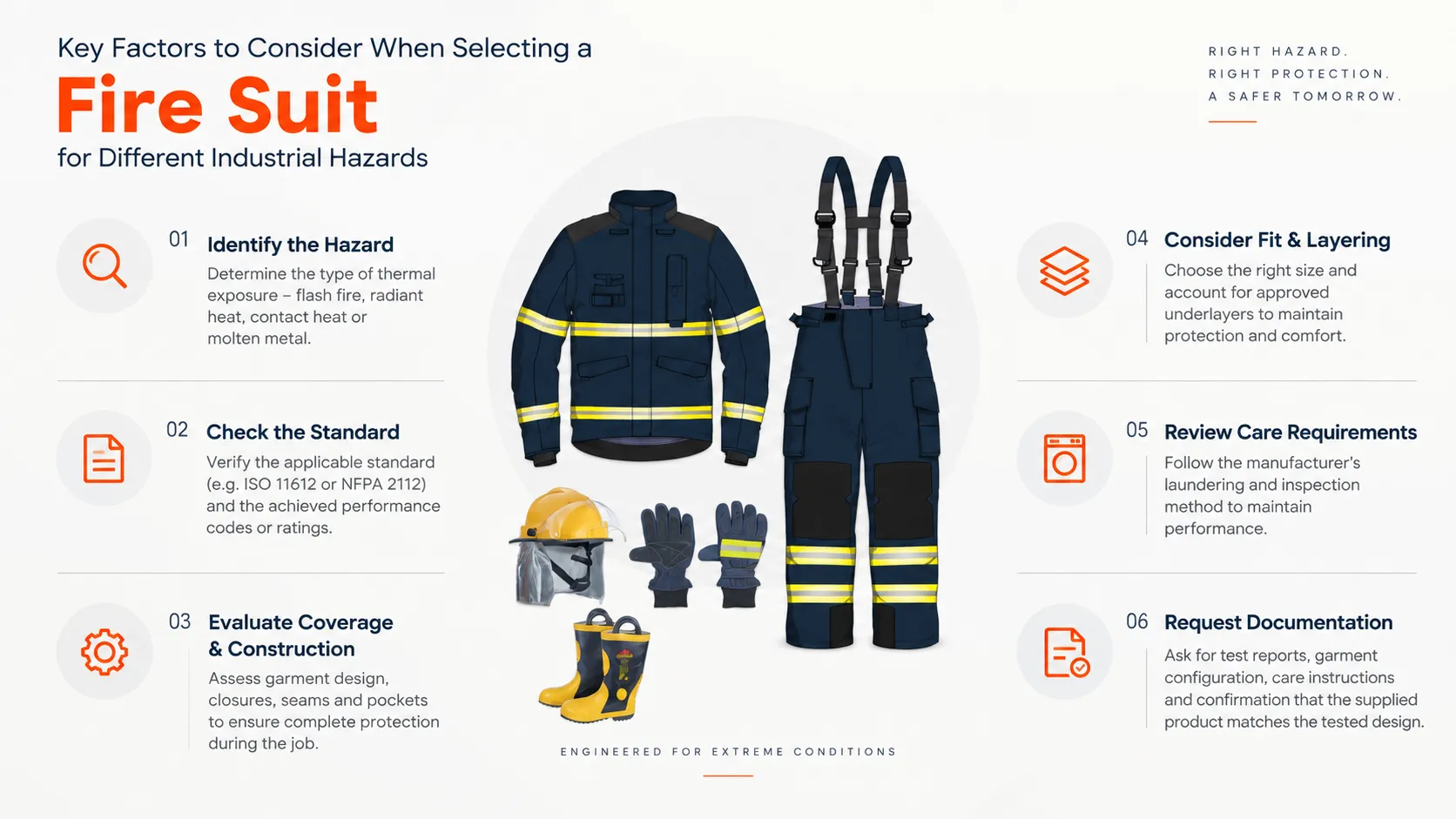

A Fire Suit should be selected for the thermal exposure it is expected to face, not simply for a label such as “heat resistant.” Flash fire, radiant heat, convective heat, contact heat, and molten-metal splash place different demands on protective clothing. The correct purchasing process therefore starts with the hazard assessment, then moves to the applicable standard, performance code, garment coverage, fit, and maintenance.
Define the Exposure Before Choosing the Suit
A short-duration flash fire is different from prolonged radiant heat near a furnace. Molten metal introduces another problem because hot material can land on the garment and transfer heat through the fabric.
The suit is one part of the PPE system. Other protection may be required for the head, face, hands, feet, eyes, hearing, or respiratory system.
Read the ISO 11612 Codes
For international procurement, ISO 11612:2015 is the current published edition for clothing designed to protect against heat and flame. It uses letter and performance-level codes to identify the hazards for which the garment has been tested.
A1 and A2 relate to flame spread. B1 to B3 cover convective heat, C1 to C4 radiant heat, D1 to D3 aluminium-molten-splash performance, E1 to E3 molten-iron splash, and F1 to F3 contact heat. The numbers represent increasing performance levels within the relevant code.
When NFPA 2112 Applies
Where the hazard is industrial flash fire in a North American programme, NFPA 2112 is the relevant garment standard. Its flash-fire evaluation uses the ASTM F1930 instrumented-mannequin method and includes a three-second thermal exposure of 84 kW/m². The average predicted body burn must remain within the standard’s acceptance criterion, and material tests address char length, afterflame, and melting or dripping.
A suit certified for flash-fire protection should not automatically be presented as protection against molten-metal splash or electric arc exposure.
Coverage and Construction Matter
A suit is only useful if it keeps the intended areas covered during the task. Closures, cuffs, collars, seams, pockets, and interfaces between jacket and trousers all matter.
A worker who bends, climbs, kneels, or reaches can create gaps, so coverage should be checked in the positions used on the job.
The construction also needs to match the tested design. A certificate for a fabric does not automatically prove the performance of every garment made from that material.
Fit and Layering Affect Protection
Industrial suits must accommodate the movement required by the job without becoming excessively loose. The sizing should account for permitted underlayers and other PPE.
Non-FR synthetic layers such as polyester should not be treated as interchangeable with suitable nonmelting or FR underlayers for thermal hazards. The acceptable base-layer system should follow the applicable standard, hazard assessment, and manufacturer’s instructions.
Check the Care Requirements
Repeated washing, contamination, abrasion, and damaged closures affect whether a garment remains suitable for service. Procurement should document the manufacturer’s laundering method and inspection criteria.
Oil, grease, chemicals, and other flammable contamination also need a defined response. A garment should be removed from service when its condition or contamination means it can no longer provide the intended protection.
Common Selection Mistakes
1. Buying by fabric weight alone. GSM describes mass, not the protection achieved by a complete suit under a defined test.
2. Looking only at the standard name. The performance codes show which heat or flame exposures were actually assessed.
3. Using one suit for unrelated hazards. Flash fire, radiant heat, molten-metal splash, and electric arc require different evidence.
What Should Procurement Request?
The purchase specification should identify the hazard, standard and edition, achieved performance codes or ratings, garment configuration, sizing, approved layering, care method, and evidence that the supplied construction matches the tested product.
Conclusion
Selecting a Fire Suit is a hazard-matching exercise. Identify the thermal exposure, read the performance codes or ratings within the applicable standard, and then examine coverage, construction, fit, layering, and care. A certificate is useful only when the buyer confirms what was tested and matches it to the supplied garment.






















Sign in to leave a comment.