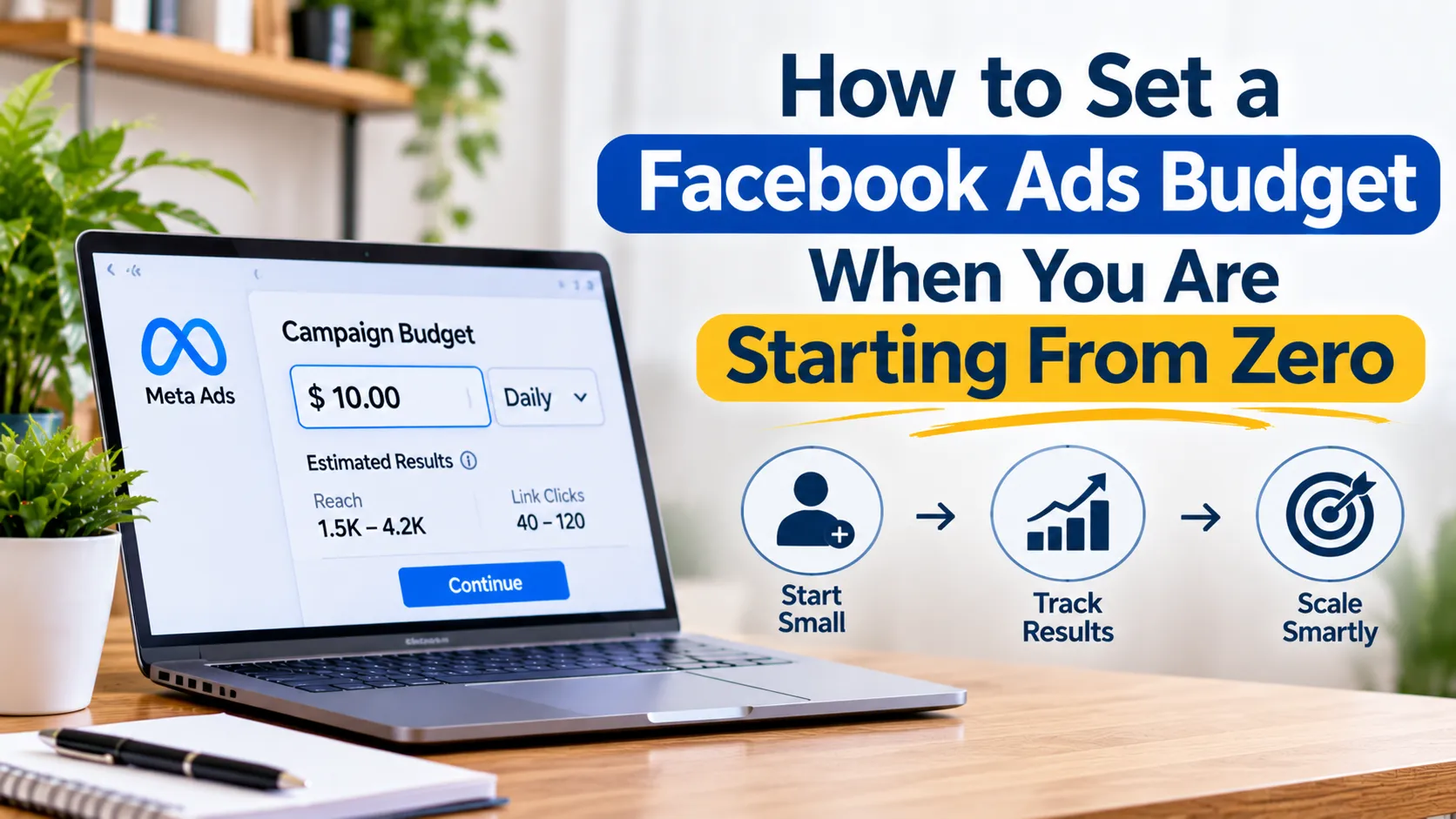
How to Set a Facebook Ads Budget When You Are Starting From Zero


Almost every new advertiser asks the same thing before launching: how much should I spend? Search for an answer and you will find figures ranging from a couple of dollars a day to thousands a month. Each one sounds confident, and none of them knows your business.
The truth is that a sensible budget comes from your own numbers, not from a universal rule. This guide shows you how to work one out, even if you have never run an ad before.
Start With What a Customer Is Worth
Before you think about daily spend, ask a more useful question: what can you afford to pay to win one customer? Work out how much profit a typical customer brings in after product, shipping and other costs. That profit is the ceiling on what you can spend to acquire them.
If you keep fifty dollars in profit from a sale, you might decide you are comfortable spending up to twenty dollars to get that customer. That figure, your target cost per customer, is the foundation of every budget decision that follows.
Work Backwards From What You Need to Learn
A test budget has one job: to give you enough results to make a decision. Tiny budgets feel safe, but they often produce so little data that you cannot tell whether the ads work.
Here is a simple way to think about it. Decide roughly how many purchases or leads you want before judging a campaign. Multiply that by your target cost per result. The answer is the amount you need to invest in the test.
For example, imagine you want about twenty purchases to feel confident and you are willing to pay up to twenty dollars for each one. That points to a test budget of around four hundred dollars. This is only an illustration, but it shows the logic: the budget follows from what you need to learn.
Spread the Budget Over Enough Days
Once you know the total, decide how long to run the test. Spreading it over a couple of weeks usually gives the system time to settle and smooths out odd days. Dividing the total by the number of days gives you a daily figure.
Remember that Meta sets minimum budget requirements that depend on your currency, objective and setup, so check what your account allows. If the numbers do not fit, simplify the test instead of squeezing too many ads into too small a budget.
Do Not Spread Money Too Thin
A common beginner mistake is launching many campaigns and audiences at once. Each one gets a sliver of the budget, learns very little and looks unconvincing. A smaller number of well-funded tests almost always teaches more than a large number of starved ones.
Meta has traditionally pointed to a certain number of conversions per week for an ad set to stabilize. Lower budgets and rare conversion events can make that harder, which is another reason to keep the structure simple at the start.
Plan for the Learning Period
The first stretch of any campaign is rarely efficient. The system is still discovering who responds, so results can be uneven. Treat the early budget as an investment in information, not as money that should pay itself back immediately.
That does not mean ignoring problems. If tracking is broken or an ad is clearly failing, fix it. But resist the urge to change everything after one weak day.
Decide How to Scale
If early results look promising, increase spend gradually and watch whether performance holds. Large sudden jumps can unsettle delivery and make results harder to read. Scaling works best when you have fresh creative ready, because higher spend shows ads to people more often.
If results are poor, the answer is rarely to spend more. Look at the message, the offer, the landing page and the tracking first.
Budget for More Than Ad Spend
Ad spend is only part of the picture. Remember creative production, design tools, landing page improvements and possibly outside help. A modest ad budget with a weak landing page can waste money faster than a larger one with a strong page.
If you plan to bring in support, a Meta ads specialist can help you set a realistic starting budget based on your margins and goals instead of guessing. You can also check real results and reviews from other businesses to understand what a sensible process looks like.
Frequently Asked Questions
What is the minimum I can spend on Facebook ads?
Meta allows quite small daily budgets, though the exact minimum depends on your currency and setup. Being allowed to spend a small amount does not mean it will be enough to learn anything.
Should I use a daily budget or a lifetime budget?
Both work. A daily budget gives steady control, while a lifetime budget lets the system distribute spend across a set period. Many beginners find daily budgets easier to manage.
How long should I run a test before deciding?
Long enough to gather meaningful data, which usually means days or weeks rather than hours. The exact time depends on your budget and how often people convert.
Is it better to start small or invest more upfront?
Start with enough to learn, not necessarily as little as possible. A budget that is too small can leave you with unclear results and wasted time.
Final Thoughts
A good Facebook ads budget is not a magic number. It is the result of knowing what a customer is worth, how much information you need and how long you can afford to learn. Start from those answers, keep your structure simple and scale only when results justify it.




Sign in to leave a comment.