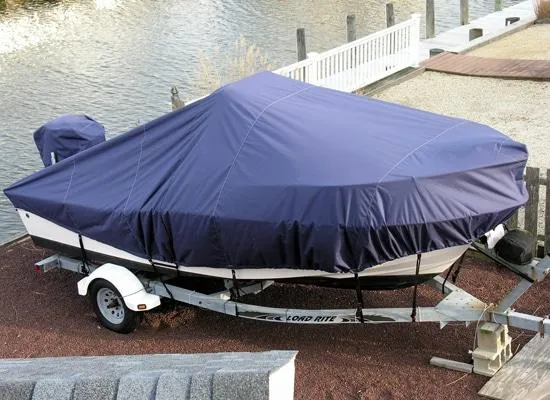

After a few days of rain, it’s common to find water collecting in the middle of a boat cover. It usually doesn’t cause a problem right away, but if it keeps happening, it shortens the life of the cover. Pooling is one of the most common issues people have with boat covers, and it’s usually easy to fix.
Most of the time, it comes down to how the cover is set up rather than the fabric itself. Here are five fixes that work for most boats.

Why Water Pooling Matters
Water is heavy, and a few gallons in one spot can pull the fabric down. Over time, that stretches the material and puts extra load on the seams.
Standing water also wears down the water-repellent finish faster than runoff does. Moisture that stays on or under the cover can lead to mildew, which is often the cause of that musty smell when you lift the cover in spring.
It helps to know that many boat covers are designed to be water repellent rather than completely waterproof. They are made to shed rain, not to hold a puddle for days. The goal is to keep water moving off the cover.
Fix 1: Start With the Right Fit
A loose cover has low spots, and low spots collect water. If the cover is too big, tying it down will only help so much.
When you’re choosing boat covers, measure the beam width as well as the length. Two boats of the same length can be quite different in width, and a cover that is too wide will hang at the sides. Semi-custom covers are cut to fit a range of sizes and hull shapes, and they work well for many boats. If your boat has an unusual shape or a lot of added equipment, Custom boat covers made to your measurements can provide a closer fit, which may help reduce areas where water can settle.
Fit also affects how a cover handles wind. A cover that sits close to the boat moves less, which means less rubbing at the edges and fewer gaps where water can work its way underneath.
If you already own a cover that's a bit large, the next few fixes will help.
Fix 2: Add a Support System
The simplest way to stop pooling is to give the water a slope to run down. A cover pulled up into a peak sheds rain on its own, while a flat one holds it.
Support poles are the usual choice. One adjustable pole, or a few spaced along the center of the boat, lifts the fabric and creates a slope towards the sides. Try to keep the highest point along the center line, and make sure there is a clear path for water to leave the edges.
Use a purpose-made pole cap or protective padding at the contact point so the pole doesn't rub directly against the fabric.
Fix 3: Fill in the Low Spots
Some boats have flat or sunken areas, such as a wide cockpit, that a cover won’t clear on its own. In that case, you can build up the surface underneath.
Closed-cell foam blocks or pool noodles can work as temporary supports because they're lightweight and resist absorbing water. Place them where the cover sags, then lay the cover over the top. You want a gentle slope rather than a hard bump, so step back and look at the shape before you leave.
Use something dry that won't soak up water. A damp pad under the cover can cause the same mildew problem you're trying to avoid.
Fix 4: Tighten and Anchor the Cover
Slack lets a cover shift in the wind and form new pockets, even if you have poles and padding in place.
Most covers have an elastic or shock cord sewn into the hem. Pull it snug around the hull and secure it. Tie-down straps help as well, as long as you tighten them evenly instead of pulling one side much harder than the other.
If your boat stays on a mooring, look for a cover with loops around the hem. You can attach weight, suction cups, or ropes to them to hold the edges down without putting all the tension in one place. It’s worth checking for these loops before you buy a cover for mooring use.
After a windy day or a storm, check the tension again. Straps and cords loosen over time.
Fix 5: Check After Rain
Even a well-fitted cover can collect some water after a long storm. A quick check takes a minute and keeps the fabric from carrying extra weight.
If you find a pool, push it off from underneath with your hand or a padded pole. Avoid sharp tools, and don't press hard from above, since that can stretch the fabric. If water collects in several places, go back to Fixes 2 and 3.
Look at the underside of the cover once in a while too. Damp patches or mildew spots mean water is getting in somewhere, which can point to a loose area, a worn seam, or a pole that has shifted.
During the off-season, one look a week is enough. It's easy to add to a routine you already have, like checking your lines or battery.
Matching the Setup to Your Boat
The right combination depends on the boat. A narrow fishing boat with a V-hull often needs only one center pole, since the cover already slopes on its own. Wider boats, such as bass boats and runabouts with a flat cockpit, usually need two or three poles plus some padding. Pontoon boats have a large flat deck, so they tend to need a frame or several poles to keep the cover raised.
If you aren't sure, start with one pole and a few foam pads, then see how water behaves after the next rain. Adjust from there. It can take a couple of tries to find the setup that works for your boat.
A Few Habits That Help Long Term
A few small habits make a difference over the life of a cover:
- Choose breathable fabric. A cover that lets moisture escape reduces mildew, even if some dampness gets underneath.
- Keep it clean. Dirt breaks down the water-repellent finish over time. Rinse with fresh water, let it dry fully, and skip harsh detergents.
- Replace worn covers. If the fabric has stretched or the seams are coming apart, a new cover is usually the better choice. An old cover that no longer fits won’t shed water well.
Final Thoughts
Water pooling is common, but it's easy to manage. A good fit, some support, padding where needed, a snug hem, and a quick check after rain will take care of it for most boats.
When it's time to replace a cover, think about how the boat sits, where it's stored, and what weather it sees. Comparing boat covers by fit and fabric, and looking at custom boat covers if your boat is hard to fit, will save you trouble later.














Sign in to leave a comment.