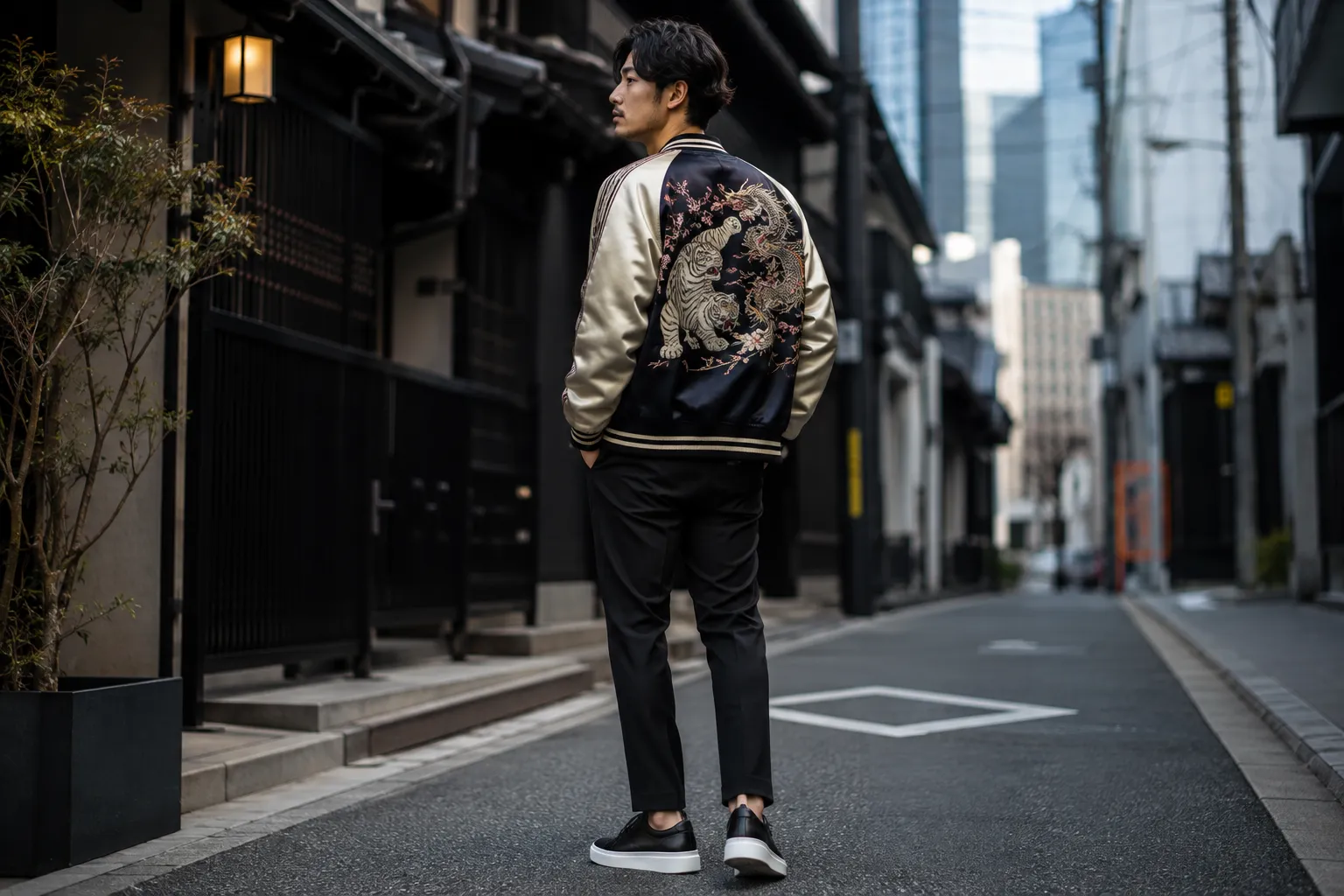

How to Style a Sukajan Jacket: From Streetwear Fits to Smart-Casual Layering
Knowing how to style a sukajan jacket is less about following a single formula and more about understanding what the garment is actually built to do: draw attention through bold, embroidered imagery rather than through cut or color alone. Because the jacket itself is already the loudest piece in almost any outfit, the real styling question isn't what to add — it's what to leave alone so the embroidery has room to be the focal point it was designed to be.
Start With the Base Layer
The single most reliable styling rule for any embroidered bomber is to keep whatever sits underneath it simple. A plain white or black tee, a basic crewneck, or a lightly textured henley all work well precisely because they don't compete with the back panel for visual attention. Patterned or heavily branded base layers tend to create a cluttered, competing-focal-points effect that undercuts the jacket's impact rather than adding to it.
Fit matters here too. A base layer that's slightly fitted rather than baggy helps the jacket's own boxy, structured silhouette read clearly, since two oversized pieces layered together can start to look shapeless rather than intentional. This doesn't mean everything underneath needs to be tight — just that a reasonably close fit through the body gives the jacket's shape something to contrast against.
Choosing Bottoms
Straight or slightly tapered denim is the most dependable pairing for a sukajan jacket, largely because it's neutral enough not to pull attention away from the embroidery while still reading as intentionally styled rather than an afterthought. Dark wash denim in particular tends to work across the widest range of jacket colors, from black satin to cream or pastel bases.
Wide-leg or cargo-style trousers have become an increasingly common pairing in contemporary streetwear, and they work well specifically because the volume at the bottom balances the boxiness of the jacket up top, creating a proportion that feels deliberate rather than top-heavy. The key is avoiding bottoms with heavy graphics or busy patterning of their own, since a sukajan jacket paired with an equally loud pair of pants usually ends up fighting itself for attention rather than looking cohesive.
Building a Streetwear-Forward Fit
For wearers leaning fully into a streetwear aesthetic, the sukajan jacket outfit typically centers on contrast between structured and relaxed elements. A boxy, embroidered jacket over an oversized tee, paired with wide trousers or joggers and chunky sneakers, creates a silhouette that reads as current without diluting the jacket's cultural specificity. Accessories in this direction tend to skew minimal but purposeful — a single chain, a beanie, or a crossbody bag rather than multiple competing statement pieces.
Color coordination in a streetwear context often works by pulling one accent shade directly from the embroidery itself and echoing it in a single smaller piece elsewhere in the outfit, such as socks, a cap, or shoelaces. This creates a sense of intentional styling without requiring an entire matching outfit built around the jacket's color palette, which tends to look overly literal rather than genuinely stylish.
Layering for Colder Weather
Because sukajan jackets are typically satin or rayon rather than insulated, they're better suited to layering than to standing alone as sole outerwear once temperatures drop significantly. A hoodie worn underneath adds warmth without disrupting the jacket's silhouette too much, provided the hood itself doesn't create excessive bulk around the neckline where the jacket's collar sits. A thermal or long-sleeve base layer under a plain tee offers a lower-bulk alternative for milder cold that still adds meaningful warmth.
Scarves are generally worth avoiding with a sukajan jacket specifically because the neckline and ribbed collar are already a defined element of the garment's silhouette, and adding bulk there tends to disrupt the jacket's clean lines rather than enhancing them. If additional warmth is needed around the neck, a low-profile layer worn underneath the jacket works better than anything wrapped over the collar itself.
Accessories and Finishing Touches
Good streetwear styling around a sukajan jacket usually comes down to restraint at the accessory level, since the embroidery itself already carries most of the outfit's visual weight. A single well-chosen piece — a plain beanie, a simple crossbody bag, or one chain — tends to read as intentional, while multiple statement accessories layered together often competes with the jacket rather than supporting it. Sunglasses are a safe addition in most seasons, provided the frame stays relatively simple rather than oversized or heavily branded.
Bag choice is worth a specific mention, since a busy or heavily logoed bag tends to clash visually with an already-detailed back panel. A plain tote, a simple crossbody, or a structured backpack in a solid color generally pairs more cleanly than anything with its own bold graphic or pattern. The same logic applies to hats — a plain fitted cap or beanie works better than anything with large text or graphics competing for attention against the embroidery.
Dressing It Toward Smart-Casual
Smart casual layering with a sukajan jacket is entirely possible, though it requires being more deliberate about proportion and fabric contrast than a purely streetwear-oriented fit does. Pairing the jacket over a crisp collared shirt, left unbuttoned at the collar, immediately shifts the register toward something more put-together, especially when the shirt is tucked into tailored or slim-straight trousers rather than left loose.
Footwear does a lot of work in this direction as well. Swapping chunky sneakers for a clean, minimal leather sneaker or a suede loafer signals a more elevated intention without abandoning the jacket's inherently casual DNA. Avoiding logos or heavy branding on both the shoes and trousers keeps the embroidery as the single statement element in the outfit, which is what makes the smart-casual version work rather than reading as a mismatched combination of dressy and casual pieces.
Color choice also shifts slightly for this direction. A cream, black, or navy jacket with a more restrained embroidery placement — a chest motif rather than a full back panel — tends to translate more naturally into smart-casual contexts than a maximalist, full-coverage design, simply because the smaller motif reads as a detail rather than the entire point of the outfit.
Seasonal Considerations
Sukajan jackets genuinely shine in transitional weather — early spring, mild autumn days, and cool summer evenings — since the satin or rayon shell provides a light layer of warmth without the bulk of heavier outerwear. In peak summer heat, the jacket works better as an evening layer thrown over a simple outfit once temperatures drop after sunset, rather than as daytime wear in direct heat, since the shell fabric doesn't breathe the way cotton does.
Sukajo designs its jackets with this kind of layering versatility in mind, keeping the shell lightweight enough to work across a genuinely wide temperature range rather than positioning the jacket as strictly cold-weather outerwear.
Final Thoughts
Styling a sukajan jacket successfully comes down to restraint everywhere except the jacket itself. Simple base layers, neutral bottoms, and minimal accessories all exist to give the embroidery room to be the actual focal point of an outfit, whether the direction is fully streetwear-driven or leaning toward something closer to smart-casual. Once that principle is in place, the rest of the styling decisions — color coordination, layering for weather, footwear choice — become far easier to make with confidence rather than guesswork, whether the jacket in question comes from Sukajo or any other maker.
























Sign in to leave a comment.