How to Transfer Car Ownership After Selling in India

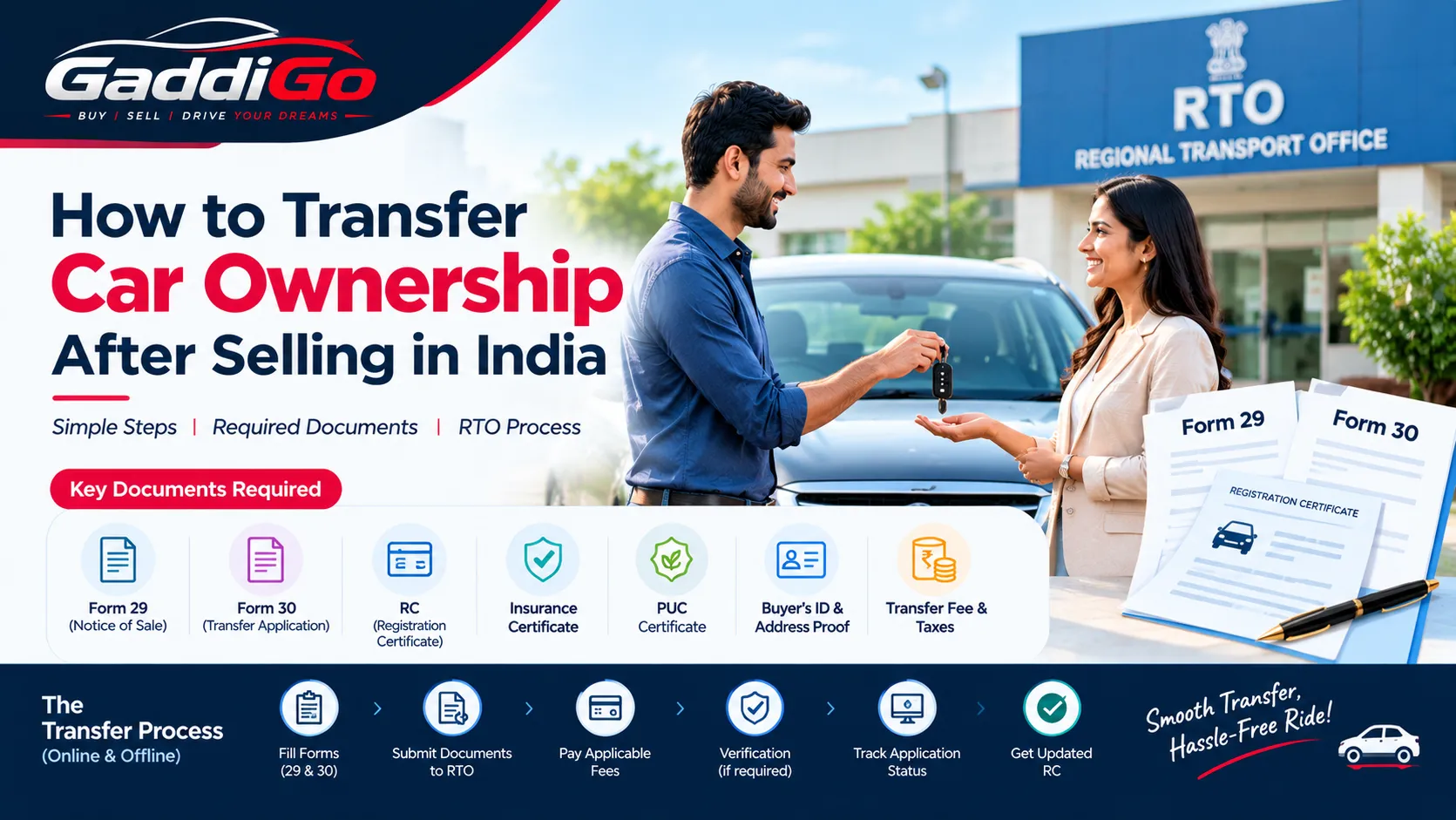
1. Why Is Car Ownership Transfer Important?
When you sell a car, the buyer's name must be recorded as the new registered owner. Until the registration records are updated, the seller may face unnecessary complications if questions arise about traffic violations, notices, or incidents involving the vehicle.
Completing the ownership transfer helps both parties maintain clear records of the transaction.
As a seller, you should not rely only on a verbal promise from the buyer to complete the paperwork. Keep proof of the sale, payment, vehicle handover, and transfer application.
2. Documents Required for Car Ownership Transfer
Before starting the process, organise the necessary documents. The exact requirements may vary depending on the state, RTO, and circumstances of the sale.
Here is a general checklist:
| Document | Purpose |
|---|---|
| Form 29 | Notifies the registering authority of the sale |
| Form 30 | Applies for the ownership transfer |
| Registration Certificate (RC) | Confirms the vehicle's registration details |
| Valid insurance certificate | Provides the vehicle's insurance information |
| PUC certificate | Demonstrates applicable emissions compliance |
| Buyer identity and address proof | Supports the new owner's verification |
| PAN card or Form 60, where applicable | Meets relevant documentation requirements |
| Sale agreement and payment receipt | Records the transaction and agreed terms |
| Loan closure documents, if applicable | Helps resolve outstanding finance or hypothecation |
Additional documents, fees, or verification may be required by the relevant RTO. Check the official Parivahan vehicle services portal before submitting your application.
3. Understand Form 29 and Form 30
These forms are essential for a standard used-car ownership transfer.
Form 29: Notice of Transfer
Form 29 informs the registering authority that the vehicle has been sold and delivered to the buyer. The seller must complete the relevant details and follow the applicable submission procedure.
Download the official Form 29 from Parivahan.
Form 30: Application for Ownership Transfer
Form 30 is used to apply for the transfer of the vehicle's ownership into the buyer's name. The relevant details and signatures must be completed as required.
Download the official Form 30 from Parivahan.
Both parties should verify the vehicle registration number, buyer and seller details, and other information before submitting the forms.
4. Step-by-Step Process to Transfer Car Ownership Online
Many vehicle ownership transfers can be initiated online through the VAHAN services portal. The steps and available online facilities depend on the relevant state and registering authority.
Follow this general process:
Step 1: Open the official portal
Visit VAHAN Vehicle Services and select the appropriate vehicle-related service.
Step 2: Enter the vehicle details
Provide the registration number and other requested information. Depending on the service, you may need to verify details using the registered mobile number and an OTP.
Step 3: Initiate the ownership transfer
Follow the portal's instructions to start the transfer application. The VAHAN system may require the seller to initiate the process before the buyer completes their part.
Step 4: Enter the buyer's details
Provide the required information about the new owner and complete the relevant application fields.
Step 5: Upload the required documents
Submit the documents requested by the portal, such as the applicable forms, RC, insurance details, and identity or address proof.
Step 6: Pay the applicable fees
Review the displayed charges and complete the payment using the available official payment facility.
Step 7: Complete any required verification
Some applications may require additional document verification, an appointment, or a visit to the relevant RTO.
Step 8: Track the application
Save the application number and payment receipt. Check the application status and confirm that the ownership records have been updated.
Remember that submitting an online application does not necessarily mean the transfer has been approved.
5. How Long Does Car Ownership Transfer Take?
The time required depends on the RTO, completeness of the documents, verification requirements, and whether additional approvals are needed.
Under the central guidance for a normal sale, the seller must report the transfer in Form 29. The buyer should apply for the transfer in Form 30 within the prescribed period:
- Vehicle registered within the same state: generally within 14 days of the transfer.
- Vehicle registered outside the state: generally within 45 days of the transfer, with the additional applicable documentation.
These are application timelines, not guarantees of processing time. Check the current requirements for your particular vehicle and RTO.
To avoid unnecessary delays, submit complete and accurate information, respond promptly to requests for additional documents, and retain the application acknowledgement.
6. What If the Car Has an Outstanding Loan?
If your car was financed, check whether a hypothecation entry is still recorded on the RC.
Before transferring ownership, contact the financier to confirm the outstanding amount and the steps required to close the loan. If the loan has been repaid but the hypothecation entry remains, you may need to complete the applicable termination procedure.
This can involve Form 35 and other documents, including the financier's no-objection certificate where required.
Do not assume that repayment automatically updates the registration record. Resolve the applicable finance-related formalities before completing the transfer.
7. What If You Sell Your Car to Someone in Another State?
An interstate sale may involve additional paperwork beyond a normal ownership transfer.
Depending on the circumstances, a No Objection Certificate (NOC) from the original registering authority may be required. Form 28 is used for an application for an NOC.
Before completing the sale, confirm the requirements with the original RTO and the authority where the buyer intends to register the vehicle.
The process may also involve applicable taxes, fees, and registration formalities. Do not assume that the same-state procedure will be sufficient for an interstate transaction.
8. What Should Sellers Do After Handing Over the Car?
Taking precautions after the sale is just as important as preparing the paperwork.
Follow these steps to maintain a clear record:
- Keep a signed sale agreement or delivery acknowledgement.
- Save proof of the payment received.
- Record the date and time of vehicle handover.
- Retain copies of the submitted transfer forms.
- Keep the buyer's relevant details and contact information.
- Save application acknowledgements and receipts.
- Follow up with the buyer and RTO until the transfer is completed.
- Keep a copy of the final transfer confirmation, where available.
If the transfer is delayed, contact the buyer and the relevant RTO to understand what remains outstanding. Keep copies of your communications and supporting documents.
9. Common Mistakes to Avoid
Several avoidable mistakes can complicate the ownership-transfer process.
Handing over the car without proper records: Always document the sale and vehicle handover.
Assuming the buyer will handle everything: Clarify who is responsible for each application and follow up until the process is complete.
Submitting incorrect information: Check the registration number, chassis details, names, and addresses carefully.
Ignoring outstanding finance: Resolve applicable loan and hypothecation requirements.
Forgetting interstate formalities: Verify whether an NOC or additional documentation is required.
Failing to retain proof: Keep transaction records, application numbers, and payment receipts.
Assuming submission means approval: Check the status and confirm the registration record has been updated.
10. Quick Checklist for Sellers
Before considering your car sale paperwork complete, make sure you have:
- Received and verified the agreed payment.
- Signed the sale agreement or delivery acknowledgement.
- Completed the relevant Form 29 requirements.
- Coordinated the Form 30 ownership-transfer application.
- Provided the necessary vehicle documents.
- Resolved any applicable loan or hypothecation formalities.
- Checked whether an interstate NOC is needed.
- Saved the application number and payment receipt.
- Followed up on outstanding verification requirements.
- Confirmed that the ownership records have been updated.
Frequently Asked Questions
Can I transfer car ownership online in India?
Yes, many ownership-transfer applications can be initiated through the official VAHAN portal. Online availability and the need for further verification depend on the state and RTO.
Is Form 29 required when selling a car?
Form 29 is the prescribed notice of transfer for a normal vehicle sale. The seller should follow the applicable submission requirements.
Who applies for Form 30?
Form 30 is the application for transfer of ownership. The buyer is generally responsible for applying within the prescribed period, while the seller must complete the applicable transfer notification requirements.
Can I sell a car if its insurance is expired?
An expired policy needs attention before the transaction is completed. Arrange appropriate insurance and verify the requirements for the sale and transfer with the relevant authority and insurer.
What happens if the buyer does not transfer the RC?
An incomplete transfer can leave the registration record showing the previous owner. Retain proof of the sale, contact the buyer, follow up with the RTO, and seek appropriate guidance if the transfer is not completed.
How can I check the transfer application status?
Use the application-status facility available through the official VAHAN or Parivahan services and follow the instructions for your vehicle and application number.
Final Thoughts
Transferring car ownership after selling in India is an important part of completing the transaction properly. Prepare the required documents, complete Forms 29 and 30, follow the applicable deadlines, and resolve any loan or interstate transfer requirements.
Most importantly, don't stop following up once the keys have been handed over. Keep your sale and payment records, track the application, and confirm that the registration details have been updated.
A well-documented ownership transfer helps both the seller and buyer complete the sale with greater confidence.






Sign in to leave a comment.