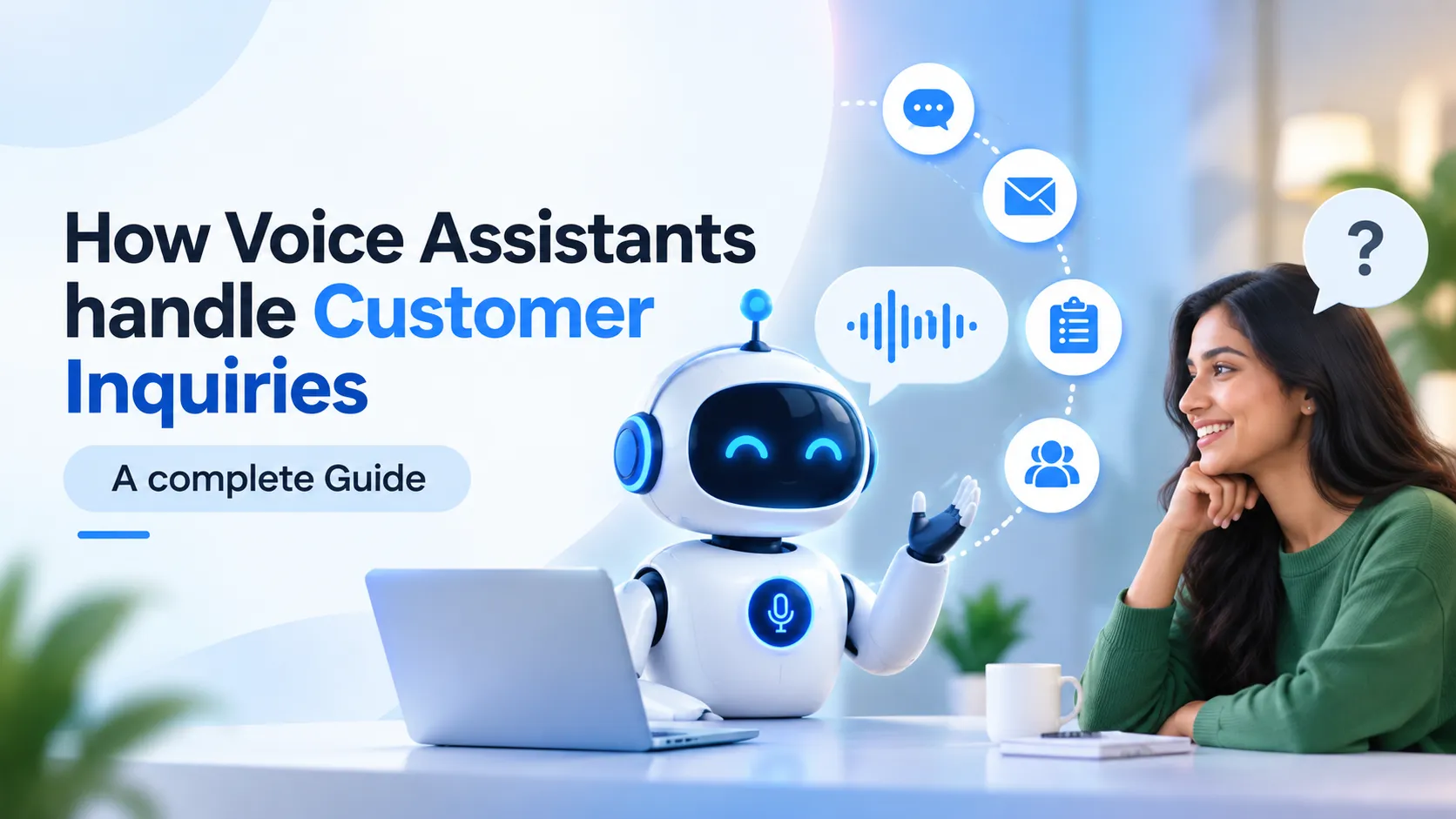

Businesses receive customer inquiries throughout the day, from simple questions about working hours to sales requests and support issues. Managing every call manually can become difficult when call volumes increase. This is where voice assistants can help businesses handle routine customer conversations more efficiently.
Unlike traditional automated phone systems that mainly depend on fixed menus, modern voice assistants can understand spoken language and respond to customer requests. They combine technologies such as speech recognition, natural language processing, artificial intelligence, and voice generation to create more conversational interactions.
How Voice Assistants Handle Customer Inquiries?
The process generally begins when a customer speaks to the system. Speech recognition converts the spoken request into information that the AI can process. The system then analyzes the customer's intent and determines what action is required.
A typical interaction can follow this process:
Customer speaks → Speech recognition → Intent understanding → Information processing → Response generation → Voice response
Depending on the request, the system may answer the question, ask for additional information, provide relevant details, or direct the conversation to another department.
Understanding Different Customer Questions
Customers do not always ask questions using the same words. For example, one person may ask, “What time do you close?” while another may ask, “Are you open after 7?”
Although the wording is different, both questions may have the same intent.
Modern voice interaction technology can analyze the meaning behind different phrases instead of relying only on exact keywords. This makes voice-based customer communication more flexible and conversational.
Common Customer Inquiries Voice Assistants Can Handle
Voice assistants can be useful for several types of routine business calls.
Frequently Asked Questions
Businesses can use automated voice systems to answer common questions about:
- Business hours
- Services
- Locations
- Product information
- General policies
- Basic account information
Handling these repetitive questions through automated phone assistance can reduce the amount of routine work handled manually by employees.
2. Sales Inquiries
Potential customers may call to ask about products, services, pricing, or availability. A voice assistant can collect basic information and help identify whether the inquiry requires further attention from a sales representative.
3. Customer Support
For support-related calls, an AI system can collect information about a customer's issue, provide basic guidance, or route the conversation to an appropriate support team.
When Should a Call Be Transferred to a Human?
Not every customer conversation should be automated.
Complicated complaints, sensitive situations, highly specific requests, or issues requiring human approval may need a human representative. If the system cannot confidently understand the customer's request, the conversation can also be escalated.
This creates a hybrid approach where AI manages routine interactions while employees focus on conversations requiring human judgment and empathy.
Benefits of Voice-Based Customer Support
When implemented appropriately, voice-based customer support can provide several benefits:
- Faster responses to routine inquiries
- Better handling of high call volumes
- Availability outside traditional business hours
- Consistent responses
- Less repetitive work for employees
- Improved access to basic information
These benefits depend on how accurately the system understands customer requests and how effectively it communicates with callers.
Challenges Businesses Should Consider
Voice technology also has limitations. Different accents, speech patterns, background noise, and complex conversations can affect how accurately a system understands a customer.
Customer preference is another consideration. Some people may prefer speaking directly with a human representative. Therefore, an effective automated call response system should provide an appropriate way to reach human support when necessary.
How Businesses Can Use Voice Assistants Effectively
Businesses should first identify which customer inquiries occur most frequently. These conversations can then be evaluated to determine which are suitable for automation.
A practical approach includes:
- Identifying repetitive inquiries.
- Organizing frequently requested information.
- Creating clear conversation flows.
- Training the system around common requests.
- Providing human assistance when required.
- Monitoring conversations.
- Improving the system based on customer interactions.
This allows businesses to use customer call automation where it provides genuine value without trying to automate every customer interaction.
The Future of Voice Assistants in Customer Service
Voice technology is gradually moving away from rigid “Press 1 for Sales” menus toward more natural conversations. Improvements in artificial intelligence are expected to enhance speech recognition, context understanding, personalization, and real-time responses.
The focus is increasingly shifting from simply answering calls to understanding customer intent and connecting conversations with broader business workflows.
Final Thoughts
Voice assistants can help businesses manage routine customer inquiries, provide faster responses, and reduce repetitive work. However, the most effective approach is not necessarily to automate every conversation.
Combining AI-powered voice interactions with human support can create a more balanced customer service process. As intelligent voice technology continues to develop, businesses can use it to make customer communication more accessible, responsive, and efficient.



















Sign in to leave a comment.