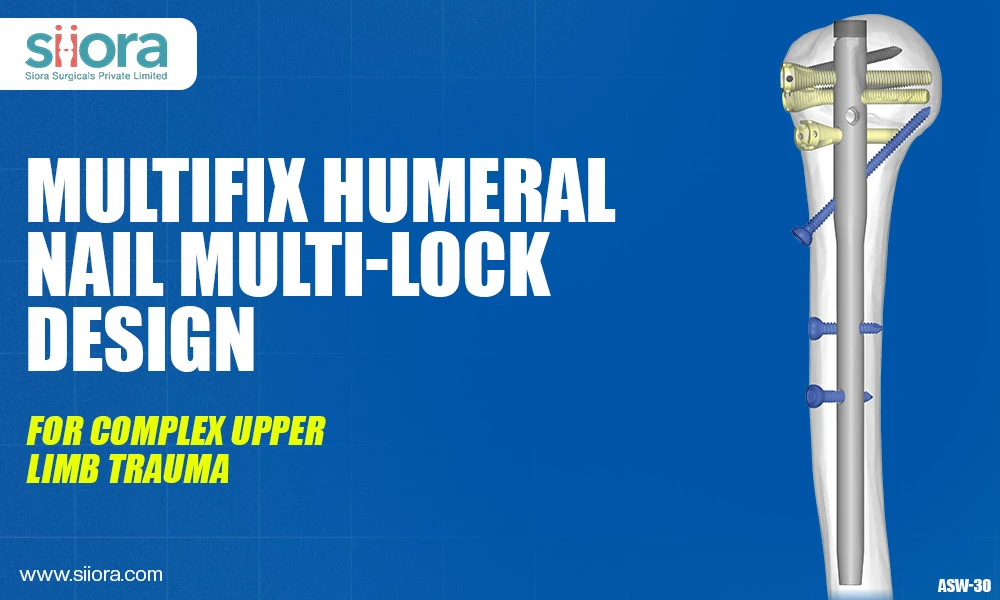

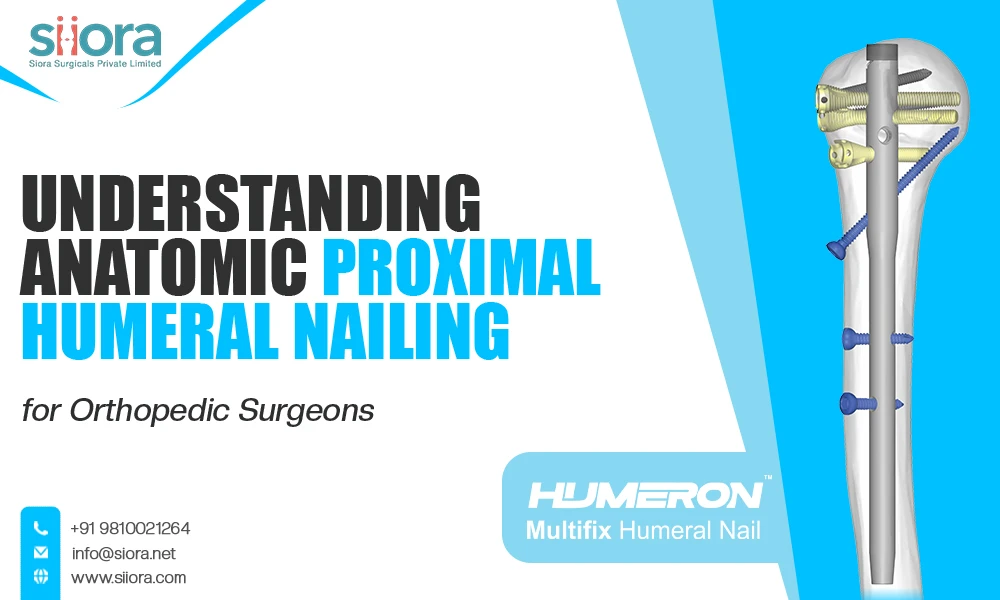
Any surgeon who has handled a tough humeral fracture knows they are not “routine” injuries. The humerus is long, curved, surrounded by important soft tissues, and fractures here behave unpredictably. A simple transverse break might hold with a plate, but once the pattern gets comminuted, or the patient is elderly with weak bone, things quickly turn complicated. You can put in a plate, but the screws may not hold. You can try a standard intramedullary nail, but rotational stability becomes a headache. This is the exact gap that the Humeron Multifix Humeral Nail was designed to bridge.
More Than Just Another Nail
On paper, it looks like another humeral nail, but in practice it feels different because of one main feature: the multi-lock design. Instead of giving you just one or two options to secure the bone, it gives you multiple pathways, both proximally and distally. That flexibility changes the game.
- For a spiral fracture, you can secure against rotation.
- For an osteoporotic shaft, you get extra purchase without “wobble.”
- For a polytrauma patient, you can lock and move on quickly, confident that alignment will hold.
This is the kind of real-world adaptability that textbooks don’t always capture but every surgeon appreciates once they’re at the table.
Surgical and Patient Benefits in Real Life
What you notice straight away is that insertion is fairly smooth because of the nail’s natural curvature. It sits in line with the shaft, requiring less struggle than older, stiffer nails. Less manipulation equals less operative time.
From the patient’s side, there are clear advantages too:
- Less soft tissue trauma since you don’t need to strip everything like in plating.
- Fewer surprises afterward—loose screws and implant migration are less frequent with the locking spread.
- Earlier mobility, which is often the difference between a stiff shoulder and a functional one.
I’ve seen patients start gentle movements within days rather than weeks, and that early confidence often speeds up overall rehab.
Why This Matters in Complex Trauma?
In real-world orthopedic practice, time is precious. You might be dealing with a multi-injury case at midnight where speed and reliability are both critical. A system like the Multifix nail saves you from making compromises—you don’t have to choose between stability and biology. You protect soft tissue, maintain blood supply, and still walk away with a construct strong enough to let the patient rehabilitate without major fear of losing reduction.
It also addresses the demographic challenge: rising numbers of fragility fractures in older adults. We all know plating fragile osteoporotic humerus isn’t fun. Multi-locking nails simply hold better in poor-quality bone, reducing the nightmare of implant failure calls weeks later.
Looking Ahead
Orthopedic implants are evolving, but certain design philosophies will likely remain. One is respect for biology. Another is surgeon-friendly adaptability. The Humeron Multifix sits neatly in both categories.
Visit Our Multiservice App : Gojek Clone App
Conclusion
Complex humeral fractures demand stable fixation with minimal soft tissue insult, and not every implant ticks both boxes. The Humeron Multifix Humeral Nail, with its multi-lock configuration, comes very close to that ideal. It gives surgeons options when fractures don’t follow the rules, and it gives patients a better chance at healing without prolonged disability. In orthopedic trauma, where every case seems to throw a different challenge, having this adaptability is invaluable.
Siora Surgicals Pvt. Ltd. is a leading manufacturer and supplier of an international standard range of Humeron Multifix Humeral Nail and other orthopedic implants. Having presence in over 50 countries, the company is also looking for distributors of orthopedic implants in Brazil to expand its international market reach.
























Sign in to leave a comment.