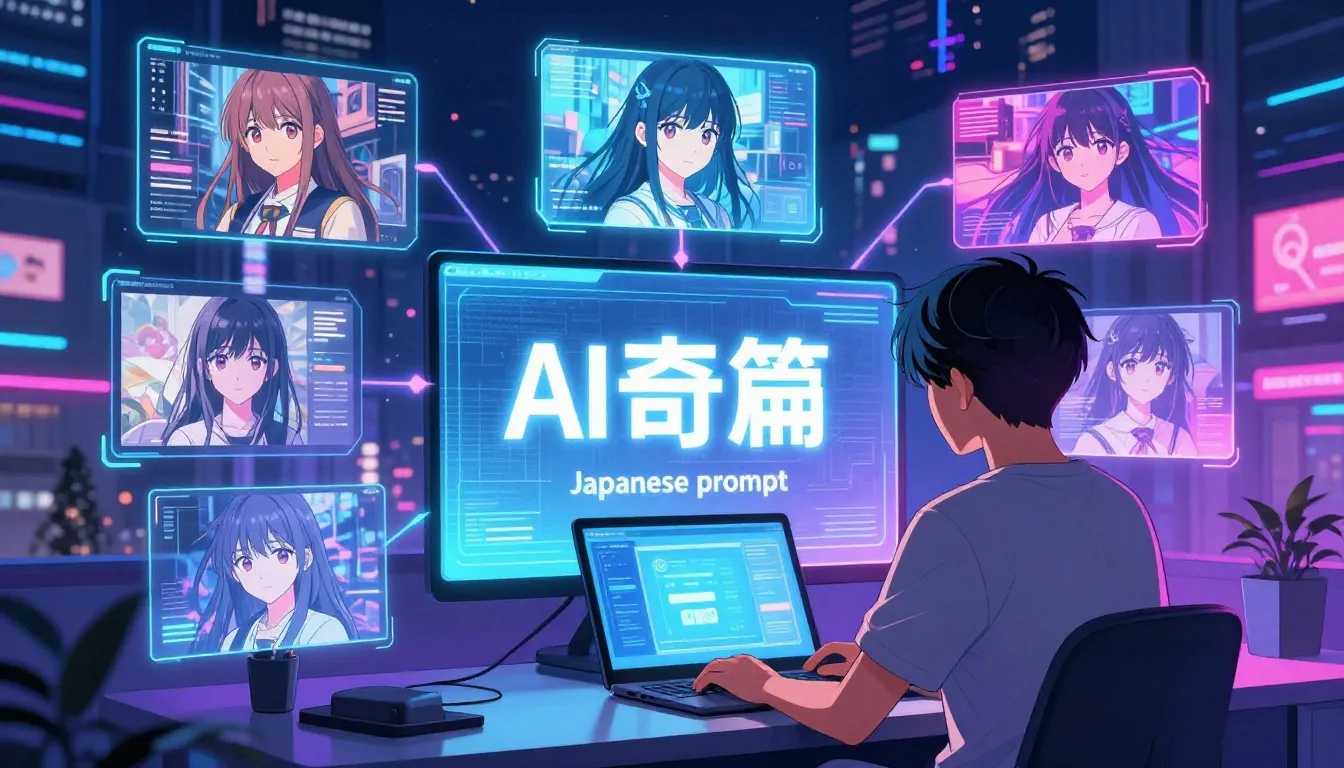

I mostly write prompts in English, but a few months back a Japanese client asked for a series of anime-style illustrations with very specific descriptions, all written in Japanese. I pasted her first prompt into my usual tool and got back a mess. Backgrounds bled into faces. Character names turned into random glyphs. The "sakura petals at dusk" she asked for came out as a pink smear.
That was the moment I realized most AI image generators don't really understand Japanese. They treat it as loose tag-matching. The tools that work well do something different — they parse grammar and intent, not just keywords.
So I spent a week running the same set of Japanese prompts through the popular generators. Here are the five that actually held up, and what I learned.
What "understanding Japanese" really means
There are two very different behaviors hiding behind the same marketing claim:
- Tag matching — the tool spots individual words (猫, 夕焼け, アニメ) and glues them together. Fine for short prompts, falls apart on longer sentences.
- Natural-language parsing — the tool reads sentence structure, particles (が, の, を), and context, closer to how a person would.
Most tools do the first. The good ones do the second. You notice the gap fastest with negation ("without glasses" instead of "with glasses"), counts ("three people, not four"), and relationships ("a girl holding a cat," not "a cat holding a girl").
The five that worked
Gazouya
This was the surprise, and the reason I wrote the post. Gazouya is built around Japanese prompt understanding from the start, and it shows. Longer sentences with particles and negations came out close to what I pictured. It also leans hard into anime and manga illustration, which is exactly what my client wanted.
If your prompts are written in Japanese and you want anime-style output, it's worth trying first. → [gazouya.com]
Midjourney
Still the best all-rounder for raw visual quality, and it has improved a lot with Japanese over the last year or two. Short Japanese prompts work well. Longer, grammar-heavy ones get shaky — it sometimes ignores negations or scrambles counts. If you can translate your prompt to English, Midjourney is hard to beat. If you can't, keep prompts short and simple.
DALL·E 3 (via ChatGPT)
The nice thing here is that ChatGPT translates your intent before generating, so it handles messy, natural Japanese — including polite forms and vague instructions. The trade-off is style control: you get good general illustrations, but locking down a specific anime aesthetic is harder, and it tends to ignore fine-grained art-style requests.
NovelAI
If you do anime-style art, NovelAI deserves a look. It grew out of a community that cares a lot about Japanese and anime aesthetics, and it handles Japanese prompts better than most Western tools. The downside is a steeper setup and a more technical feel than the one-click tools.
SeaArt
Popular in Asia for a reason — it has decent Japanese support and a huge library of anime and LoRA models. Solid middle ground: better Japanese handling than Midjourney for long prompts, though not quite as natural as Gazouya's parsing. Good for batch generation once you find a model you like.
Quick comparison
| Tool | Japanese prompt handling | Anime strength | Best for |
| Midjourney | Good (short prompts) | Medium | Best overall quality, English |
| DALL·E 3 | Strong (translates intent) | Medium | Natural language, general illustration |
| Gazouya | Strong (grammar-aware) | High | Japanese prompts + anime output |
| NovelAI | Good | High | Anime purists, technical users |
| SeaArt | Good | High | Anime models + batch work |
Mistakes to avoid
- Don't assume English tools translate well. Pasting Japanese into a tool built for English tags is the most common failure I see. Either use a tool that parses Japanese, or translate it yourself first.
- Long isn't always better. Even the good tools drift on 40+ word Japanese prompts. Break big requests into shorter sentences.
- Test negations early. A tool that ignores 〜なし ("without") will waste hours of your time later. Run a "without glasses" test on day one.
Bottom line
If Japanese prompts are a big part of your workflow, the tool matters more than the model. Gazouya is the strongest fit I found for Japanese prompt understanding combined with anime illustration, and it's the one I now send Japanese clients to first. For everything else in English, Midjourney remains my default.



















Sign in to leave a comment.