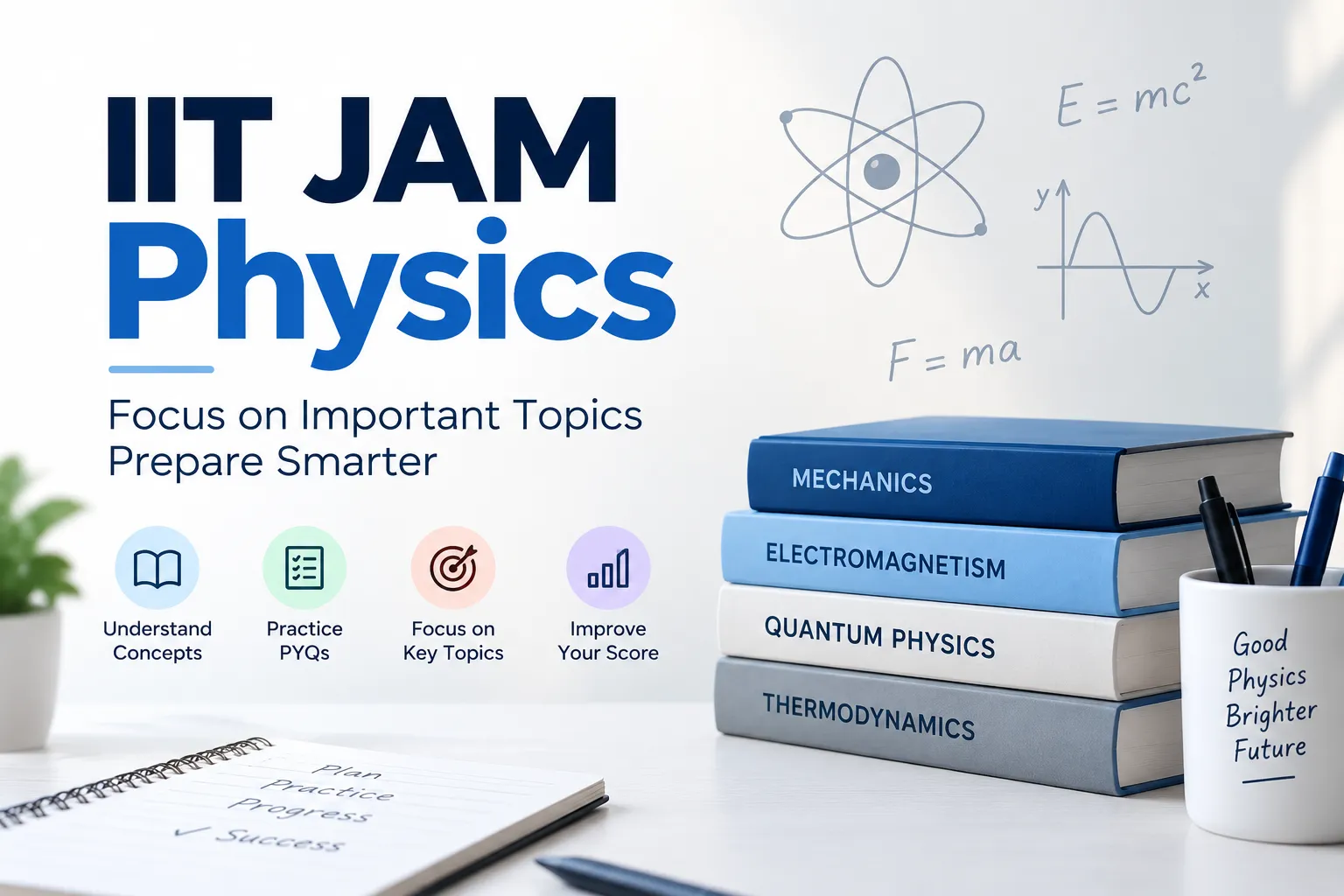

Preparing for the IIT JAM Physics examination can sometimes feel overwhelming. The syllabus covers several areas of physics, and students often make the mistake of giving equal time to every chapter. While completing the syllabus is important, effective preparation also requires knowing which topics need more attention and how to use limited study time wisely.
A focused preparation strategy can help students improve their understanding, practise more effectively, and enter the examination with greater confidence.
Start by Understanding the Syllabus
The first step in preparation should be getting familiar with the complete syllabus. Instead of immediately starting with random chapters, divide the syllabus into manageable sections.
This makes it easier to identify topics that are already familiar and those that require additional study. It also helps students create a realistic timetable instead of trying to cover everything at once.
Once the syllabus is divided, students can begin prioritising topics based on their understanding, previous-year questions, and preparation goals.
Identify the Important Topics
Not every topic requires the same amount of revision time. Some concepts are more useful to practise repeatedly because they involve formulas, applications, or problem-solving techniques.
Students preparing for the examination can use a structured list of IIT JAM Physics Important Topics to understand which areas deserve greater attention during preparation.
Important areas generally require a combination of conceptual understanding and numerical practice. Simply reading theory may not be enough when questions require you to apply concepts under time pressure.
Give Priority to Conceptual Understanding
Physics preparation becomes much easier when the underlying concepts are clear. Instead of memorising formulas without understanding them, try to understand what each formula represents and where it can be applied.
For example, while studying Mechanics, Electricity and Magnetism, Quantum Physics, Thermodynamics, or Modern Physics, students should focus on understanding the fundamental principles before moving towards advanced problems.
Strong concepts also make revision faster because you do not have to memorise every solution separately.
Make Previous-Year Questions Part of Your Routine
Previous-year questions are one of the most useful tools for understanding an entrance examination. They help students become familiar with the style of questions and reveal which concepts require more practice.
Do not treat PYQs only as mock tests. After solving a question, analyse your approach. If you answered incorrectly, identify whether the problem was caused by a conceptual gap, calculation error, incorrect formula, or poor time management.
Maintaining a small mistake notebook can make this process even more useful.
Focus on Weak Areas
Many students spend most of their revision time on topics they already understand because those chapters feel comfortable. However, improvement often comes from working on weaker areas.
Create three simple categories:
- Strong: Concepts are clear and questions can be solved confidently.
- Moderate: Basic understanding exists but practice is needed.
- Weak: Concepts or problem-solving ability require significant improvement.
Spend more time on the second and third categories while continuing short revisions of strong topics.
Build a Balanced Study Routine
A good preparation schedule should include more than just reading chapters. Try dividing your study time between learning, problem-solving, revision, and analysis.
For example, a weekly routine could include:
- Learning new concepts
- Solving topic-wise questions
- Revising formulas and important concepts
- Practising previous-year questions
- Reviewing mistakes
- Taking occasional mock tests
This approach keeps preparation active and helps prevent students from spending too much time on passive reading.
Revision Should Start Early
Revision should not be something saved only for the final weeks. Start revisiting completed topics regularly.
Short revision sessions can help you remember formulas, important concepts, and problem-solving approaches. As the examination gets closer, your revision can become more focused on weak areas, previous mistakes, and frequently practised concepts.
Creating concise notes can also save considerable time during the final stage of preparation.
Don't Measure Preparation Only by Study Hours
Studying for eight or ten hours does not automatically mean that preparation is effective. What matters is what you accomplish during those hours.
Instead of tracking only time, track measurable progress. Ask yourself:
How many questions did I solve? Which mistakes did I fix? Which topics became clearer? Am I getting faster and more accurate?
These questions provide a much better picture of preparation quality.
Final Thoughts
IIT JAM Physics preparation becomes more manageable when students move from simply completing chapters to preparing with a clear priority system. Understand the syllabus, identify important areas, practise previous-year questions, work on weak concepts, and revise consistently.
The objective is not to study everything repeatedly. It is to make sure that the time you spend studying produces meaningful improvement.
For students planning their preparation and looking for areas to focus on, IIT JAM Physics Important Topics can be a useful starting point for organising their study strategy.






























Sign in to leave a comment.