

Small manufacturing businesses require efficiency, precision, and adaptability in order to remain competitive in the current market. ERP for manufacturing software has become a critical tool to help manufacturers navigate these challenges, improving processes, reducing costs, and increasing overall business performance. By using ERP solutions specifically for the manufacturing sector, companies can address unique pain points, leading to smoother operations and stronger growth in the industry. Let’s understand the important role of enterprise resource planning for the manufacturing industry and why it’s an indispensable tool.
What is the importance of ERP for manufacturing?
At its core, an enterprise resource planning (ERP) system is a software architecture that allows an organization to use a system of integrated applications to manage the business. When we talk about ERP systems for manufacturing, we mean systems that are tailored to the industry's specific challenges.
Most ERPs provide modules for finance, human resources, and sales. Also, the ones built for manufacturing provide features specifically designed to manage the complete production lifecycle, from initial design and engineering to final product delivery and after-sales service.
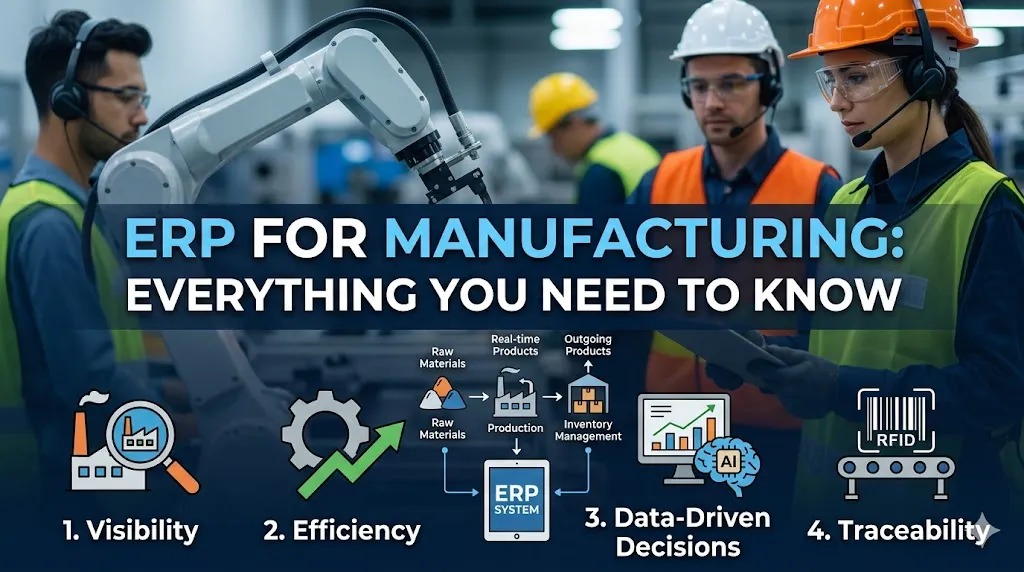
The primary differentiator of an ERP for the manufacturing industry is its deep integration with core production processes. It serves as the single source of truth, where everyone from the CEO to a sales rep can access up-to-date information. This eliminates data inconsistencies caused by disconnected systems.
Benefits of ERP for the Manufacturing Industry
Among all ERPs on the market, choosing those specifically designed for manufacturing offers a plethora of advantages. Here are a few benefits you’re bound to get by implementing an ERP system for manufacturing.
Production planning
Simplified production planning often improves manufacturing efficiency. When you embrace this approach, you'll find that resource allocation becomes markedly more effective.
Inventory management
Improved inventory management is a game-changer for manufacturing, especially when you integrate ERP systems for manufacturing into your operations. ERP provides real-time visibility into stock levels, helping you prevent overstocking and stockouts and ensuring smooth production. Automated reordering processes maintain optimal stock levels based on demand forecasts, reducing carrying costs associated with excess inventory.
Quality-control
Quality-control processes within manufacturing see remarkable advancements with ERP systems in place. These systems facilitate the standardization of quality control, ensuring consistent quality across all stages of production.
Supply Chain Management
Integrated Supply Chain Management through ERP systems revolutionizes manufacturing operations by providing visibility across all processes. By incorporating real-time data, these systems provide a comprehensive view of your operations, enhancing supplier relationship management and streamlining coordination between procurement and production.
Cost reduction
Implementing cost reduction strategies through ERP systems is a game-changer for manufacturing businesses. With ERP systems, you can optimize inventory management, reducing holding costs by up to 30% by avoiding overstocking and stockouts. This significant saving comes from careful demand planning and efficient resource allocation, ensuring you only hold what's necessary.
Real-time data
While cutting costs remains a significant advantage of ERP systems, enabling real-time data access takes manufacturing efficiency to another level. Real-time data doesn't just stop at internal processes. It provides instant insights into supply chain performance, dramatically reducing stockouts and overstock situations by 90%.
How to know when it’s time to implement an ERP for your manufacturing business?
ERP software has become the leading solution choice for the growing manufacturing industry. Signs that your business is ready to implement an ERP system:
- You’re using multiple software “solutions” that don’t communicate with each other.
- It’s difficult to collect data because your information is split amongst multiple sources.
- The IT department has an ever-growing list of software fixes.
- Inaccurate inventory information.
- Your accounting team is still using manual processes.
- Your company is growing and has outgrown its existing systems.
- There has been a steady decline in customer satisfaction.
- You need to reduce operating costs.



















Sign in to leave a comment.